Vegetarian and vegan restaurants in Chiang Mai: a practical dining guide
Is Chiang Mai easy for vegetarian and vegan travelers?
Yes, relatively — Chiang Mai has a genuine cluster of dedicated vegetarian and vegan restaurants (particularly around the Old City and Santitham), plus the Thai phrase 'gin je' (strict vegan, no meat, egg, dairy, or pungent alliums) is widely understood at markets. Regular street stalls are hit-or-miss since fish sauce and shrimp paste appear in many 'vegetable' dishes by default, so dedicated restaurants are the more reliable choice.
Chiang Mai’s vegetarian and vegan scene, honestly assessed
For travelers weighing whether Chiang Mai is a genuinely manageable destination for a strict plant-based diet, or simply an easier-than-average one that still requires ongoing vigilance, this guide aims to answer that specific, practical question rather than offering a generic “Thailand is vegan-friendly” reassurance. The short answer is that it’s one of the more workable Thai cities for this, but “workable” still means active navigation — reading the situation stall by stall and restaurant by restaurant — rather than assuming every menu is already built with your dietary needs in mind.
Chiang Mai has one of the more workable vegetarian and vegan dining scenes in Thailand, driven by three overlapping factors: a long-established Chinese-Thai community whose culinary traditions include genuine je (strict vegan) cooking, a Buddhist temple culture that includes vegetarian food traditions even if it’s not commercially organized around it, and a substantial community of long-stay Western travelers and wellness-focused residents who’ve driven demand for dedicated vegan restaurants over the past decade or more. That combination means plant-based travelers can eat well here — but it does take some active navigation rather than assuming every “vegetable dish” on a menu is actually vegetarian.
This guide covers both dedicated restaurants and the more common scenario of eating vegetarian at regular street stalls and markets, where the reality is more mixed.
Why this guide separates vocabulary, restaurants and markets
Rather than a single running list of “vegan-friendly places,” this guide is deliberately split into the language you need, the dedicated restaurants worth seeking out by neighborhood, and the separate, messier question of navigating regular markets and street stalls — because those three things require genuinely different strategies and the confusion between them is where most travelers run into trouble. Knowing the right phrase does little good if you don’t also know which neighborhoods have the restaurants worth using it in, and knowing the restaurants doesn’t help on a day when you’re at a market with no dedicated vegan options nearby.
The vocabulary that actually matters
The single most useful thing to know before ordering is the difference between “mangsawirat” (vegetarian, loosely used) and “je” (strict vegan, precisely used). Je food avoids not just meat and fish but also eggs, dairy, and the “pungent” vegetables in Buddhist dietary tradition — garlic, onion, chives and a few others. Stalls serving genuine je food typically mark themselves clearly, often with a yellow flag bearing a red Chinese character, especially visible during the annual vegetarian festival period. If you ask for “mangsawirat” at a regular stall, you may still get a dish cooked with fish sauce, since many cooks don’t consider fish sauce a meat product in the way a strict vegetarian would. If avoiding all animal products matters to you, specifically ask “gin je” or state “mai sai nam pla, mai sai gapi” (no fish sauce, no shrimp paste).
The September vegetarian festival
Chiang Mai observes a version of the Vegetarian Festival (Tesagan Gin Je), tied to Chinese-Thai religious tradition and generally falling in September or October depending on the lunar calendar. During this roughly nine-to-ten-day window, participating stalls — concentrated especially around Warorot Market and the historically Chinese Chang Moi district — fly yellow flags and serve dedicated je food, dramatically expanding the range of reliable strict-vegan options across the city. It’s a genuinely useful window to time a visit around if plant-based eating is a priority, though it’s a smaller, quieter observance in Chiang Mai than the more famous version held in Phuket.
Dedicated vegetarian and vegan restaurants
Chiang Mai’s dedicated plant-based restaurants cluster mainly around the Old City, Santitham (the residential area just north of the moat) and Nimman, reflecting where long-stay travelers and health-focused residents tend to live. Well-known names travelers repeatedly cite include an organic farm-to-table restaurant near Wat Suan Dok serving vegetarian Thai food grown on its own land, a long-running raw and vegan café near the Old City known for juice cleanses and plant-based comfort food, and several buffet-style vegetarian restaurants that let you build a plate from a wide rotating selection of Thai and international dishes at a fixed price. Prices at these restaurants typically run 60-150 baht (US$1.70-4.30) for a plate, comparable to or only slightly above regular Thai restaurant pricing.
Eating vegetarian at street food markets
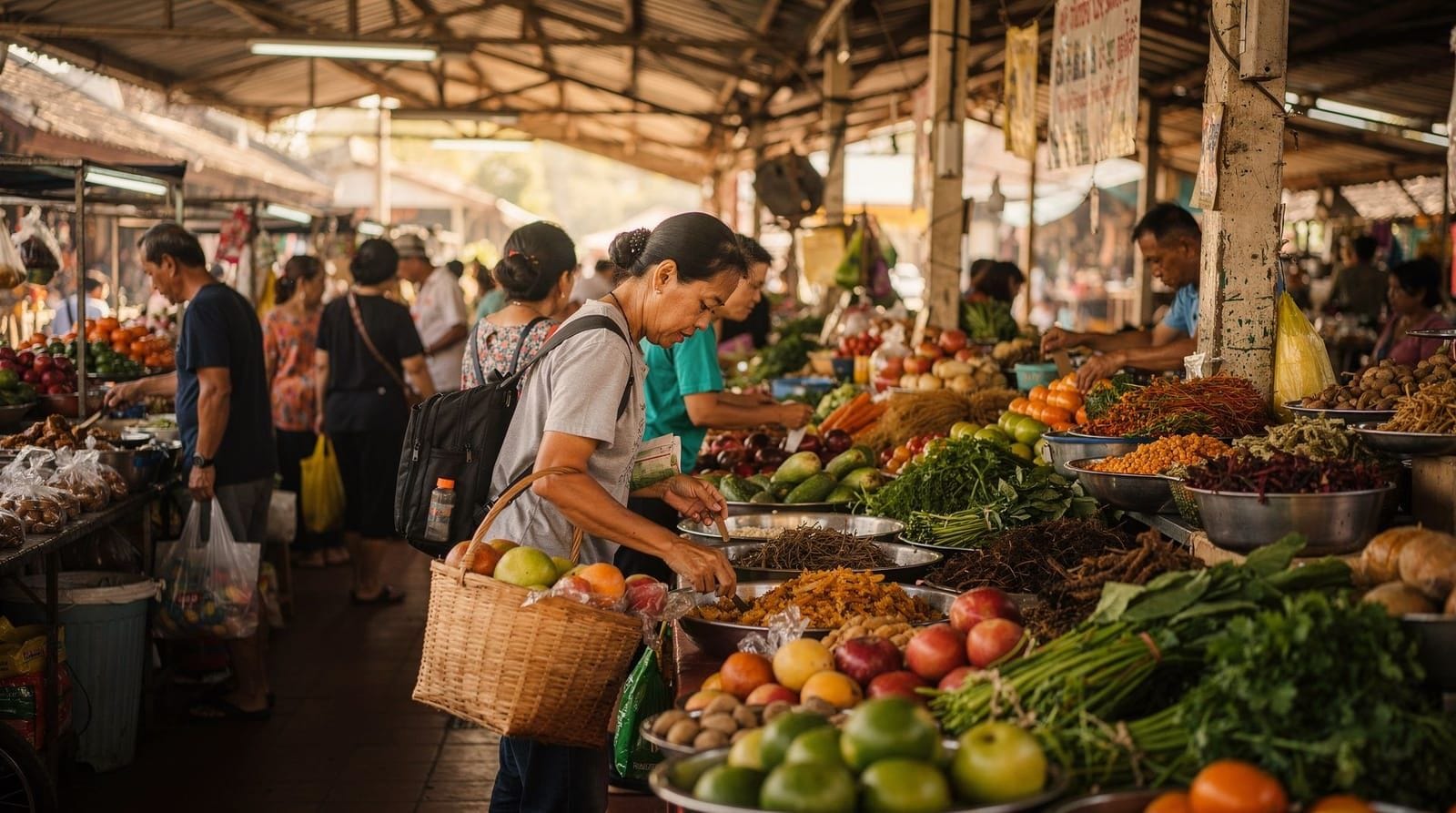
At Chiang Mai’s markets — see the street food guide for the full market landscape — the reliable plant-based options are:
- Tofu-based dishes — stir-fried tofu with vegetables, tofu soup, and fried tofu skewers are widely available and usually safe to assume are meat-free, though confirm no fish sauce was used.
- Fresh fruit — abundant, cheap, and unambiguously plant-based, a reliable fallback at every market.
- Sticky rice and plain rice dishes — a safe base, though anything served alongside it (dips, curries) needs checking individually.
- Je-flagged stalls — the most reliable single signal at any market, especially during the September festival window, and present in smaller numbers year-round at Warorot and some night markets.
What to be cautious of: many northern Thai dips like nam prik ong traditionally include pork, and vegetable stir-fries at non-vegetarian stalls are very commonly finished with fish sauce or shrimp paste as a default seasoning — see the northern Thai dishes guide for which classic dishes are and aren’t naturally plant-based.
Where the dedicated restaurants cluster, in more detail
The Old City remains the single richest area for dedicated plant-based dining, partly a legacy of Chiang Mai’s long-established wellness tourism scene and partly simple density — with so many restaurants competing for the same visitor foot traffic, plant-based options have had room to specialize rather than needing to serve everyone. Restaurants here range from raw-food and juice-focused cafés to full Thai vegan menus covering curries, stir-fries and noodle dishes adapted from standard Thai recipes. Santitham, just north of the moat and more residential in character, has a quieter but growing cluster favored by longer-term expatriate and digital-nomad residents rather than short-stay tourists, often reflected in slightly lower prices and a more local, less polished presentation than the Old City’s more visitor-facing spots. Near Wat Umong, the forest temple on the city’s western edge, an organic farm-to-table restaurant grows much of its own produce on adjoining land and serves a rotating seasonal vegetarian Thai menu, worth combining with a temple visit given the proximity. Nimman’s plant-based options tend toward a more polished, Instagram-friendly presentation and Western-fusion menu style, reflecting the district’s broader character described in our coffee culture guide.
What a typical vegan Thai menu looks like
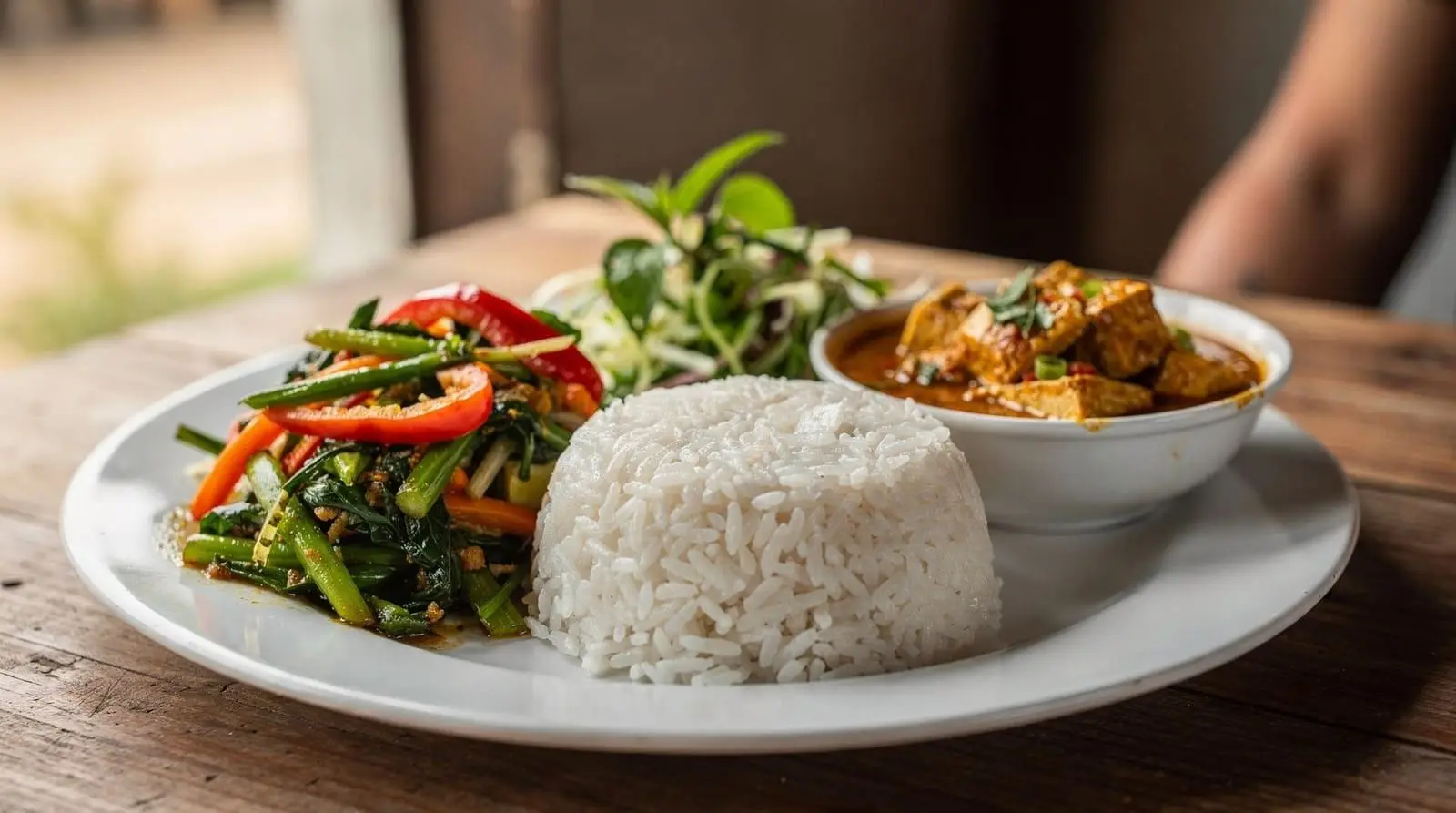
For travelers unfamiliar with how Thai cooking adapts to a vegan framework, it helps to know what to expect on a typical dedicated vegan restaurant’s menu here. Curries are usually made with a vegetable or mushroom-based stock rather than the meat or fish stock used traditionally, and coconut milk-based curries adapt particularly well since the curry paste itself is often already vegan before stock is added — northern dishes like a plant-based take on gaeng hang lay, discussed in our northern Thai food dishes guide, do exist at some restaurants, using mushrooms or jackfruit to mimic the traditional pork belly’s texture. Stir-fries substitute tofu, tempeh or extra vegetables for meat, and som tam (green papaya salad) can be made vegan on request by omitting the fish sauce and dried shrimp typically used, though this requires explicitly asking since the standard recipe includes both. Rice and noodle dishes are generally the most straightforward to adapt, since the base ingredients are already plant-based before any protein or sauce is added.
Cooking classes as a vegetarian-friendly option
Several Chiang Mai cooking schools offer dedicated vegetarian or vegan class options, letting you learn and eat a full plant-based Thai meal in a controlled setting rather than navigating a market menu — a genuinely useful option if you want to guarantee a fully vegan experience for at least one meal of your trip.
Why Chiang Mai’s vegan scene grew the way it did
It’s worth understanding the specific reasons Chiang Mai developed such a substantial dedicated vegan and vegetarian dining scene, since it’s genuinely unusual for a mid-sized Thai city outside Bangkok. A long-running wellness and yoga tourism industry, centered partly around the city’s meditation retreats and its reputation as an affordable long-stay base, has created sustained demand from health-focused travelers and expatriates for years rather than months. This is reinforced by Chiang Mai’s status as one of Southeast Asia’s most popular digital-nomad bases, a demographic that skews notably toward vegetarian and vegan eating relative to the general travel population. Layer on the pre-existing Chinese-Thai je vegetarian tradition described above, which gave the city a genuine local vegetarian food culture to build on rather than starting from nothing, and the combination explains why Chiang Mai’s plant-based dining feels considerably more developed than in many comparably sized cities elsewhere in the region.
Grocery shopping and self-catering for vegans
If you’re staying in Chiang Mai for an extended period or simply prefer cooking some of your own meals, self-catering as a vegan is genuinely workable. Rimping Supermarket and similar higher-end grocery stores stock a reasonable range of plant-based milks, meat substitutes and imported vegan products aimed at the city’s long-stay foreign resident population, at a price premium over local markets but with far more variety than a decade ago. For fresh produce, Warorot Market and smaller neighborhood markets offer the cheapest and freshest vegetables, fruit and tofu, though reading Thai labels or asking directly about ingredients in prepared items (like premade curry pastes, which sometimes include shrimp paste) is worth doing if strict veganism matters to you. Several longer-stay apartments and guesthouses in Nimman and Santitham are set up with kitchenettes specifically because of this resident demand, making a hybrid approach — cooking some meals, eating out for others — realistic for visitors of a week or more.
Vegan and vegetarian eating on day trips outside the city
It’s worth setting honest expectations for day trips beyond the city center. Rural destinations like Doi Inthanon, hill-tribe villages, or more remote stops toward Pai or Mae Hong Son have far fewer or no dedicated vegetarian options, and even ostensibly vegetable-based dishes at rural food stops are more likely to include fish sauce or shrimp paste as standard seasoning without a dedicated vegetarian alternative on offer. Eating a substantial vegan meal in the city before a full-day excursion, or packing shelf-stable snacks (dried fruit, nuts, packaged goods from Rimping or a similar store), is a sensible precaution for any day trip lasting more than a few hours, rather than assuming the same density of options you’ll find in the city center.
Halal and vegetarian overlap
Travelers managing both halal and vegetarian needs (or traveling in a mixed group) will find some overlap useful — je-marked vegetarian stalls and halal-certified stalls are both, by definition, free of pork, which simplifies group ordering somewhat. See the halal food guide for that community’s specific dining cluster.
Prices at a glance
| Setting | Typical price (THB) |
|---|---|
| Vegetarian street stall / je-marked market stall | 25-45 |
| Buffet-style vegetarian restaurant | 60-150 |
| Dedicated vegan restaurant (Old City/Santitham) | 80-180 |
| Nimman-area plant-based café | 120-250 |
These prices sit broadly in line with, or only modestly above, standard Thai restaurant pricing in the same neighborhoods, which is a reasonable indication that plant-based dining in Chiang Mai isn’t treated as a specialty-priced niche the way it can be in some Western cities.
A few honest limitations to know about
It’s worth being upfront about where Chiang Mai’s vegan scene still has real limits, rather than presenting it as flawless. Ingredient transparency at smaller, non-dedicated restaurants remains inconsistent — a menu item labeled “vegetable” is not a reliable guarantee of a vegan preparation without asking directly, and staff at busier tourist-facing restaurants don’t always have detailed knowledge of every sauce’s ingredients. Cross-contamination in shared kitchens (a wok used for both meat and vegetable stir-fries, for instance) is a genuine concern for strict vegans with any sensitivity, and it’s not something most casual Thai restaurants actively manage the way a dedicated allergen-aware kitchen might. Finally, while the dedicated restaurants covered above are genuinely good, the sheer number of options can create a slightly curated, expat-facing bubble in areas like Nimman and parts of the Old City — venturing to more purely local vegetarian stalls at markets like Warorot gives a different, less polished but arguably more authentic version of Thai vegetarian eating.
Frequently asked questions about vegetarian and vegan dining in Chiang Mai
Is it hard to find vegan food outside the city center?
Yes, noticeably — day trips to rural areas like Doi Inthanon or hill-tribe villages have far fewer dedicated options, so it’s worth eating a substantial vegan meal before heading out or packing snacks for longer excursions.
Do Chiang Mai restaurants clearly label vegan vs. vegetarian on menus?
Increasingly yes at dedicated plant-based restaurants, which distinguish vegan from lacto-ovo vegetarian dishes; regular Thai restaurants are far less consistent about this distinction and require asking directly.
Can I get vegan khao soi in Chiang Mai?
At some dedicated vegetarian restaurants and a few mainstream shops on request, yes, using a tofu or vegetable base instead of meat, though it’s a smaller subset of khao soi shops than meat versions — see the khao soi where-to-eat guide.
Is coconut milk vegan-safe in Thai cooking?
Yes, coconut milk itself is plant-based and used constantly in northern Thai cooking (including in khao soi’s broth), so it doesn’t need special checking — the concern is usually meat stock, fish sauce or shrimp paste added alongside it.
Are vegetarian options clearly marked at night markets?
Only at je-flagged stalls specifically; general market stalls don’t typically label vegetarian status, so asking directly or sticking to visibly plant-based dishes (tofu, fruit) is the more reliable approach.
Is it considered rude to ask detailed questions about ingredients?
No — Chiang Mai vendors are generally used to dietary questions from both Thai and international customers, particularly given the city’s large long-stay wellness and vegan traveler community, and are typically happy to clarify.
Are there vegan cooking classes specifically, separate from general vegetarian options?
Yes, a small but genuine number of cooking schools in the city run fully vegan-focused classes rather than offering a single vegetarian substitution within an otherwise standard menu — worth seeking out specifically if learning fully plant-based Thai cooking is a priority rather than just eating it.
Do Chiang Mai’s vegetarian restaurants cater to other dietary restrictions too, like gluten-free?
Some of the more established dedicated vegan restaurants, particularly those in the Old City and Nimman with a longer-standing international customer base, do offer gluten-free labeling or substitutions on request, though this is far less consistent than vegetarian or vegan labeling itself and is worth confirming directly with the specific restaurant.