Sunday Walking Street food guide: best stalls on Ratchadamnoen Road
Chiang Mai: Evening Sightseeing and Local Food Guided Tour
What is the best strategy for eating well at Sunday Walking Street?
Arrive by 5:30-6pm before the heaviest crowds build, eat from the smaller side-soi stalls rather than only the main Ratchadamnoen Road frontage where prices run slightly higher, and pace yourself across the full 1km-plus route rather than filling up in the first few hundred meters near Tha Phae Gate.
Why Sunday Walking Street deserves its own food guide
Most travelers who’ve heard of Chiang Mai have heard of this market by reputation before they arrive, which creates a specific challenge: expectations set by secondhand accounts or photos rarely match the practical reality of navigating dense crowds, deciding where to eat among hundreds of options, and figuring out timing on a market that only exists for a few hours once a week. This guide exists to close that gap between reputation and practical navigation.
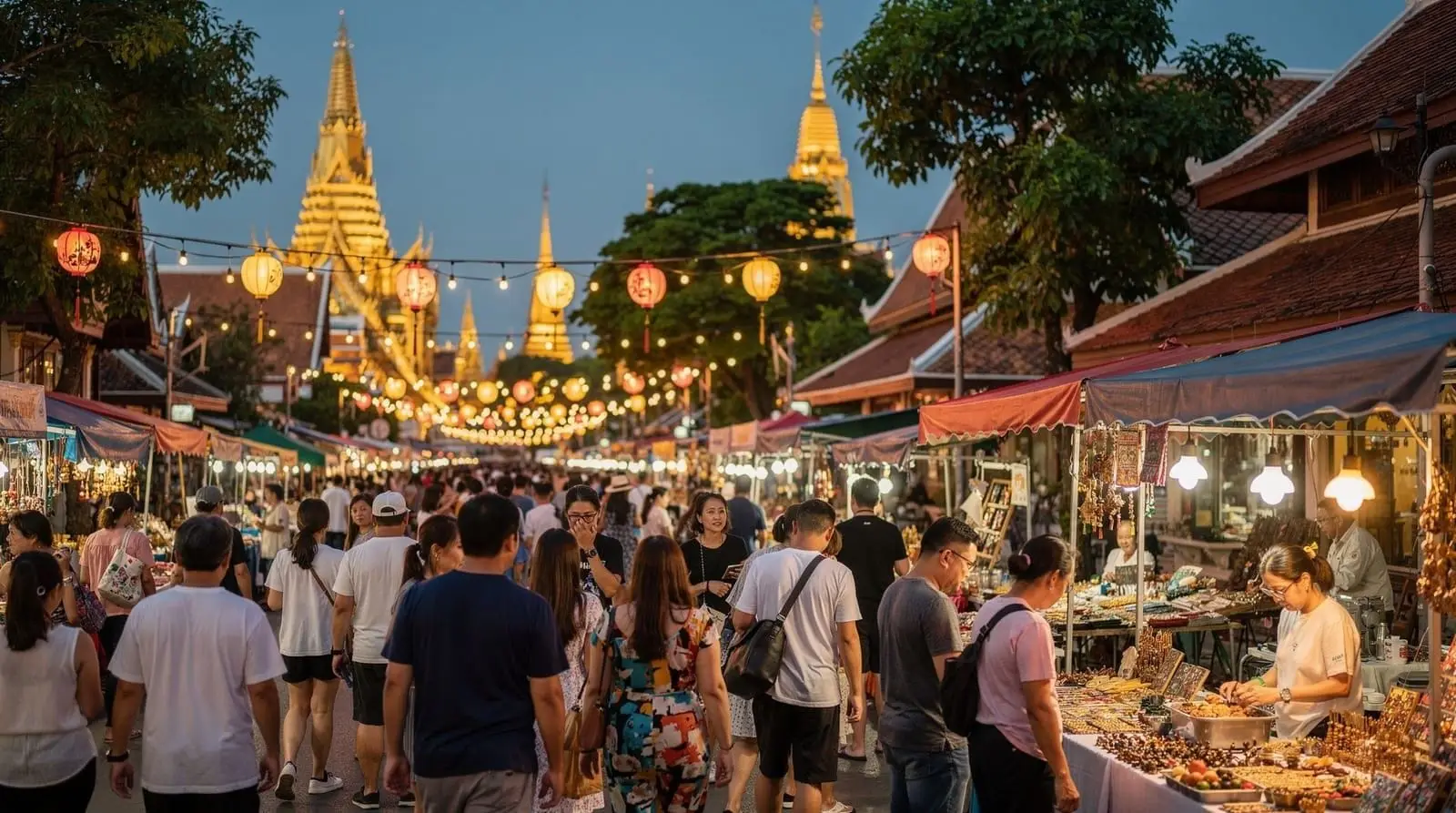
Sunday Walking Street is Chiang Mai’s biggest weekly market by far, closing Ratchadamnoen Road for its full length through the Old City every Sunday evening. Most coverage of it focuses on the crafts, clothing and souvenirs, but the food running alongside — and down the side sois branching off the main road — is dense enough and varied enough to warrant its own plan, separate from the general shopping experience. This guide focuses purely on the eating: what’s actually good, where the crowd thins out, and how prices here compare to the rest of the city’s markets.
For the wider comparison against Chiang Mai’s other night markets, see the best night markets for food guide; for general market strategy and pricing benchmarks, see the Chiang Mai street food guide.
The route: where the food actually is
Knowing the route’s geography in advance makes a real difference to how you experience the evening, since where you enter and how far you walk shapes which stalls you’ll realistically reach.
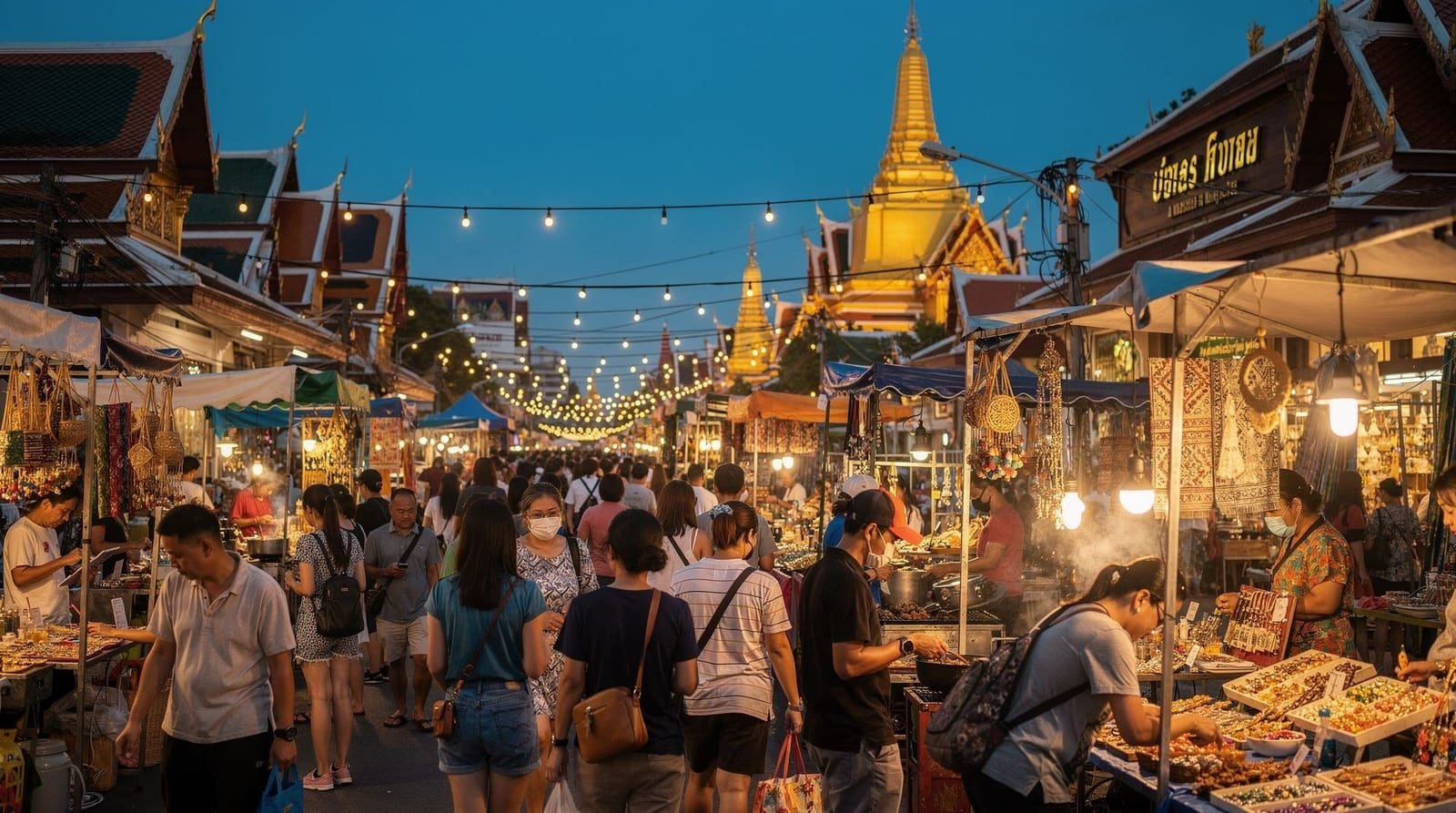
The market runs the length of Ratchadamnoen Road, starting near Tha Phae Gate at the eastern end and continuing west past several temples toward Wat Phra Singh. Food is spread unevenly along this route:
- Near Tha Phae Gate (eastern end) — the busiest, most crowded section, heavy with both crafts and food, but also the most congested; good for browsing, harder for a relaxed meal.
- Mid-route, main road — a steady mix of crafts and grab-and-go food stalls, moderate crowding.
- Side sois branching off Ratchadamnoen — noticeably quieter, often with proper seated stalls rather than pure takeaway, and where some of the better sit-down noodle and khao soi options are found away from the main foot traffic.
- Near Wat Phra Singh (western end) — quieter still, a good spot to end the evening with dessert or a drink after working through the busier middle section.
What to eat
With the layout in mind, it’s worth knowing specifically what to look for once you’re actually walking the route.
The market’s food mirrors the wider city’s street food landscape — see the northern Thai food dishes guide for background on the specific dishes — but a few categories are especially well represented here:
- Grilled skewers and satay — abundant along the entire route, easy to eat while walking.
- Khanom (Thai desserts) — a strong dessert showing compared to other markets, including grilled banana, coconut pancakes (khanom bueang) and mango sticky rice from multiple vendors.
- Fresh fruit shakes and juices — useful for cooling down given the crowd density and evening heat.
- Northern noodle dishes — khao soi and khanom jeen appear at several stalls, generally in the quieter side sois rather than the packed main frontage.
- Vegetarian-marked stalls — present in reasonable numbers; see the vegetarian and vegan guide for how to spot them.
Prices: a modest premium over Warorot
Knowing roughly what to expect to pay avoids the awkward feeling of not knowing whether a price is fair mid-transaction, especially in a crowded, fast-moving environment like this one.
Expect prices roughly 10-20% above Warorot Market’s daytime baseline, reflecting the market’s popularity and prime Old City location, though still well below the Night Bazaar’s food court pricing.
| Item | Typical price (THB) |
|---|---|
| Grilled skewer | 15-25 |
| Khanom bueang (coconut pancake) | 20-30 |
| Fruit shake | 30-45 |
| Bowl of noodles | 40-60 |
| Mango sticky rice | 50-80 |
Timing and crowd strategy
The market runs roughly 4-5pm to 10-11pm, with the heaviest crowding between 7pm and 9pm, especially near Tha Phae Gate. Arriving by 5:30-6pm gets you eating before the worst of the crush, and staying past 9:30pm as the crowd thins gives a noticeably more comfortable second pass through stalls you may have skipped earlier. If you’re combining the market with temple visits, doing an Old City temple walk in the late afternoon before the road closes to traffic and stalls set up is a natural sequence.
Walking food tourHow the market has grown and what that means for food quality
Sunday Walking Street has grown substantially in scale over the years as its reputation has spread among both domestic and international visitors, and that growth has had a genuinely mixed effect on food quality. On one hand, the sheer number of vendors now competing for space means real competitive pressure to maintain quality and reasonable pricing, since a mediocre stall is easily bypassed for a dozen others nearby. On the other, the market’s popularity has drawn some vendors whose primary skill is high-volume, tourist-facing operation rather than the kind of decades-deep specialization you’d find at a stall like Warorot’s longest-running vendors. The practical takeaway is that quality varies more here than at a smaller, more locally-oriented market — worth bearing in mind rather than assuming every stall along the route meets the same bar.
A closer look at the side sois
The side streets branching off the main Ratchadamnoen corridor deserve more specific attention than they usually get in general market coverage. These sois host a mix of semi-permanent noodle shops and restaurants that operate every day of the week, not just during the Sunday market hours, plus additional temporary stalls that appear specifically for the walking street. This mix means the side sois often have more considered, better-executed food than the pure pop-up stalls on the main road, since at least some of what you’re eating there comes from an establishment with a reputation to maintain beyond one busy Sunday evening. If the main road’s crowd and pace feel overwhelming, ducking into one of these side sois for a proper seated meal and then returning to the main road for browsing and dessert afterward is a genuinely good strategy.
What locals do differently from visitors
Chiang Mai residents who regularly attend Sunday Walking Street tend to approach it differently than first-time visitors, and their habits are worth borrowing. Locals generally arrive either early (before 6pm, while stalls are still setting up but some food is already available) or quite late (after 9:30pm, once crowds thin and vendors are sometimes willing to offer a small discount to move remaining stock before packing up). They also tend to have a specific plan — two or three known favorite stalls — rather than trying to sample everything on offer, treating the market as a regular weekly habit rather than a once-only event to maximize. Adopting either of these habits, rather than arriving at peak time with no particular plan, generally produces a more satisfying visit.
Combining with the rest of the Old City
Because Sunday Walking Street runs directly past several major temples, it’s easy to build a full evening around it: a late-afternoon visit to Wat Chedi Luang or Wat Phra Singh, followed by the market itself as the sun sets and the street fills in. See the Old City destination guide for how to sequence a full afternoon-into-evening this way.
Navigating the crowds without losing your group
Given how genuinely dense the crowds get during peak hours, it’s worth having a specific plan for staying together if you’re traveling with others. Agreeing on a meeting point in advance — a specific temple gate or a recognizable landmark rather than “somewhere on the main road” — is more useful here than at almost any other market in the city, since phone signal can be inconsistent in the densest crowd sections and simply calling to regroup isn’t always reliable. Splitting up to browse different stalls and reconvening at set intervals works better than trying to stay in a single-file group moving at the same pace, since the crowd density naturally separates people who aren’t holding hands or staying in constant physical contact. Families with young children in particular benefit from arriving earlier in the evening window, before the crowd reaches its peak density around 7-8pm.
Weather contingency planning
Because Sunday Walking Street is entirely open-air, it’s worth having a backup plan for rain, which is a real possibility roughly June through October and occasionally outside that window as well. A sudden downpour typically causes vendors to hastily cover stalls with tarps and much of the crowd to scatter toward covered shopfronts along the road, and the market can partially or fully shut down for the duration of a heavy storm before resuming once it passes. If rain is forecast for a Sunday evening, it’s worth having the covered Kalare or Ploen Ruedee food courts near the Night Bazaar as a backup plan, discussed in the best night markets for food guide, rather than counting entirely on Sunday Walking Street running as normal.
How Sunday Walking Street compares to its Saturday counterpart
If you have flexibility in your schedule and are trying to decide between the two walking street markets, it’s worth understanding the real differences rather than assuming they’re interchangeable. Sunday Walking Street on Ratchadamnoen Road is substantially larger, draws a bigger crowd, and has the wider food selection covered throughout this guide. Saturday Walking Street on Wua Lai Road is smaller, more locally used, and historically tied to the street’s silversmithing heritage, with food playing a smaller supporting role relative to crafts. If you can only attend one and food variety is your priority, Sunday is the stronger choice; if you’d prefer a calmer, less crowded evening with a more local feel, Saturday is worth considering instead, even though its food offering is comparatively modest.
Photography considerations given the crowd density
Sunday Walking Street is a popular subject for travel photography, and it’s worth a brief note on etiquette given how packed the market gets. Photographing the general market scene, food displays and the temple backdrops along the route is standard practice and unlikely to bother anyone, but stopping to set up a shot in the middle of the densest crowd flow creates a genuine obstruction for everyone behind you — stepping to the side of the main pedestrian flow before taking photos is a small courtesy that makes a real difference during peak hours. As at other markets, asking before photographing an individual vendor directly is the more considerate approach.
Building a Sunday around the market
Because the market only runs one evening a week, it’s worth thinking about how to structure the rest of that Sunday around it rather than treating it as an isolated evening plan. A reasonable structure starts with a relaxed late morning and early afternoon — perhaps a visit to Wat Chedi Luang or another Old City temple before the midday heat peaks, followed by lunch and a break during the hottest hours. As the road begins closing to traffic and stalls set up in the late afternoon, a walk through the temples along the route while things are still quiet gives a different, calmer perspective on the same streets that will be packed a couple of hours later. Arriving at the market itself by 5:30-6pm, as outlined earlier in this guide, then completes a full day that uses the temple-dense Old City efficiently around the market’s fixed weekly schedule, rather than treating the temples and the market as entirely separate trips.
Budgeting a full evening
For planning purposes, a realistic budget for an evening focused primarily on eating (rather than crafts or clothing shopping) runs 300-500 baht (US$8.60-14.30) per person, covering several savory dishes, a dessert or two, and a couple of drinks across the course of the evening. Adding a modest amount for crafts or souvenirs, which the market also does well, pushes a typical combined evening budget to 500-1,000 baht (US$14.30-29) per person, still inexpensive by most international standards for a full evening’s entertainment and food. Couples or groups splitting several larger dishes between them can eat comfortably for less than these per-person figures, since much of the market’s food is designed to be sampled in small portions across multiple stalls rather than ordered as one large individual meal.
Frequently asked questions about the Sunday Walking Street food guide
Is Sunday Walking Street food safe to eat?
Generally yes, using the same judgment as anywhere else in the city — look for stalls with steady turnover and food cooked to order; see the street food safety guide for the fuller checklist.
Can I sit down to eat, or is it all walk-and-eat?
Both — the main road is mostly takeaway-and-walk given the crowd density, but the side sois have proper seated noodle shops and small restaurants if you’d rather sit.
Is it worth going if it’s raining?
The open-air main road is disrupted by heavy rain, though some vendors continue under awnings; if rain is forecast, the covered Kalare or Ploen Ruedee food courts near the Night Bazaar are a more reliable backup for that evening.
How much cash should I bring for an evening here?
1,000-1,500 baht per person (US$29-43) covers a substantial evening of eating across multiple stalls plus a few small souvenirs, though eating alone can realistically be done for 200-300 baht.
Is Sunday Walking Street suitable for families with young children?
It can work, but the crowd density during peak hours makes strollers difficult and young children easy to lose track of — arriving early, before the heaviest crowds, is the more manageable approach for families.
Does the market run on public holidays that fall on other days?
No, it’s specifically a Sunday-only event tied to that day of the week, regardless of holidays — check the Saturday Walking Street (Wua Lai) option if your only free evening is a Saturday instead.
Is the market accessible for visitors with mobility limitations?
It’s genuinely challenging during peak crowd hours given the closed-off street’s uneven surface in places and the density of foot traffic, though the quieter stretches near the western end toward Wat Phra Singh and the earlier or later time windows discussed above are considerably more manageable for anyone with mobility concerns.
Do prices at Sunday Walking Street change throughout the evening?
Not typically for food specifically — prices are generally fixed for the duration of the market rather than fluctuating hour to hour, though as noted earlier, some vendors are willing to offer a small discount on remaining stock very late in the evening as they prepare to pack up.
Top experiences
Bookable activities with verified prices and instant confirmation on GetYourGuide.