Pai
A boho mountain town 3-3.5 hours from Chiang Mai via a winding road — canyon sunsets, hot springs, night markets, and why it needs an overnight.
From Chiang Mai: Day Tour to Pai Highlights by Private Car
Duration: Full day
Quick facts
- Distance / time
- ~135km NW of Chiang Mai, 3-3.5 hours by minivan or car via Route 1095 (762 curves)
- Getting there
- Minivan (~150-250 THB / ~$4-7 one-way), private car/driver, or self-drive; some fly Chiang Mai-Pai (~25 min)
- Days needed
- 1-3 nights minimum; a rushed same-day round trip means 6-7 hours of driving for a few hours on the ground
- Key sights
- Pai Canyon, Pai Walking Street, hot springs, Mo Paeng waterfall, bamboo bridge, Yun Lai viewpoint
- Best time
- November-February for cool, clear mornings; expect haze February-April and quieter, greener roads June-October
Pai sits in a narrow mountain valley about 135km northwest of Chiang Mai, and almost everyone who mentions it in the same breath mentions the road: Route 1095, a two-lane mountain highway that famously twists through 762 curves on its way up and over the ranges between the two towns. That road is as much a part of Pai’s reputation as the town itself, and it shapes almost every practical decision about visiting — including, most importantly, whether to attempt it as a day trip at all.
Quick answer: Pai is a small, laid-back mountain town roughly 3-3.5 hours from Chiang Mai by minivan or car, reached via the winding 762-curve Route 1095 (many passengers get carsick, so plan seating and motion-sickness tablets accordingly). It’s best treated as an overnight or multi-night stop rather than a single rushed day — highlights include Pai Canyon, the Walking Street night market, hot springs, waterfalls, and a scattering of viewpoints and cafés that reward slow exploration rather than a checklist visit.
Why the road matters more than people expect
Route 1095 climbs and descends through forested hills for the entire drive, and the 762-curve figure isn’t marketing exaggeration — it’s the approximate count of turns on the official route marker signs along the way, and locals and repeat visitors treat it as a genuine fact of life rather than folklore. Motion sickness is common enough that minivan drivers routinely stop partway for a break, and it’s standard advice from tour operators and guesthouses alike to take sickness tablets beforehand if you’re prone to it, sit toward the front of the vehicle if possible, and avoid reading or looking at a phone screen during the drive.
This isn’t a reason to skip Pai — it’s a reason to plan around it. A same-day round trip from Chiang Mai means roughly 6-7 hours of driving for perhaps 4-5 hours on the ground in Pai itself, which is a rough trade for a town whose main appeal is unhurried time rather than a checklist of sights. Staying even one night changes the arithmetic substantially: the return drive stops feeling like the main event, and you get an evening at the Walking Street market and a full unrushed day rather than a few compressed hours.
Getting to Pai
Shared minivans run frequently from Chiang Mai’s Arcade bus station and various tour-agency pickup points, typically costing 150-250 THB (roughly $4-7) one-way and taking 3-3.5 hours depending on stops and traffic. Private car or driver options cost more but offer flexibility on stops and departure time, useful if you want to break the drive at a viewpoint or avoid a fixed group schedule. A short domestic flight also connects Chiang Mai and Pai in around 25 minutes on smaller aircraft, though schedules are limited and weather-dependent, and most travelers still go overland at least one way for the scenery.
Self-driving is possible for confident riders and drivers, but the road itself demands real attention — narrow shoulders, blind curves, and occasional oncoming traffic cutting corners are genuine hazards, not exaggerated warnings, so this route is not the place to build confidence on a rented motorbike for the first time.
Pai Canyon
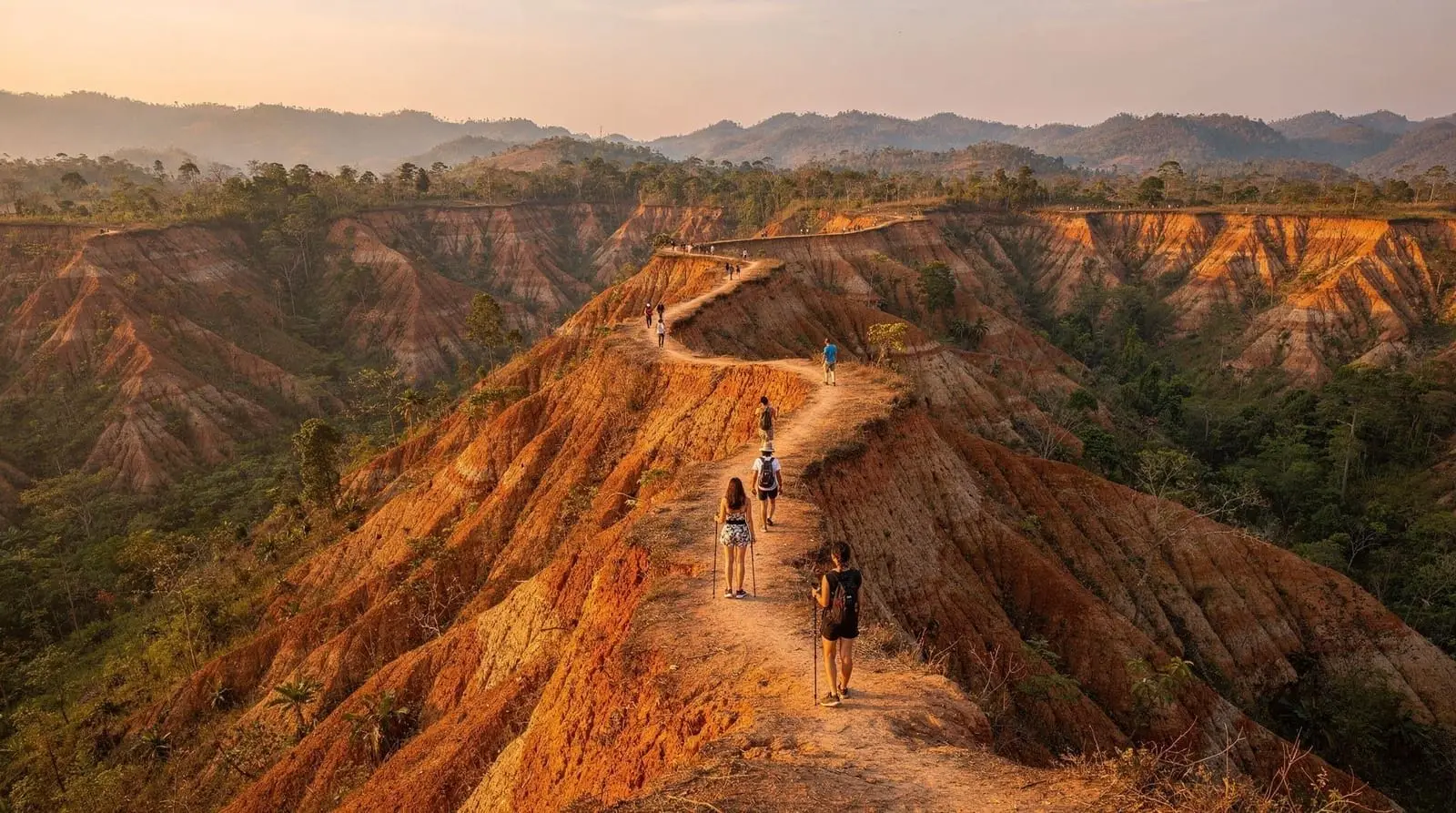
Pai Canyon (Kong Lan) is a set of narrow, eroded sandstone ridges a short drive south of town, with footpaths running along knife-edge crests between drop-offs on either side. It’s most popular at sunset, when the ridge trails fill with visitors watching the light change over the surrounding hills, and the narrow paths mean it gets genuinely crowded at peak sunset times in high season. Sturdy shoes matter here — sandals are common but the ridge sections have real exposure, and the sandstone can be loose or slick after rain.
Arriving an hour before sunset secures a decent vantage point without the tightest crush of the peak fifteen minutes; arriving right at the golden-hour peak means sharing the narrowest ridge sections with a crowd, which affects both the experience and, honestly, the safety margin on the exposed sections.
Pai Walking Street and evening life
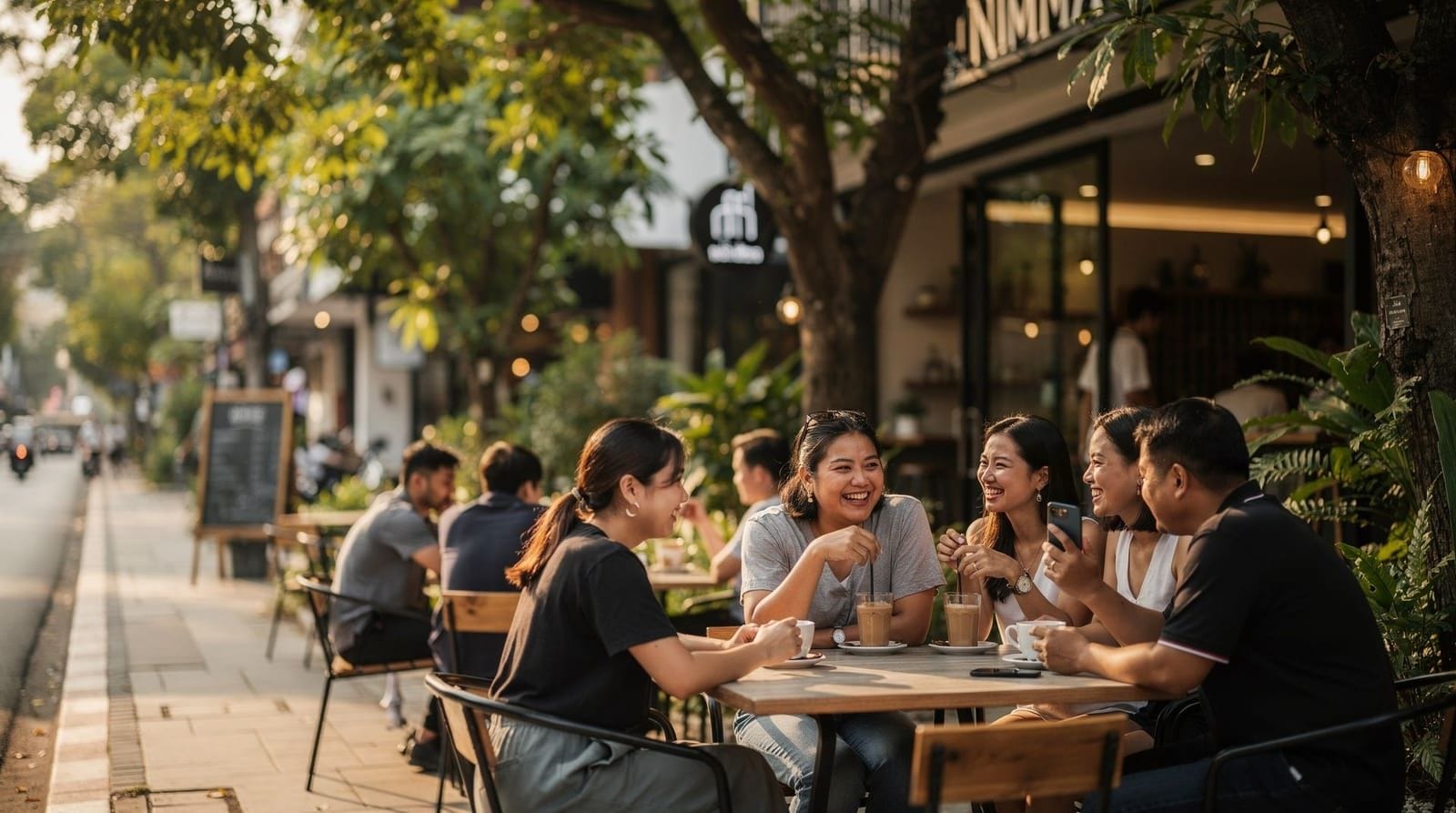
Pai’s night market, generally called Walking Street, sets up along the town’s central road each evening and runs the length of a few blocks with food stalls, handicrafts, clothing, and the general low-key backpacker-market atmosphere the town has built its reputation on. It’s a good gauge of Pai’s overall pace: unhurried, heavily geared toward long-stay travelers and repeat visitors, and much less transactional than Chiang Mai’s larger night markets. Food stalls here are a reasonable way to sample northern Thai street food alongside the wider backpacker-cafe fusion food Pai has become known for — banana pancakes, shakes, and Western breakfast options sit alongside khao soi and other regional dishes without much tension between the two food cultures.
Hot springs, waterfalls, and the bamboo bridge
Several hot spring sites sit within a short drive of town, most consisting of developed pools alongside a natural geothermal source, with entry fees typically in the small tens of baht range. Mo Paeng Waterfall, a multi-tiered cascade with natural rock slides that locals and visitors use recreationally, is a popular half-day stop, particularly in the wetter months when flow is stronger.
Boon Ko Ku So, more commonly known as the bamboo bridge, is a long footbridge built by monks and local villagers across paddy fields connecting Wat Nam Hu to a nearby temple, and makes for one of Pai’s more distinctive photo stops, especially early morning or late afternoon when the surrounding rice fields catch the light. A guided Sai Ngam hot spring, bamboo bridge and Santichon village half-day tour bundles several of these together efficiently if you’re short on time, and a similar hot springs, waterfalls and lunch day trip covers a slightly different combination for travelers approaching Pai from Chiang Mai directly.
Yun Lai viewpoint and the WWII Memorial Bridge
Yun Lai viewpoint, on a hillside northwest of town near a small Chinese Yunnanese village, gives an early-morning view over Pai’s valley mist settling into the rice fields below — worth the pre-dawn alarm if you’re a photography-minded traveler, since the mist typically burns off within an hour or two of sunrise. The WWII Memorial Bridge, a wooden-plank structure built during the Japanese occupation era and later reconstructed, sits along the road toward the canyon and functions today mostly as a photo stop and small local market rather than a major historical site, though the informational signage on-site covers its wartime background for those interested.
Land Split
A short drive from town, Land Split (Pai Land Split) is a small, privately-run stop centered on a genuine fissure that opened in a farmer’s field after seasonal flooding, now surrounded by a simple garden where the family who owns the land serves homemade snacks and drinks, traditionally by donation rather than fixed price. It’s a modest, quirky stop rather than a major attraction, but it’s a good example of Pai’s low-key, personal-scale approach to tourism versus the more commercialized version found in busier parts of the country.
Combining Pai with a Mae Hong Son loop
Pai sits at the start (or midpoint) of the wider Mae Hong Son Loop, the roughly 600km mountain circuit connecting Chiang Mai, Pai, Mae Hong Son, and back — see the Mae Hong Son guide for the fuller route. If you have 3-4 days rather than 1-2, continuing from Pai onward to Mae Hong Son rather than backtracking directly to Chiang Mai makes considerably better use of the driving time already invested getting this far into the mountains. A guided Mae Hong Son highlights car tour departing from Pai is a practical way to see the next leg of the loop without arranging your own transport partway through the trip.
A multi-day Pai itinerary
For travelers with two full nights, a workable rhythm is: arrive by early afternoon on day one, settle in and walk the Walking Street market that evening; spend day two on the main loop — Pai Canyon at sunset, hot springs and the bamboo bridge earlier in the day, Land Split on the way back; use a third morning, if you have it, for Yun Lai viewpoint at sunrise before departing. This pacing avoids the common mistake of trying to compress everything into a single frantic day and instead treats Pai’s actual selling point — unhurried mountain time — as the point of the trip rather than an obstacle to sightseeing efficiency.
Where Pai fits against Chiang Dao and Mae Hong Son
Travelers deciding between northern day-trip destinations often weigh Pai against Chiang Dao, a much shorter 1.5-hour drive north of Chiang Mai centered on a cave system and mountain, or against continuing the full loop to Mae Hong Son itself. Chiang Dao suits travelers who want a genuine mountain-nature outing without committing to an overnight stay or the long winding drive; Pai suits those willing to invest the travel time for a distinct town experience with its own nightlife, café culture, and multi-day pacing; Mae Hong Son suits those continuing the loop who want the full remote, misty province experience rather than Pai’s more developed, backpacker-oriented version of the same mountains.
A brief history of Pai
Pai began as a small Shan and Thai Yai trading town along an old route between Chiang Mai and Mae Hong Son, with a population historically made up of Shan, Lisu, and other hill-tribe communities alongside ethnic Thai residents — a mix still visible in the surrounding villages and in dishes on local menus that lean more Shan than central-Thai. Its shift toward a backpacker destination began gradually in the 1990s and accelerated through the 2000s as word spread among long-stay travelers about the valley’s scenery, cheap guesthouses, and slower pace relative to Chiang Mai. A 2010 Thai romantic film, “Pai in Love,” gave the town a further surge in domestic Thai tourism, and today Pai draws both international backpackers and Thai weekend visitors in roughly comparable numbers, which shows up clearly in the mix of accommodation styles — from long-stay bungalows to newer boutique guesthouses aimed at Thai couples.
That layered history is part of why Pai feels different from other northern day-trip towns: it isn’t a single-audience destination built around one type of traveler, but a town that has absorbed several waves of tourism development without losing the valley setting and slower pace that drew people there in the first place.
Where to stay
Accommodation in Pai clusters loosely into a few areas: the town center near Walking Street, walkable to the market and most restaurants but busier in the evening; the riverside area along the Pai River, generally quieter with a more scenic outlook; and a scattering of countryside bungalow resorts a short drive or bike ride outside town, trading walkability for rice-field views and quiet. Budget guesthouses remain plentiful and cheap by regional standards, while the boutique and resort tier has grown substantially over the past decade, particularly in the countryside ring around town. Whichever area you choose, a rented bicycle or scooter (for those already comfortable riding one) makes getting around town and to the nearer sights considerably easier, since Pai’s center is compact but the canyon, waterfalls, and viewpoints are a few kilometers out in different directions.
Practical notes
ATMs and 7-Elevens are present in town, so cash isn’t hard to access, though smaller guesthouses and market stalls still favor cash over cards. Wi-Fi is generally reliable in cafés and most accommodation, a legacy of Pai’s long-running popularity with digital-nomad-style long-stay visitors. Nights can be genuinely cool from November through February, cooler than Chiang Mai given the elevation and valley setting, so pack at least a light layer if visiting in that window.
Frequently asked questions about Pai
How long does it take to get to Pai from Chiang Mai?
About 3-3.5 hours by minivan or car via Route 1095, a winding mountain road with roughly 762 curves. A short flight takes about 25 minutes but runs limited schedules.
Is Pai worth visiting as a day trip?
It’s possible via a private car tour, but a same-day round trip means roughly 6-7 hours of driving for a handful of hours in town. An overnight, even just one night, produces a substantially better experience for the travel time invested.
Is the road to Pai really that winding?
Yes — the 762-curve figure comes from official route markers along Route 1095, and motion sickness is common enough that minivan drivers routinely build in a stop. Sit toward the front and take motion-sickness tablets in advance if you’re prone to it.
What is the best time of year to visit Pai?
November through February for cool, clear conditions. February through April brings agricultural burning haze that can dull mountain views; the green season (roughly June-October) is lush but wetter, with a real chance of the road being affected by heavy rain.
Can I ride a motorbike to Pai as a first-time rider?
It’s not recommended. The mountain road has narrow shoulders, blind curves, and real elevation changes that reward experienced riders and punish overconfidence; a minivan, private car, or driver is the safer choice for less experienced riders.
What’s the best way to see Pai Canyon?
Arrive roughly an hour before sunset to get a good vantage point before the peak crowd, wear sturdy shoes rather than sandals, and be cautious on the narrow, exposed ridge sections, especially if the sandstone is damp.
Should I continue from Pai to Mae Hong Son?
If you have 3-4 days rather than 1-2, yes — continuing the loop onward rather than backtracking directly to Chiang Mai makes better use of the mountain driving you’ve already done. See the Mae Hong Son guide for the fuller loop route.
Is Pai touristy?
It’s popular and well-developed for its size, with a long-established backpacker and long-stay-traveler scene, cafés, and a nightly market geared toward visitors. It still feels markedly slower and less commercial than Chiang Mai’s Old City or Night Bazaar, which is much of its appeal.
Top experiences
Bookable activities with verified prices and instant confirmation on GetYourGuide.

From Chiang Mai: Day Tour to Pai Highlights by Private Car
Pai Highlights Private One Day Trip from Chiang Mai
1-Day Trip from Chiang Mai to Pai (Van Rental with Driver)
Chiang Mai: Charming Pai in One Day Trip with Driver
From Pai: Private Highlights Car Day Tour with Pai Canyon