Songthaew guide: how Chiang Mai's red trucks actually work
How do I use a red songthaew in Chiang Mai?
Flag one down from the roadside like a taxi, tell the driver your destination through the open window, and if it's roughly on their route they'll wave you aboard for a shared fare of about 30-40 baht per person. If your destination is well out of the way, the driver may offer to charter the whole truck to you directly for a higher agreed price. Pay when you get off, and don't be afraid to say no and wait for the next truck if a driver quotes a price that seems too high.
Why the songthaew is worth learning, not just avoiding
It’s tempting for a first-time visitor to skip songthaews entirely and default to Grab for every trip, and that’s a perfectly reasonable choice. But the red trucks remain one of the cheapest, most characteristic ways to move around Chiang Mai, and once the basic mechanics click — how to flag one, how to state a destination, how fares actually work — most travellers find them straightforward rather than intimidating. This guide breaks down exactly how the system works, so you can use it with confidence rather than defaulting to an app out of uncertainty.
What a songthaew actually is
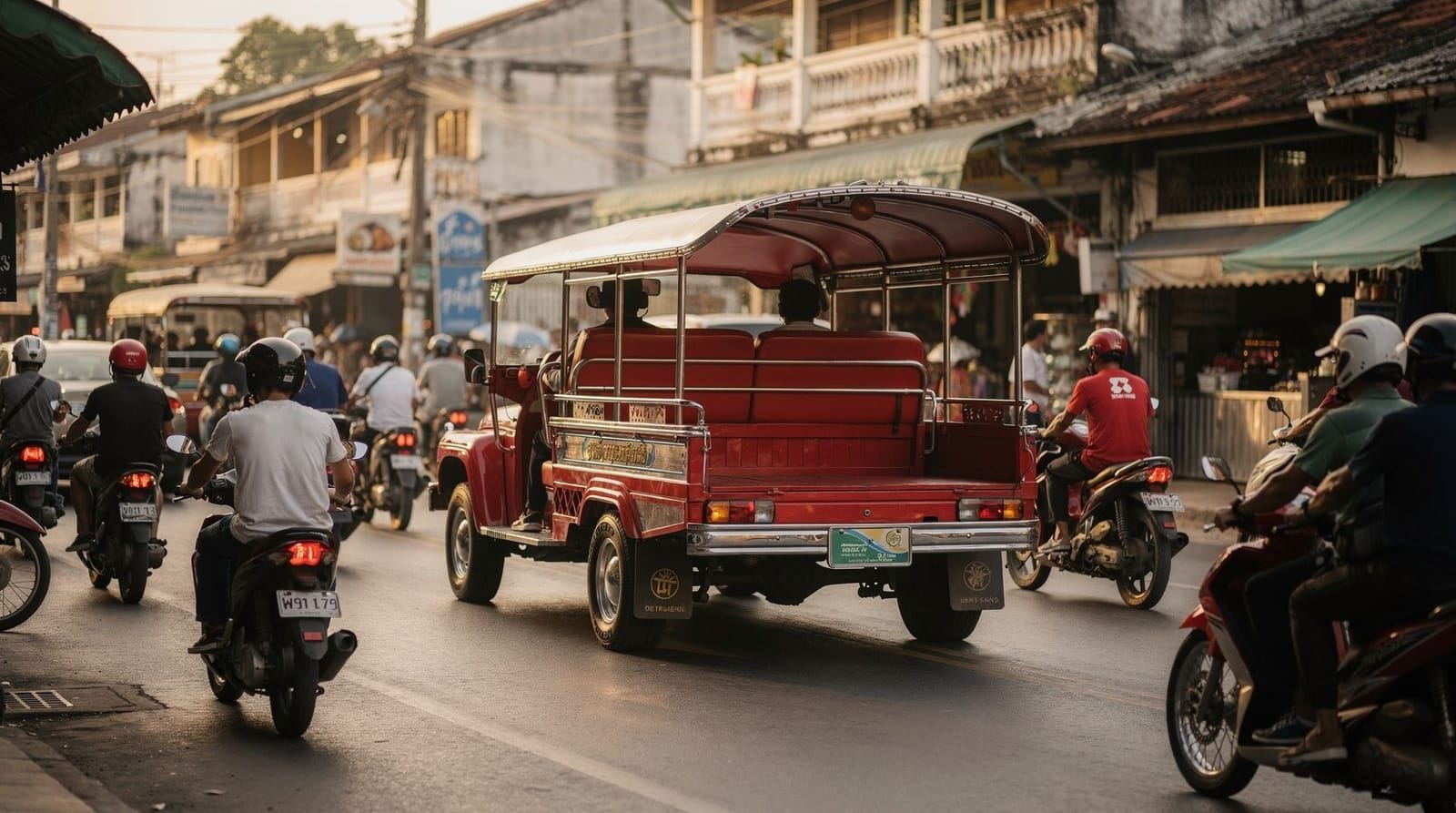
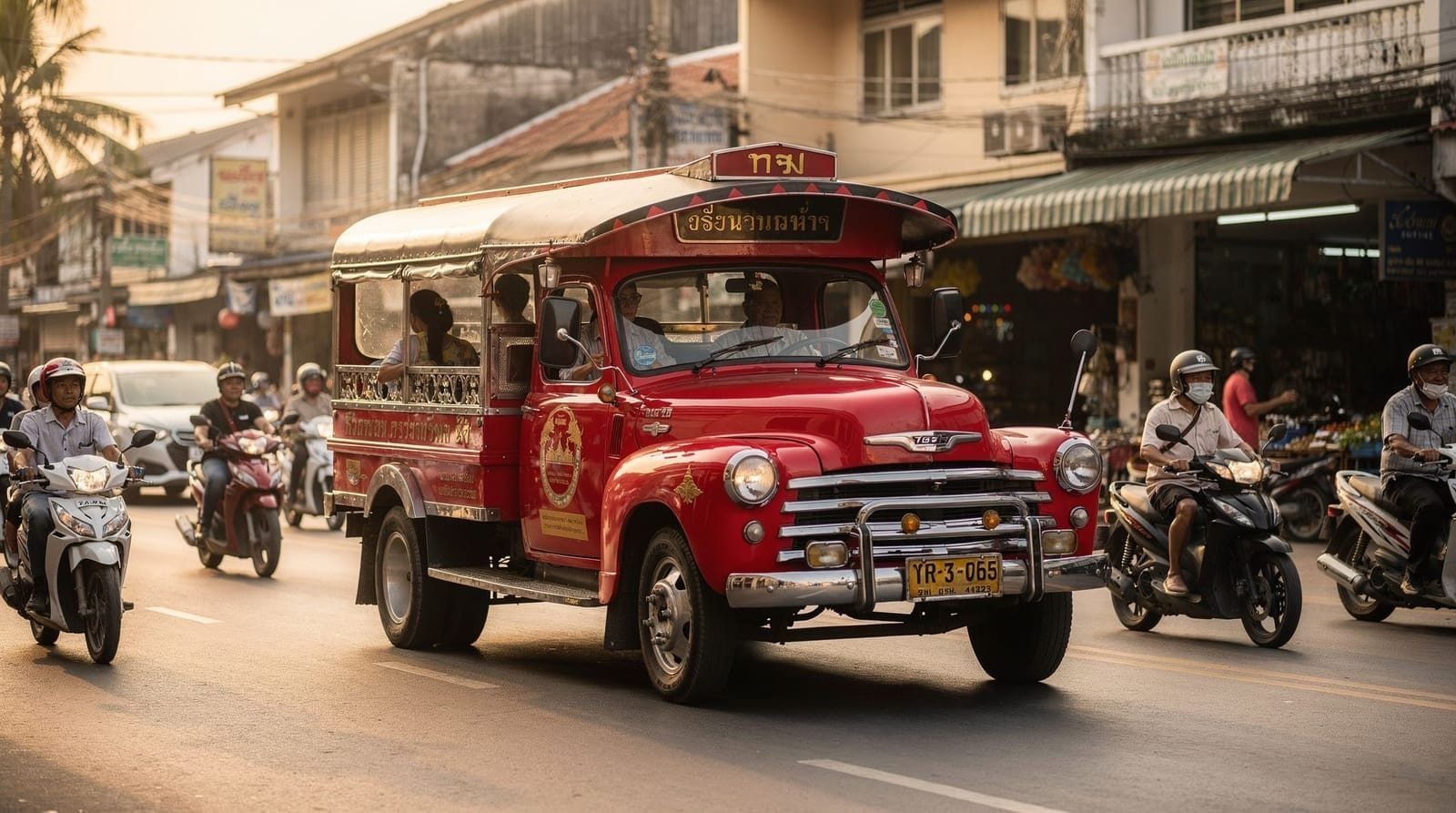
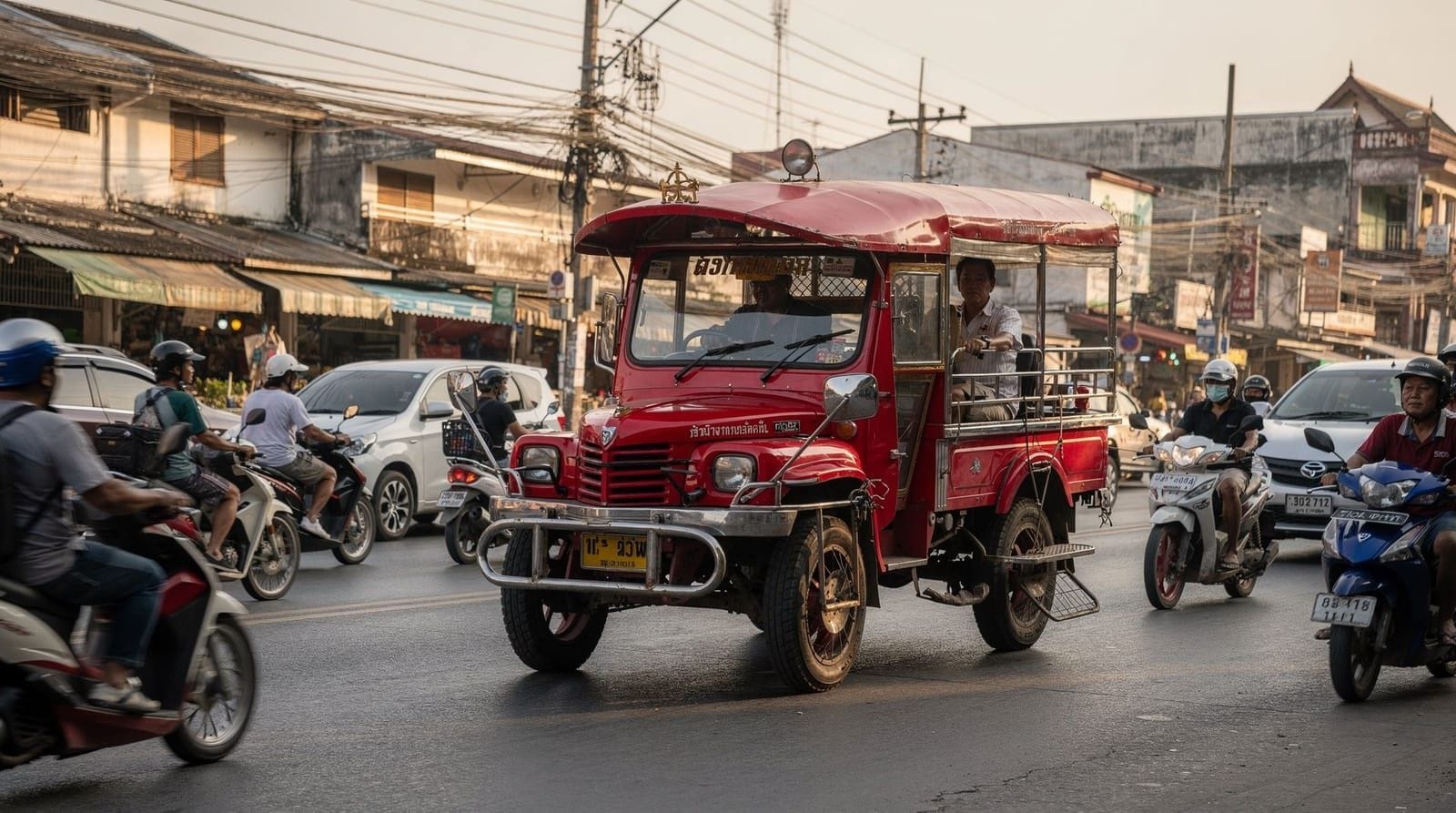
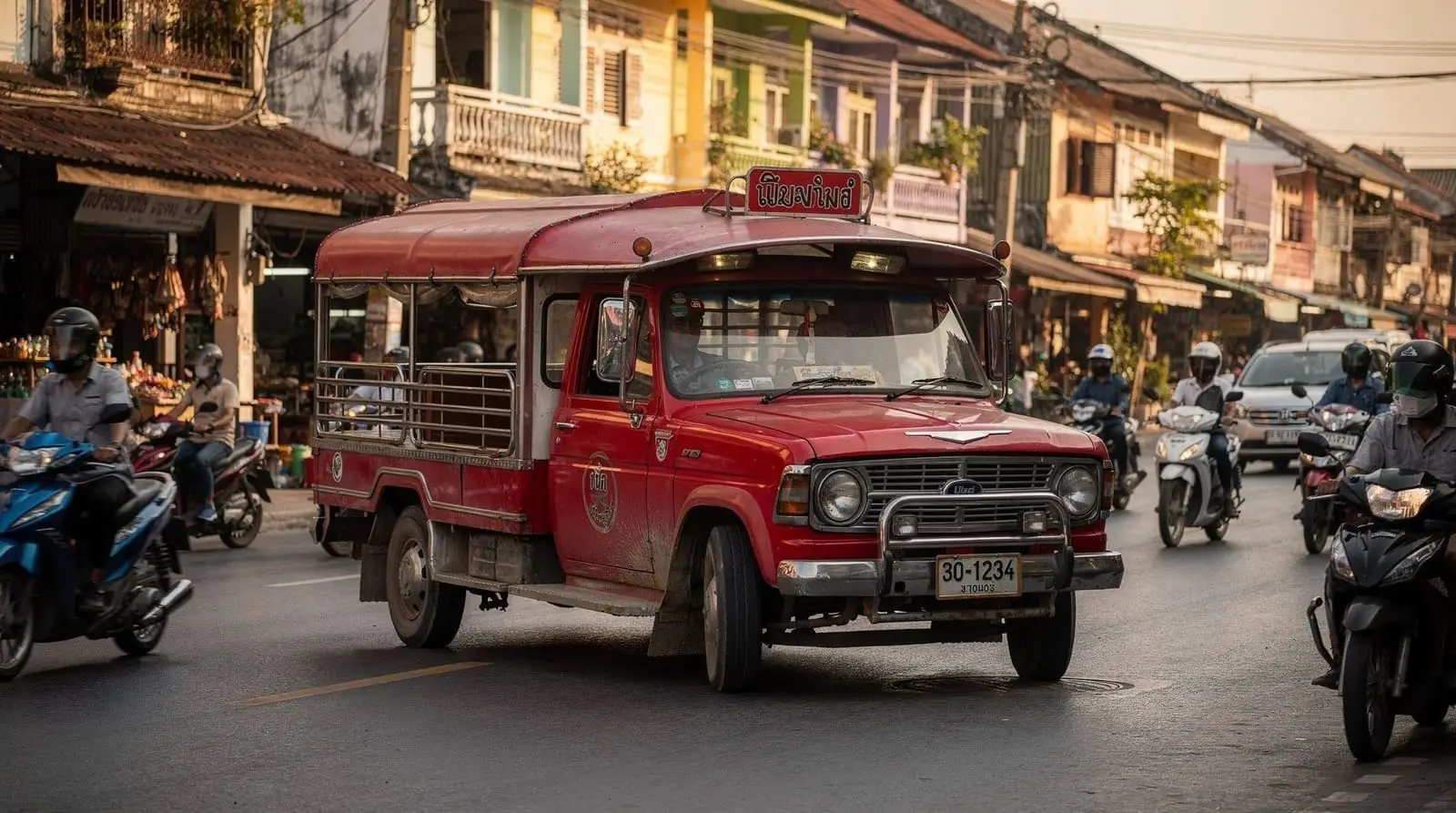
A songthaew is a pickup truck fitted with a covered bed and two facing bench seats running down each side — the name literally means “two rows.” Chiang Mai’s city songthaews are painted red, which is why locals and guidebooks alike often just call them “red trucks” or “rot daeng.” They don’t run on a fixed timetable or numbered route the way a city bus system would; instead, drivers circulate through the city picking up and dropping off passengers headed in a broadly similar direction, adjusting their path as fares come and go.
This informality is exactly what makes them cheap and flexible, but it’s also why they reward a little basic know-how — knowing what to say, how much to expect to pay, and what to do if a driver says no to your stop.
How to flag one down
Stand at the roadside facing the direction you want to travel and raise a hand as a songthaew approaches, the same gesture used to hail a taxi anywhere. Drivers will slow if they have room and your general direction works for them. Lean toward the passenger window and state your destination — a well-known landmark, temple name, market or neighbourhood works far better than a street address, since drivers think in terms of places rather than formal addresses. “Wat Chedi Luang,” “Warorot Market,” or “Nimman” will get you a quicker, clearer answer than reading out a hotel’s street number.
What happens next: shared vs. chartered
If your destination sits roughly on the truck’s current route, the driver will usually nod or wave you in, and you climb into the bed alongside whichever other passengers are already aboard. This is the shared model, and it’s the cheapest way to ride — typically 30-40 baht per person, paid to the driver when you get off (tap the roof or say “here” to signal your stop).
If your destination is well out of the way — say, you want to go somewhere the truck isn’t currently headed, or you have a specific address off the beaten path — the driver may instead offer to take you there directly for a higher, chartered price. This is worth agreeing on clearly before boarding: state where you’re going, ask “how much,” and settle a number you’re both comfortable with. A chartered ride costs more than a shared fare but is still often a reasonable option for a small group splitting the cost, especially with luggage.
What if a driver says no?
It happens regularly and isn’t a rejection to take personally — it usually just means your stop doesn’t fit the truck’s current route or passenger load. The normal response is simply to thank the driver and flag the next one, or switch to Grab if you’re pressed for time or heading somewhere unusual. Multiple refusals in a row are uncommon for well-known destinations inside the city core.
Songthaews vs. Grab: when to pick which
Songthaews shine for short, everyday hops around the Old City, to markets like Warorot Market, or to well-known temples and landmarks where the shared-route model works smoothly. Grab is generally the better call for cross-town trips, anything after dark when you’d rather have a tracked driver and a named destination pinned on a map, or if you’re carrying significant luggage and want door-to-door certainty without negotiating. Full comparison and setup details are in the Grab app guide, and the wider transport picture, including tuk-tuks and scooters, is in the getting around Chiang Mai guide.
Songthaews outside the city core
The red trucks you’ll flag inside Chiang Mai city are specifically an in-town service. Longer routes to outlying towns and districts around the province often use songthaews in other colours departing from specific stops rather than being hailed from any roadside — this is a different, more route-fixed system than the red city trucks and generally isn’t the practical choice for day-trip logistics covered elsewhere on this site, where minivans, private cars and tours are the more reliable options. See the Chiang Mai to Pai transport guide and Chiang Mai to Chiang Rai transport guide for those specific routes.
Etiquette and small practicalities
Climb in from the rear of the truck bed and take a seat on either bench; there’s no assigned seating and passengers shuffle in and out at different stops along the way. Keep bags on your lap or between your feet rather than blocking the aisle for others getting on or off. Carry small notes and coins — a driver running a shared route with several passengers won’t always have change for a large bill. Tap the roof of the truck or call out clearly when you want to stop, since there are no announced stops the way a fixed bus route would have.
Fair pricing and avoiding overcharging
The 30-40 baht shared fare is the honest baseline for a standard in-town ride, and most drivers working the regular circulation routes charge close to this without issue. Overcharging shows up more with chartered rides to less obvious destinations, where a visitor unfamiliar with distances might accept an inflated number without questioning it. Asking “how much” before boarding and having a rough sense of distance (a same-neighbourhood hop should cost noticeably less than a cross-city charter) is the simplest protection. If a quoted price feels clearly out of line, it’s entirely normal to decline and either flag another truck or switch to Grab, where the fare is fixed and visible before you commit.
A realistic first ride
For a first-timer, a good low-stakes way to try a songthaew is a short, well-known route — from an Old City guesthouse to Warorot Market, or from Tha Phae Gate to Nimman. Both are common enough routes that drivers will recognise the destination instantly, fares are predictable, and the ride itself takes only 10-15 minutes. Once that first ride demystifies the process, most visitors find themselves reaching for a songthaew instinctively for the rest of the trip whenever the shared-fare, low-cost option makes sense.
A brief history of the red truck system
Songthaews have operated as Chiang Mai’s informal shared-taxi backbone for decades, filling a role that in many cities would belong to a fixed-route city bus network. Converted from standard pickup trucks with an added bench-lined, covered bed, they emerged as a flexible, low-infrastructure solution that didn’t require the fixed stops, tracks, or overhead wiring a formal transit system would need — a model that’s stayed remarkably consistent even as the city has grown considerably around it. Understanding this origin helps explain why the system still runs on driver judgment and roadside hailing rather than an app-based dispatch model: it was never designed as a rigid network, and that flexibility remains both its main strength and its main source of unpredictability for newcomers.
Illustrative example rides
A few concrete scenarios help make the mechanics less abstract. Heading from a guesthouse near Tha Phae Gate to Warorot Market for breakfast is a classic short shared ride — say “Warorot” or “Kad Luang” to the driver, expect to pay around 30 baht, and the trip takes under 10 minutes. A trip from the Old City out to Nimman for dinner is a slightly longer shared hop, typically 30-40 baht and 15-20 minutes depending on traffic. A late-evening return from the Night Bazaar back to an Old City hotel after 10pm is more likely to require a chartered fare, since shared songthaew traffic thins out considerably after dark — in that case, agreeing a flat 60-100 baht for a direct ride, or simply switching to Grab, are both reasonable choices.
Songthaew vs bus vs Grab: the quick summary
It’s worth being direct that Chiang Mai does not have a comprehensive fixed-route city bus network filling the gap songthaews occupy — some limited bus routes exist, but they’re not the default transport mode for visitors the way they might be in a larger Thai city. That leaves songthaews and Grab as the two realistic everyday options, with tuk-tuks as an occasional third choice for short novelty rides. Songthaews win on price for short, well-known routes; Grab wins on certainty, comfort and late-night reliability. Most visitors end up using both across a single trip rather than picking one exclusively — see the getting around Chiang Mai guide for the full comparison across every option including tuk-tuks and rental scooters.
Managing luggage on a songthaew
Songthaews handle a single backpack or a small rolling suitcase without issue — stow it on the bench beside you or between your feet rather than blocking the narrow rear entry other passengers use to climb in and out. For multiple large suitcases or a group with substantial luggage, chartering the truck directly (rather than trying to fit into a shared ride) or switching to Grab, which has more usable trunk and footwell space, avoids the awkwardness of asking other passengers to make room.
A few useful Thai phrases for smoother rides
You don’t need fluent Thai to use a songthaew well, but a handful of phrases go a long way: “Pai [destination]” (“go to [destination]”) when telling a driver where you’re headed, “Tao rai” (“how much”) when confirming a chartered fare, and “Yoot tee nee” (“stop here”) when you want to get off at your destination. None of these are essential — pointing, landmark names and simple gestures work perfectly well too — but drivers consistently respond warmly to visitors making even a small effort in Thai.
Songthaews and the local economy
It’s worth understanding that songthaew driving is a genuine livelihood for a significant number of Chiang Mai residents, often passed within families or maintained as a long-term occupation rather than a stopgap job. This context matters practically: a driver quoting what seems like a slightly higher fare for a specific route isn’t necessarily overcharging — fuel costs, vehicle maintenance and the reality of unpredictable daily earnings all factor into how drivers price chartered trips, particularly for routes outside the standard shared circulation pattern. Approaching a fare negotiation as a normal, respectful transaction rather than an adversarial one tends to produce a smoother interaction for both sides.
Combining songthaews with a day of temple-hopping
The Old City’s temple-dense layout makes songthaews a natural fit for a day spent visiting several wats in sequence — hop between Wat Phra Singh, Wat Chedi Luang and Wat Chiang Man using short shared rides or simply walking where distances are short enough, since all three sit within the same compact quarter. For temples further out, like Doi Suthep up in the hills, a chartered songthaew round trip is a common and practical choice, since the shared-route model doesn’t extend naturally to a single-destination mountain excursion.
What to do if you feel unsure about a fare or route
If a songthaew ride doesn’t go as expected — a driver takes a route that seems circuitous, or the agreed fare gets disputed at the end — staying calm and simply paying the originally agreed amount while politely declining any request for more is the most effective response in the vast majority of cases. Genuine disputes are uncommon precisely because the shared-fare model is well understood by both drivers and regular riders; when disagreements do happen, they’re almost always resolved through a calm conversation rather than escalating further.
A note on weather and comfort
Because the truck bed is open-sided (covered overhead but not enclosed), weather affects the experience more directly than it would in a car. A sunny afternoon ride is pleasant and breezy; a sudden downpour means getting at least partially wet unless the truck has side curtains rolled down, which not all do. Keeping a compact umbrella or light rain jacket in your bag during the rainy season (roughly June-October) is a small, sensible precaution for exactly this reason.
Tipping and small courtesies
Tipping a songthaew driver isn’t expected or customary — paying the agreed shared or chartered fare is sufficient, and rounding up slightly for a helpful driver is a nice but entirely optional gesture rather than any kind of obligation. A simple “khob khun” (thank you) as you disembark is a small courtesy that’s always well received and costs nothing to offer.
Why it’s worth trying at least once
Even for visitors who end up relying mostly on Grab for convenience, riding a songthaew at least once is worth doing simply as a slice of how Chiang Mai actually moves day to day — sharing a truck bed with a mix of local commuters, monks heading to a temple, and other travellers headed the same general direction offers a small window into the city that a private car ride doesn’t provide in quite the same way. It costs almost nothing, takes only a few minutes to figure out, and tends to become one of the more fondly remembered small details of a Chiang Mai trip once travellers look back on it.
Frequently asked questions about Chiang Mai songthaews
Can I book a songthaew in advance the way I would a taxi?
Not typically — they operate on a hail-from-the-roadside basis rather than advance booking or dispatch. If you need a pre-arranged pickup at a specific time, Grab or a hotel-arranged taxi is the more reliable choice.
Do songthaews run all night?
They become noticeably less frequent after roughly 10-11pm, particularly outside the busiest tourist streets. Grab is the more dependable option for late-night trips.
Is there a difference between songthaews near tourist areas and ones locals use?
Not structurally — it’s the same fleet and system, though drivers working routes near hotels and the Night Bazaar are more used to tourists and may quote in English more readily than those working quieter residential routes.
What’s the maximum number of passengers a songthaew carries?
The truck bed typically seats around 8-10 passengers across both benches, though it’s common to see it run with far fewer during quieter parts of the day.
Can I ask the driver to wait for me at a stop and take me onward afterward?
This is possible if you charter the truck directly rather than joining a shared route, and it’s worth negotiating clearly upfront, including the waiting time and total price, since it moves outside the driver’s normal shared-fare model.
Are there songthaew stops or do they only work by flagging one down?
Inside the city, flagging from anywhere along a road is the norm. Near certain major hubs like Warorot Market or the bus stations, informal gathering points exist where several trucks wait for passengers, but there’s no fixed “stop” infrastructure like bus shelters.