Chiang Mai scams to avoid
What are the most common scams in Chiang Mai?
The gem and jewelry showroom scam, the tuk-tuk driver claiming a temple is closed to redirect you to a commission shop, motorbike rental deposits withheld over pre-existing damage, and songthaew or tuk-tuk fare overcharging without an agreed price are the most consistently reported. All are avoidable with a few specific habits: agree fares before riding, decline unsolicited shopping suggestions, and photograph rental vehicles thoroughly before and after use.
Most visits to Chiang Mai go by without any scam-related incident at all, and it’s worth saying that plainly before diving into a list of what to watch for, since travel-safety content can otherwise leave an inflated impression of risk. That said, a handful of specific, well-documented scam patterns target travelers here consistently enough that knowing them in advance, and knowing exactly how to shut each one down, meaningfully reduces both the odds you’ll be affected and the stress if you are.
This guide covers the specific mechanics of each common scam rather than a vague “be careful” warning, since recognizing the actual pattern is what makes these easy to sidestep once you know them. It’s also worth keeping the response measured rather than confrontational: nearly every scam covered below is resolved simply by declining and moving on, without needing an argument, a scene, or an emotional escalation, all of which tend to make an already awkward moment worse without improving the outcome.
The tuk-tuk “temple is closed” scam
The mechanic: a driver tells you, often convincingly, that your intended temple is closed today, for a holiday, cleaning, or a private ceremony, and offers to take you to an alternative instead, almost always a gem shop, tailor, or souvenir warehouse paying a per-tourist commission. The temple is virtually never actually closed.
The fix: politely but firmly decline the alternative and ask to continue to your original destination. If the driver won’t comply, it’s reasonable to end the ride and find another. This scam relies entirely on you not knowing it’s a scam; once recognized, it has no power.
The gem and jewelry showroom scam
The mechanic: a friendly stranger, sometimes presenting as a student, off-duty official, or fellow traveler, strikes up casual conversation and eventually steers you toward a gem or jewelry “sale,” often framed as a limited-time, government-connected export deal on sapphires or other stones. The gems are typically synthetic or low-quality, priced well above genuine value, and any official or government framing is fabricated.
The fix: decline any unsolicited gem or jewelry shopping suggestion outright, regardless of how credible or friendly the pitch feels. If you want to buy gems or jewelry, do it through an established, independently reviewed retailer you’ve sought out yourself, ideally with an independent gemological certificate for any significant purchase.
Motorbike rental deposit disputes
The mechanic: a budget rental shop photographs or documents existing damage on a bike poorly, or not at all, at handover, then claims “new” damage at return in order to withhold a cash deposit or hold your passport as leverage for payment. This isn’t universal among rental shops, but it’s common enough to warrant a specific precaution.
The fix: photograph and video every existing scratch, dent, and mirror crack on the bike from multiple angles before riding off, ideally with a timestamp visible, and repeat the process at return before handing back the keys. Choosing a shop with reviews specifically mentioning fair deposit handling, and reading the rental agreement’s deposit terms before signing, both help. Our motorbike rental guide and general car and scooter rental guide cover licensing and insurance considerations alongside this specific issue.
The tailor “custom suit” scam
The mechanic: closely related to the gem shop pattern and sometimes run by the same referral network, a tuk-tuk driver or street tout recommends a specific tailor shop for a “same-day” custom suit at a bargain price, often as the alternative destination in the same conversation that includes a claim about a temple being closed. The resulting suits are frequently made from low-quality fabric, finished poorly given the unrealistic same-day or next-day turnaround, and priced well above what the actual materials and workmanship are worth, even though the upfront quoted price sounds like a bargain compared to a Western tailor.
The fix: treat any tailor recommendation that arrives via a tuk-tuk driver, street tout, or unsolicited stranger with the same skepticism as a gem shop referral, and if you do want a custom suit made in Chiang Mai, research a specific, independently reviewed tailor yourself rather than accepting a driver’s suggestion, and ask to see fabric samples and previous work before committing to a same-day promise that’s rarely realistic for genuinely good tailoring.
Songthaew and tuk-tuk fare overcharging
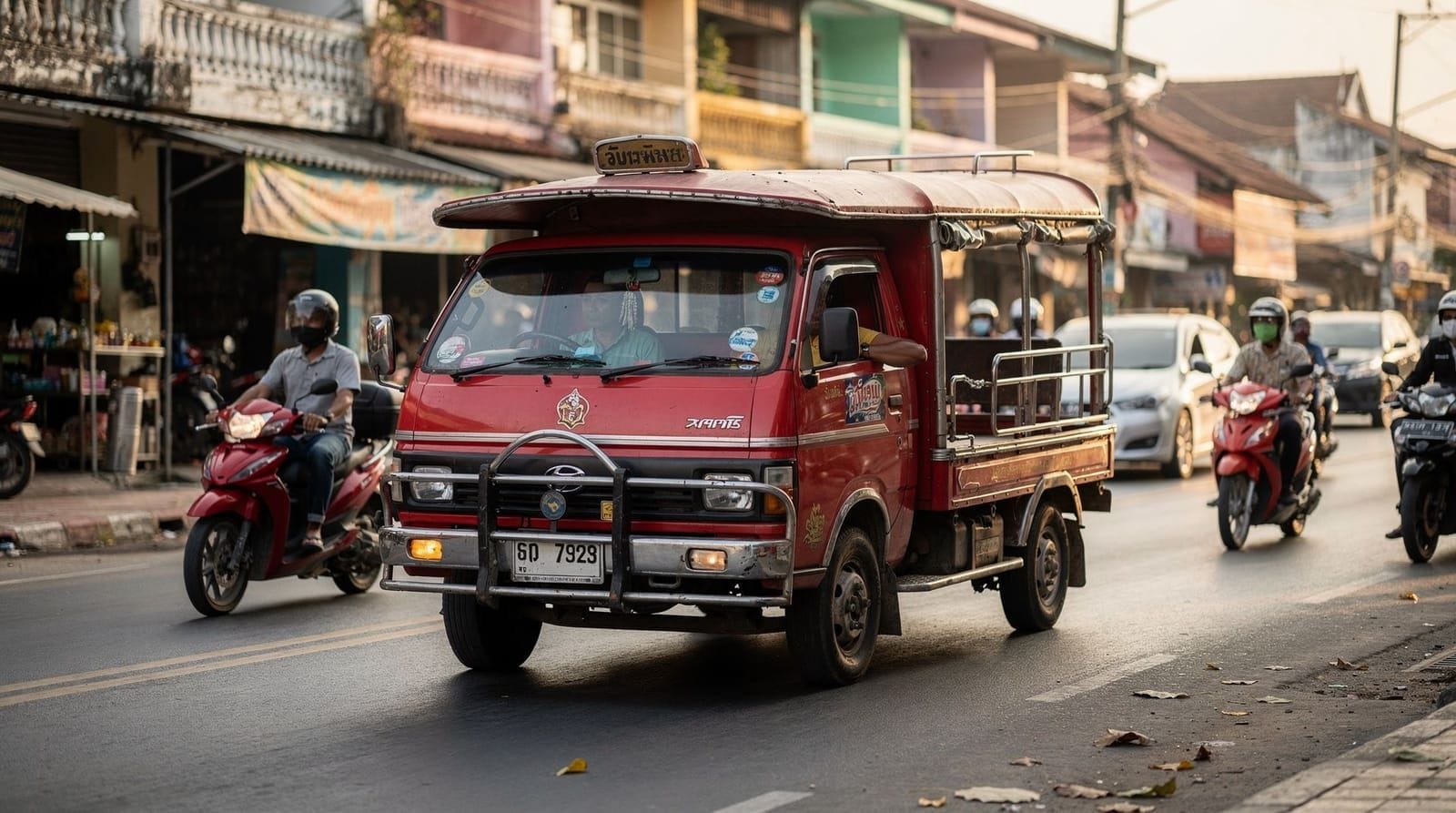
The mechanic: without a meter, songthaew and tuk-tuk fares are negotiated verbally, and drivers sometimes quote a considerably higher price to visibly foreign passengers than what a local would pay for the same route, or claim a different, higher fare on arrival than what was discussed at pickup.
The fix: agree the fare explicitly before getting in, not after, and if a driver claims a different price on arrival than what was agreed, calmly restate the agreed number rather than paying the higher figure under pressure. Grab, which shows the price upfront before you commit to the ride, avoids this issue entirely and is a reasonable default if fare certainty matters more to you than the lower cost a negotiated songthaew ride sometimes offers.
Fake tour and activity booking websites
A less commonly discussed but real risk: unofficial third-party websites, sometimes ranking well in search results or advertised through social media, sell tours and activities (elephant sanctuary visits, cooking classes, day trips) at a markup, sometimes without ever confirming the booking with the actual operator, leaving travelers with a paid confirmation email and no real reservation on arrival. Booking directly through an operator’s own verified channel, or through an established, reputable booking platform with clear cancellation policies and customer support, reduces this risk considerably compared to an unfamiliar site found through a generic search or an unsolicited social media ad.
Fake or unofficial “government” offices
A specific variant worth flagging separately: some shops, particularly gem and jewelry showrooms, display official-looking signage or claim government affiliation to lend false credibility to their pitch. There is no legitimate “government gem store” model in Thailand’s actual retail gem trade, and any shopping recommendation invoking official government endorsement, especially from a stranger or driver, should be treated as a red flag rather than a reassurance.
Overpriced or fake tour and event tickets
Popular, high-demand events, official Yi Peng lantern festival tickets especially, sell out well in advance, creating an opening for resellers and, occasionally, fake listings on unofficial marketplaces or through in-person touts near the Old City. Buying tickets directly through an event’s official channel, and treating unusually cheap or last-minute ticket offers with real skepticism, protects against both overpaying and being sold an invalid ticket. Our Yi Peng lantern festival guide covers this specific pattern in more depth for festival tickets.
ATM skimming and card safety
Card skimming exists in Thailand as it does globally, though it’s not a dominant or especially targeted risk in Chiang Mai specifically. Using ATMs attached to bank branches or located in well-lit, populated areas rather than isolated standalone machines, and covering the keypad when entering your PIN, are reasonable universal precautions. Separately, Thai ATMs charge a standard foreign transaction fee, typically around 220 THB (about 6 USD) per withdrawal, applied uniformly to foreign cards; this is a genuine bank fee rather than a scam, but it’s worth knowing about so it doesn’t read as a suspicious charge when you check your statement. Our money, ATMs, and currency guide covers ways to minimize these fees.
Staged or exaggerated “closing down sale” shops
Some souvenir and clothing shops, particularly around heavily trafficked tourist strips, run permanent or repeatedly-renewed “closing down, everything must go” sale signage designed to create urgency around what are, in reality, ordinary retail prices or in some cases a genuine markup dressed up as a discount. This is a low-stakes, low-harm version of pressure sales rather than an outright scam, but it’s worth recognizing the pattern: a “final sale” that’s been running for months isn’t really a final sale, and comparing prices at a second shop before committing to an urgent-feeling purchase is a reasonable habit. This same instinct, checking a second source before committing under time pressure, applies just as well at markets generally, where haggling is normal and expected rather than a sign of dishonesty; our bargaining etiquette guide covers how to negotiate respectfully without either overpaying or causing offense.
Fake monk donation solicitations
A specific and somewhat delicate scam worth knowing about: individuals dressed in monk robes, sometimes in tourist-heavy areas like the Night Bazaar or around popular temples, approach visitors asking for donations or offering a blessing in exchange for money. Genuine Thai monks are, by monastic rule, generally not permitted to solicit donations directly from passersby on the street in this way; legitimate temple donations are made at donation boxes within temple grounds or through recognized merit-making ceremonies. This doesn’t mean every monk you encounter on the street is fraudulent, monks do walk to receive alms in the early morning as part of a genuine, different tradition (tak bat), but an unsolicited approach specifically asking for cash donations away from a temple context is a recognized pattern worth treating cautiously.
The overly friendly stranger pattern, in general
It’s worth naming the pattern underlying several of the scams above explicitly, since recognizing it in the moment matters more than memorizing every individual variant: an unusually friendly, well-spoken stranger initiates conversation with a tourist, builds rapport over several minutes of genuinely pleasant small talk, and only then introduces a specific recommendation, a gem shop, a tailor, a “must-see” alternative attraction. The friendliness itself is usually genuine in tone even when the underlying motive is commission-driven, which is part of what makes this pattern effective; it doesn’t feel like being scammed while it’s happening. Treating any unsolicited recommendation from a new acquaintance, however pleasant the conversation, as a prompt to independently verify rather than act on immediately is the most broadly useful habit from everything in this guide.
What to do if something does go wrong
For a significant financial loss or a serious dispute, Thailand’s Tourist Police, reachable at the dedicated line 1155, handle exactly this category of complaint and typically have English-speaking staff experienced with the specific scams covered above. For smaller disputes, a motorbike deposit disagreement especially, calmly citing your own timestamped before-and-after photo evidence is often sufficient to resolve things without needing to escalate further. Keeping a simple written or photo record of agreed prices, rental conditions, and any ticket or booking confirmations as you go makes any of these conversations considerably easier if a dispute does arise.
A quick pre-trip checklist
Before you land, a short list of habits covers most of what’s above without requiring you to memorize every individual scam: save the Tourist Police number (1155) in your phone; agree transport fares before riding or default to Grab; decline any unsolicited shopping, tailor, or gem recommendation regardless of who suggests it; photograph any rented vehicle thoroughly before and after use; and book tours, festival tickets, and activities directly through verified operator channels rather than unfamiliar third-party sites. None of these habits require ongoing vigilance or a suspicious mindset throughout your trip, they’re a five-minute setup that covers the overwhelming majority of scam patterns documented in Chiang Mai specifically.
The broader pattern worth remembering
Nearly every scam covered here shares one structural feature: it routes you toward an unsolicited third party, a shop, a ticket reseller, an alternative destination, introduced by someone other than a source you sought out yourself. That single pattern, an unprompted suggestion from a stranger, driver, or unofficial reseller, is worth treating as an automatic prompt for extra scrutiny regardless of how the specific pitch is dressed up. Our broader Chiang Mai tourist traps guide covers the related category of experiences that aren’t outright scams but still don’t deliver what they promise, worth reading alongside this guide for the fuller honest-planner picture.
Keeping this in perspective
It bears repeating at the close of this guide what was said at the start: the overwhelming majority of Chiang Mai visits pass without any scam-related incident whatsoever, and the specific patterns covered above are worth knowing precisely so you can stop thinking about them, recognize the handful of situations that warrant a polite decline, and spend the rest of your trip enjoying the city without a background hum of suspicion toward every friendly stranger you meet.
Frequently asked questions about Chiang Mai scams
How do I know if a tuk-tuk driver is running a scam?
The clearest tell is an unprompted claim that your destination is closed, followed by an alternative suggestion, almost always a shop that pays commission. Legitimate drivers rarely volunteer this kind of unsolicited itinerary change. If it happens, politely decline and ask to continue to your original destination, or simply get out and find another ride if the driver won’t comply.
What should I do before renting a motorbike to avoid a deposit dispute?
Photograph and video every existing scratch, dent, or damage on the bike from multiple angles, with a timestamp visible if your camera supports it, before you ride off, and repeat the same process at return before handing back the keys. Choose a rental shop with visible reviews specifically mentioning fair deposit returns, and read the rental agreement for what happens to your deposit or passport if a dispute arises.
Are Grab and metered transport safer than tuk-tuks and songthaews?
Generally yes for fare certainty, since Grab shows the price upfront and songthaews and tuk-tuks are negotiated verbally with no meter in most cases. That doesn’t mean tuk-tuks and songthaews are unsafe to use, they’re a normal and often cheaper part of getting around, just that agreeing a fare before you get in, rather than after, avoids almost all fare-related disputes.
What’s the safest way to buy gems or jewelry in Thailand?
Through an established, independently reviewed jewelry retailer you’ve sought out yourself, ideally with a return policy and, for anything significant, an independent gemological certificate. Never through an unsolicited stranger’s recommendation, a tuk-tuk driver’s suggestion, or a “government sale” framing, all of which are consistent hallmarks of the classic gem scam rather than a legitimate deal.
Is it safe to use ATMs in Chiang Mai?
Generally yes, but as anywhere, using ATMs attached to banks or in well-lit, populated areas rather than isolated standalone machines reduces skimming risk, and covering the keypad when entering your PIN is a sensible habit regardless of location. Thai ATMs also charge a foreign transaction fee (typically around 220 THB, about 6 USD, per withdrawal) that’s worth budgeting for rather than a scam, since it applies uniformly to all foreign cards.
What should I do if I think I’ve been scammed?
For a significant financial loss, report to the Tourist Police (dial 1155, a dedicated tourist-focused police line with English-speaking staff), who handle exactly this kind of complaint regularly and can sometimes assist with mediation or recovery. For smaller disputes, like a motorbike deposit, calmly citing your own before-and-after photo evidence is often enough to resolve things without escalation.