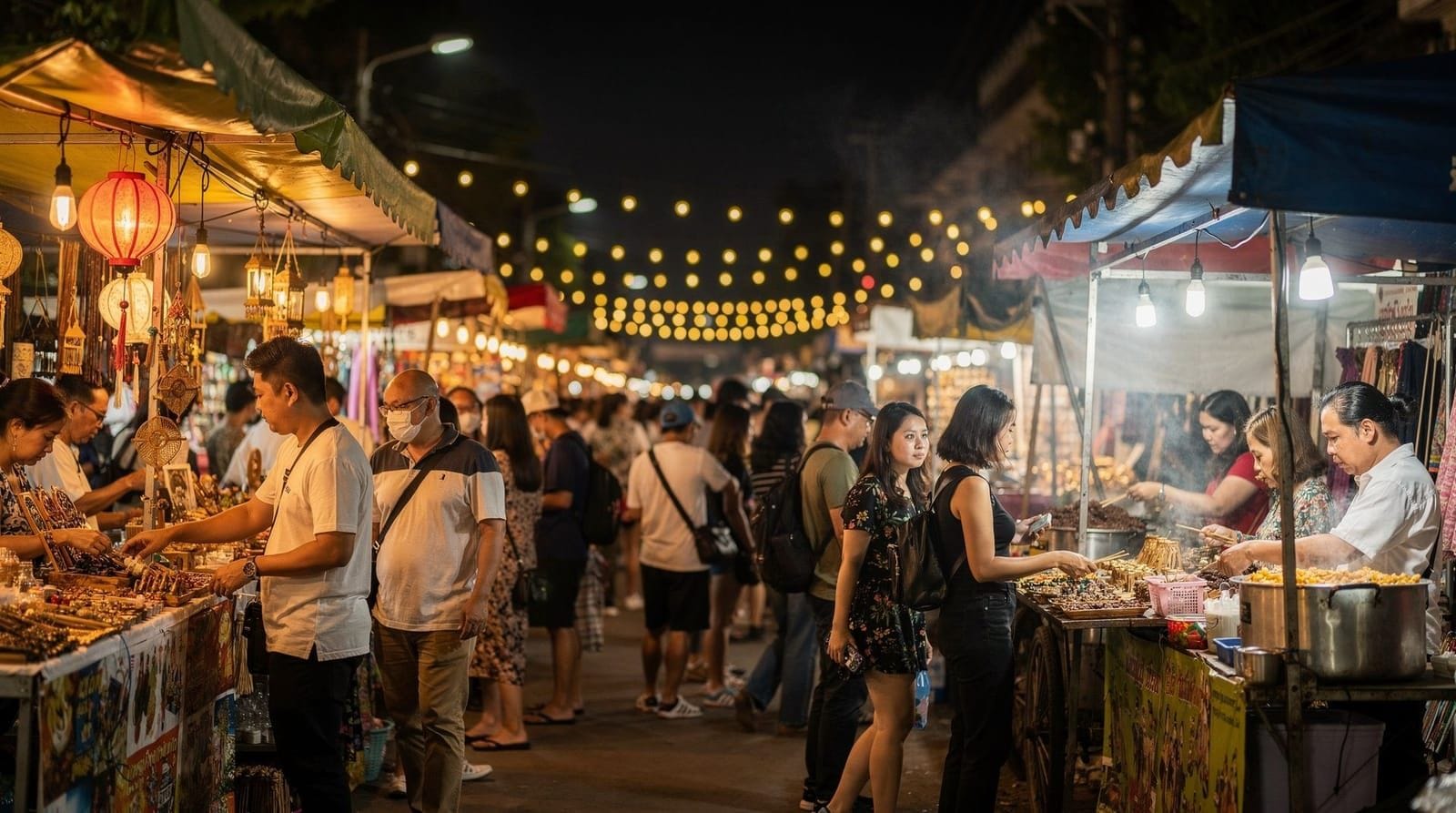
Bargaining etiquette at Chiang Mai's markets
How much should I expect to get off the first price at a Chiang Mai market?
Roughly 10-30% off the first quoted price is realistic at craft, clothing and souvenir stalls, achieved through a polite counter-offer rather than an aggressive back-and-forth. Food stalls, restaurants and any shop inside a mall have fixed prices and are not part of this custom at all.
Bargaining is one of the first things visitors ask about before their first Chiang Mai market visit, usually out of a fear of either overpaying badly or offending a vendor by haggling too hard. Neither fear should stop you — it’s a well-understood, low-stakes custom at Chiang Mai’s craft and souvenir stalls, with clear enough norms that a few practical guidelines cover almost every situation you’ll actually encounter.
Quick answer: expect roughly 10-30% off the first quoted price at market stalls selling crafts, clothing and souvenirs, achieved through a polite counter-offer rather than an aggressive back-and-forth. Food stalls, sit-down restaurants and anything inside a mall run fixed prices and simply aren’t part of this custom — trying to haggle there reads as unfamiliarity rather than savvy.
Where bargaining applies, and where it doesn’t
This is the distinction most first-time visitors get wrong, and getting it wrong in either direction causes an awkward moment. Bargaining is normal and expected at stalls selling handicrafts, clothing, souvenirs, jewelry and general goods across the Night Bazaar, Sunday Walking Street and Saturday Walking Street. It does not apply to food — a bowl of khao soi or a skewer of grilled meat at any of these markets, or at Warorot Market, has a fixed, well-known price that regulars and vendors both treat as non-negotiable. It also doesn’t apply inside malls like Central Festival or MAYA, at 7-Eleven or other convenience stores, or at sit-down restaurants with printed menus. If a price is printed or posted, that’s your signal to pay it rather than negotiate.
A realistic discount range
For most craft, clothing and souvenir purchases, landing 10-30% below the first quoted price through a single round of polite negotiation is a realistic outcome — not a rock-bottom “insider” price, just a fair one that reflects the fact that first quotes to visitors are routinely set with negotiation room built in. Higher discounts are sometimes possible on larger purchases or when buying multiple items from the same vendor, since volume gives you more leverage than a single small item does. Treat anything beyond 30-40% off as unusually good rather than the expected baseline, and don’t feel you’ve failed if a vendor holds firm closer to their original price on something clearly handmade or labor-intensive.
How to actually do it
A simple, low-pressure sequence works in almost every situation: ask the price, receive the first quote, and respond with a friendly counter-offer somewhere around 50-60% of that number, expecting to meet in the middle after one or two rounds of back-and-forth. Tone matters more than technique — a relaxed, smiling counter-offer, sometimes accompanied by a laugh at an especially high opening quote, lands far better than a serious or confrontational one. A calculator (on a phone or a physical one many vendors keep on hand) is a genuinely useful tool for negotiating across a language gap, since typing a counter-number sidesteps any confusion about spoken figures.
When walking away actually works
Walking away from a stall after a counter-offer isn’t accepted is a legitimate tactic, and vendors sometimes call out a better price as you leave. But it only works, and only feels honest, if you’re genuinely willing to leave without the item — using it as a manipulative pressure tactic on something you clearly want and intend to come back for tends to be transparent to the vendor and can sour the interaction rather than improve your price. If a piece is a specific, hard-to-replace find (an original painting, a particular handmade silver design), walking away risks losing it entirely rather than a guaranteed better deal.
Adjusting your approach by market
Tone and expected firmness shift somewhat by venue. Sunday and Saturday Walking Street both draw a genuine mix of local and visiting shoppers, which tends to keep pricing and negotiation more grounded and relaxed — vendors are used to Thai customers bargaining too, not just tourists. The Night Bazaar’s more heavily tourist-facing stalls sometimes open at a higher first quote specifically because the customer base skews toward visitors less familiar with local pricing, which means a firmer, more deliberate counter-offer can be worthwhile there. None of this changes the basic etiquette — friendly, unhurried, willing to walk away — just the expected starting gap between quote and fair price.
Bargaining for higher-value or handmade items
Silver jewelry and homeware, particularly from workshop-front stalls at Saturday Walking Street on Wualai Road, deserve a gentler approach than a mass-produced magnet or T-shirt. Craftspeople selling genuinely handmade, labor-intensive pieces tend to hold firmer on price, and pushing hard for a steep discount on something with real material and skill behind it reads differently than haggling over a stack of identical keychains. A fair negotiation here means acknowledging the craftsmanship rather than treating every stall as an identical opportunity for maximum discount. The same logic applies to original artwork at Sunday Walking Street — asking about the piece and the artist, rather than opening straight into a hard bargain, tends to produce both a better interaction and a more reasonable price.
What good etiquette actually looks like
Beyond the mechanics of price, a few habits separate a pleasant negotiation from an awkward one. Smiling and keeping the tone light throughout signals that you’re engaging in a normal, low-stakes custom rather than a confrontation. Comparing prices across two or three stalls selling similar items before committing to a purchase — completely normal and expected — gives you a realistic sense of the going rate without needing to negotiate hard at every single stop. And once you’ve agreed on a price verbally, following through and paying it is important; backing out after a vendor has accepted your counter-offer, or continuing to push for an even lower number after agreement, crosses from normal bargaining into bad etiquette.
Common mistakes to avoid
A handful of habits reliably produce a worse negotiation than the norms above. Opening with an insultingly low counter-offer — a tenth of the quoted price, for instance — tends to shut down a friendly negotiation before it starts rather than signal savvy bargaining. Continuing to push for a lower price after a vendor has already agreed to your counter-offer is widely seen as poor etiquette; once a number is agreed verbally, following through and paying it is expected. And comparing a Chiang Mai market price directly to home-country retail prices, then treating any local price as too high, misreads the whole exercise — the point is a fair local price, not a rock-bottom one measured against a different economy entirely.
Bargaining as part of the local shopping culture
It’s worth remembering that bargaining isn’t a performance staged for visitors — Thai shoppers negotiate at these same stalls, particularly at Sunday and Saturday Walking Street where the crowd genuinely mixes local and visiting customers. Approaching it as a normal, slightly playful part of shopping, rather than either an intimidating skill to master or an opportunity to extract the lowest possible number, tends to produce both a fairer outcome and a more pleasant interaction on both sides. Most vendors who deal with this daily are entirely comfortable with the process and don’t take a reasonable counter-offer personally, even when it doesn’t result in a sale.
Why this custom exists, briefly
Bargaining at Thai markets isn’t a leftover oddity or a game staged for foreign visitors — it reflects a genuinely flexible, relationship-based approach to small-scale retail that predates mass tourism and remains part of how many Thai shoppers themselves interact with market vendors. First quotes at informal stalls have traditionally carried negotiation room built in, partly because vendors don’t have the fixed overhead of a formal retail business and can adjust based on the specific interaction, the size of the sale, and how the conversation goes. Understanding it this way — as a normal commercial custom rather than something unique to tourist interactions — helps set the right tone: relaxed and transactional, not adversarial.
When it’s better not to bargain at all
There are moments where skipping the negotiation entirely is the more considerate choice, even at a market stall where haggling is technically the norm. Buying something small from an elderly vendor, or from someone clearly making a modest living from a single folding table, is a reasonable case for simply paying the asked price if it’s already fair rather than squeezing out the last 10-20% for its own sake. Bargaining exists to arrive at a fair price, not to extract the maximum possible discount regardless of context — reading the specific situation, not just applying a fixed formula, is part of doing this well.
Bargaining etiquette for first-time visitors specifically
If this is your first experience with market bargaining anywhere, not just in Chiang Mai, it’s worth knowing that the fear of doing it wrong is almost always bigger than the actual risk. Vendors accustomed to visitors have seen every level of bargaining skill and comfort, from confident negotiators to visibly nervous first-timers, and respond to both with the same basic patience as long as the interaction stays friendly. Starting with a smaller, lower-stakes purchase — a printed textile or a small paper good rather than an expensive silver piece — is a reasonable way to build comfort with the custom before attempting to negotiate on something more significant later in the trip.
What changes when buying from a fixed-price shop instead
It’s worth noting that not every Chiang Mai retail interaction follows market rules, and mixing up the two contexts is a common visitor mistake. Boutiques, branded shops, and increasingly some higher-end craft galleries operate with fixed, marked prices even outside the mall environment, and attempting to bargain there can come across as out of place. A simple visual cue helps: stalls with handwritten or verbally quoted prices are almost always negotiable; shops with printed price tags, barcodes, or a cash register rather than a cash box are almost always not, regardless of whether they’re inside a market complex or a standalone building.
Reading a vendor’s opening price
With a little practice, it becomes possible to gauge roughly how much room a vendor has built into a first quote. Items that are clearly mass-produced and available identically at multiple stalls (magnets, printed T-shirts, keychains) tend to carry the most padding, since the vendor’s own cost is low and volume matters more than any single sale. Items that appear genuinely handmade or unique — an original painting, a specific silver design, a large woodcarving — tend to have less padding relative to the asking price, since the vendor’s cost and time investment is real rather than negligible. Adjusting your counter-offer accordingly, pushing harder on the former and more gently on the latter, tends to produce fairer outcomes on both sides than applying a flat discount expectation to every purchase.
Bargaining across a language barrier
Language is rarely the actual obstacle it might seem, since numbers and a calculator carry a negotiation the whole way through without needing shared vocabulary at all. Pointing at an item, holding up fingers or typing a number, and letting a calculator display go back and forth is a completely normal, well-understood way to negotiate at any Chiang Mai market, used daily between vendors and visitors from dozens of different language backgrounds. If a vendor seems confused by a spoken number, switching immediately to the calculator resolves it faster than repeating the same word more slowly or loudly, which rarely helps.
Group buying and multi-item discounts
Buying more than one item from the same vendor is one of the more reliable ways to improve on a single-item discount, since it gives the vendor a bigger total sale to work with rather than asking them to absorb a discount on one small purchase. This works particularly well at stalls selling textiles, jewelry or small craft items where buying two or three pieces, even different designs, as a bundle often unlocks a better per-item price than negotiating each one separately. It’s a genuinely useful tactic for travelers shopping for multiple gifts rather than a single souvenir for themselves.
A few phrases that help
You don’t need Thai to bargain effectively, but a few words go a long way toward a friendlier interaction: “tao rai” (เท่าไหร่, “how much”) to open, and “lot dai mai” (ลดได้ไหม, “can you reduce it”) as a polite way to signal you’d like a better price without demanding one outright. Most vendors accustomed to visitors respond just as readily to English, especially paired with a calculator for the actual numbers, so treat any Thai phrases as a nice-to-have that shows effort rather than a requirement for a fair price.
Frequently asked questions about bargaining in Chiang Mai
Is it rude to bargain in Chiang Mai?
No, it’s normal and expected at market stalls specifically, as long as it’s done politely. It becomes rude only when pushed too far or done with visible frustration over a small sum.
Where should I never try to bargain?
Food stalls, sit-down restaurants, malls, convenience stores and anywhere with a printed, fixed price — all of these run non-negotiable pricing.
What’s a good opening counter-offer?
Starting around 50-60% of the first quoted price is common, expecting to meet somewhere in the middle after a round or two of friendly back-and-forth.
Do vendors expect me to walk away if I don’t like the price?
Sometimes, and it can work if you’re genuinely willing to leave. Used as a pressure tactic on something you clearly want, it tends to backfire or read as insincere.
Does bargaining work the same at every market?
Roughly, though the Night Bazaar’s more tourist-facing stalls sometimes open higher, while Sunday and Saturday Walking Street’s mixed local-visitor crowd keeps pricing generally more grounded.
Is it okay to bargain in English?
Yes, most vendors dealing with visitors handle basic price negotiation in English, often with a calculator to show numbers.
Should I bargain for silver or handmade items differently?
Yes, more gently — genuinely handmade, labor-intensive pieces from workshop-front craftspeople deserve a softer approach than mass-produced souvenirs.
What discount range is realistic overall?
10-30% off the first quoted price for most craft and souvenir purchases, with anything beyond 30-40% being an unusually good outcome rather than the norm.