Thai silk weaving in Chiang Mai: the process and where to watch it
Chiang Mai Thai Dress & Doi Suthep Cultural Tour
Where can I watch silk actually being made in Chiang Mai, and how do I buy the real thing?
Workshops along the San Kamphaeng crafts road demonstrate the full process from silkworm cocoons through dyeing and loom weaving, with finished scarves and fabric sold on-site. Genuine Thai silk shows a slightly irregular, slubbed texture and a distinctive two-tone sheen that shifts color depending on the viewing angle - features that machine-made synthetic imitations rarely replicate convincingly.
Silk scarves and fabric are among the most commonly purchased souvenirs in Chiang Mai, and also among the easiest to overpay for or be sold a synthetic imitation of if you don’t know what you’re looking at. This guide covers the part most souvenir shopping doesn’t: how silk is actually made, from a mulberry silkworm’s cocoon to a finished woven scarf, where in Chiang Mai you can watch that full process happen, and the practical checks that separate genuine hand-woven silk from a machine-made look-alike.
Quick answer: Workshops along the San Kamphaeng crafts road demonstrate the full silk-making process from cocoon through dyeing and loom weaving, with finished pieces sold on-site. Genuine Thai silk shows a slightly irregular, slubbed texture and a distinctive two-tone sheen that shifts color depending on viewing angle - features a machine-made synthetic imitation rarely replicates convincingly.
From silkworm to thread: how silk is actually made
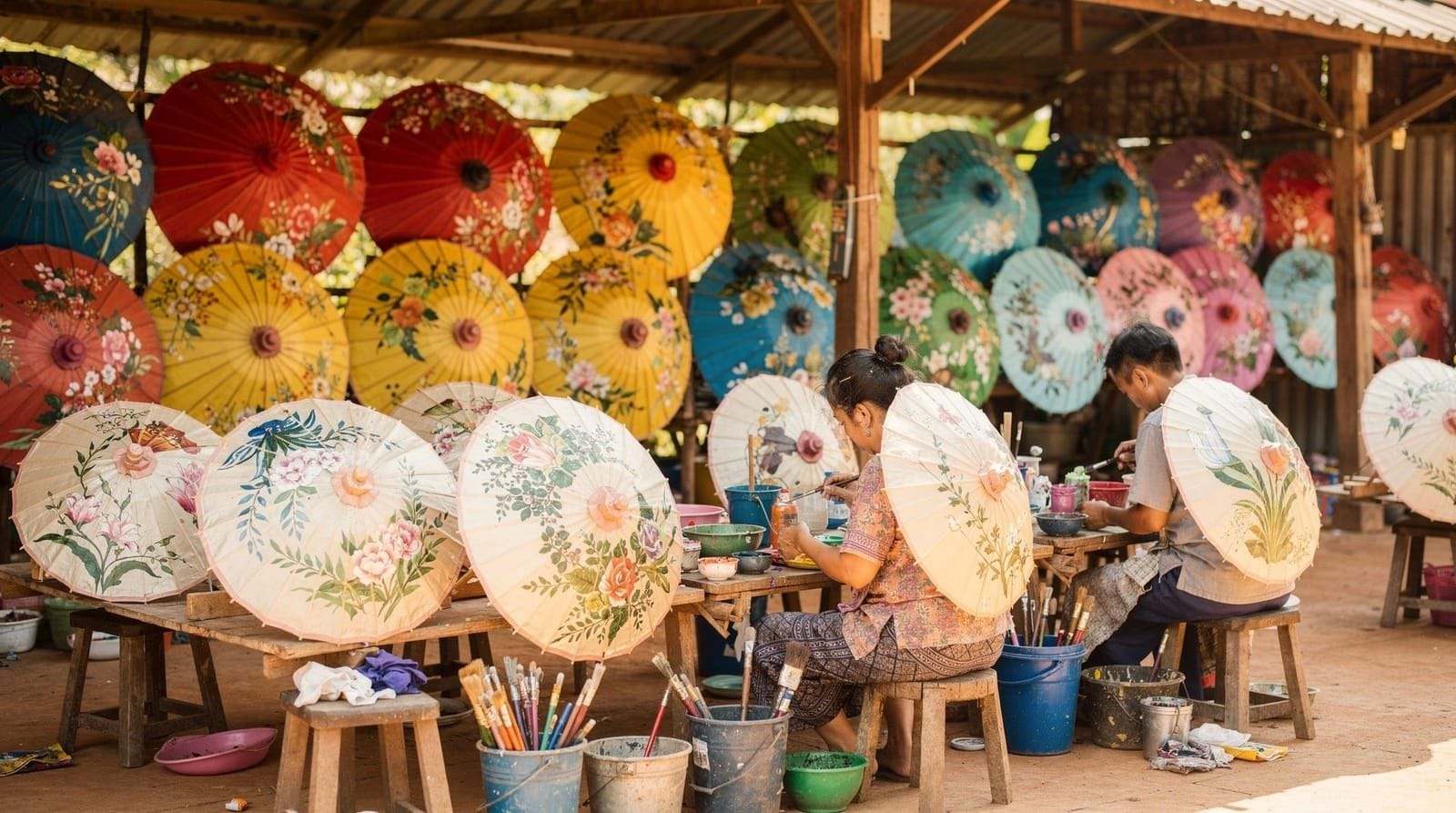
Silk begins with the domesticated silkworm (the larva of the silk moth), raised specifically on a diet of mulberry leaves - the same mulberry tree, incidentally, whose bark supplies the sa paper used in Bo Sang’s umbrella craft, a small but genuine overlap between two of the region’s signature materials. Each silkworm spins a single continuous protein filament around itself to form a cocoon, and it’s this filament, unwound rather than spun from short fibers the way cotton or wool are, that gives silk its distinctive strength and sheen.
To extract the filament, cocoons are boiled in water, a process that loosens sericin, the natural gum holding the filament’s structure together, and allows the thread to be reeled off in a continuous strand. Traditional Thai silk production is generally associated with a double-boiling technique, which preserves a degree of natural irregularity in the resulting thread rather than smoothing it into perfect uniformity - this irregularity is a defining, recognizable feature of genuine Thai silk fabric rather than a flaw. Several individual filaments are twisted together into a usable weaving thread, since a single cocoon’s filament alone is far too fine to weave with directly.
Dyeing: natural and synthetic methods
Once reeled, silk thread is dyed before weaving, using either traditional natural dyes - derived from plants, bark, and other organic sources, producing the earthier, more muted color palette associated with traditional Lanna textiles - or modern synthetic dyes, which allow a far broader and more consistent color range at generally lower cost. Both methods are in active use across Chiang Mai’s silk workshops today; natural dyeing tends to feature more prominently in higher-end or specifically traditional-styled pieces, while synthetic dyeing dominates mass-market, brightly colored scarves and yardage aimed at a wider price range of buyers.
Weaving: the loom process
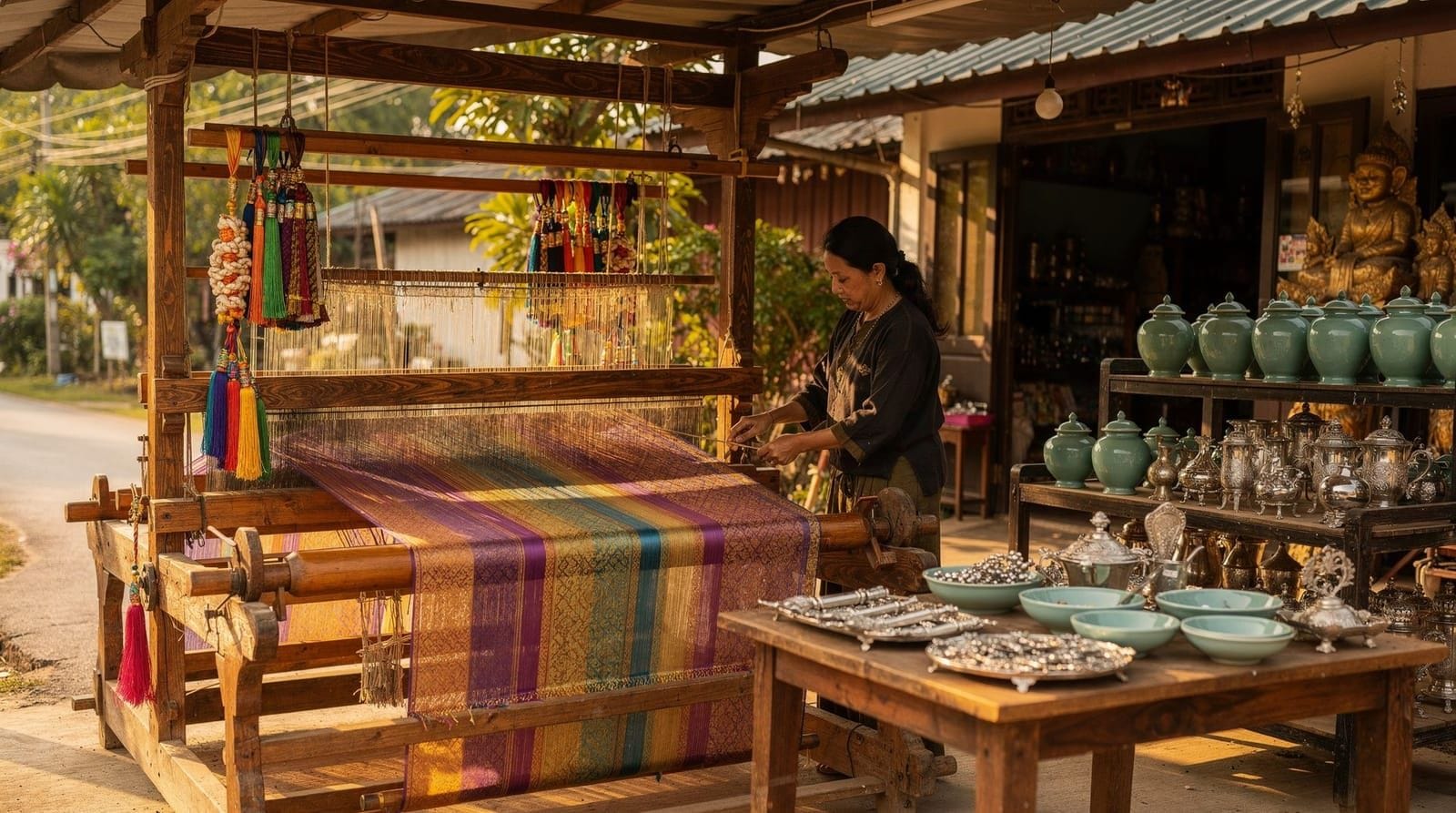
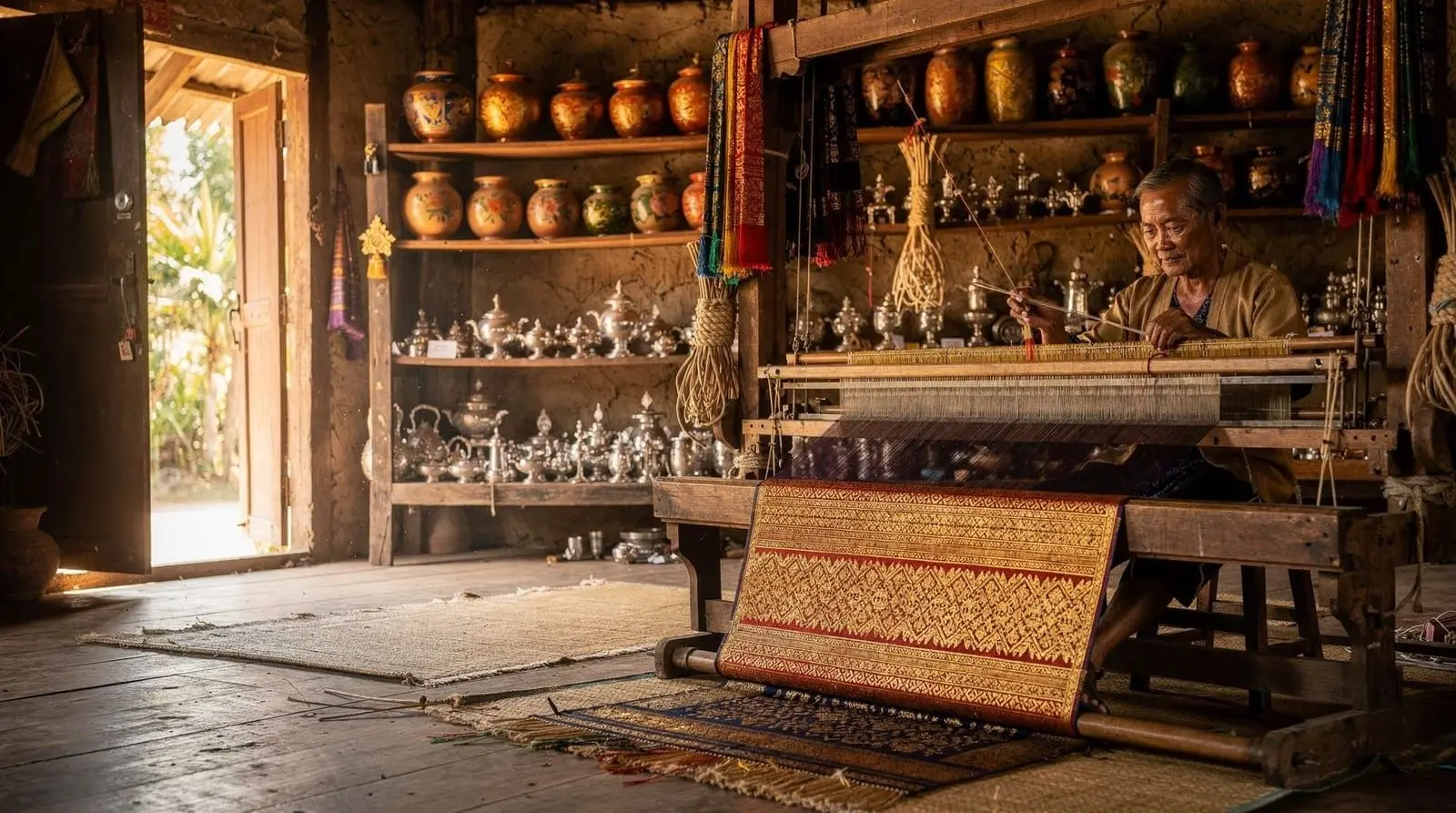
Dyed thread is woven into finished fabric on a loom, a process most San Kamphaeng crafts-road workshops demonstrate directly for visitors. Traditional Thai silk weaving often incorporates supplementary weft or ikat-style resist-dyeing techniques to create patterned fabric, in which sections of thread are dyed before weaving according to a planned design, so that the pattern emerges as the weaving progresses rather than being printed onto finished cloth afterward - a technically demanding approach that adds considerably to a piece’s value compared to a plain-woven or printed equivalent.
Watching a weaver work a loom is, for many visitors, the single most rewarding part of a crafts-road stop: the rhythmic combination of foot-operated treadles and hand-thrown shuttle is visually clear even without narration, and the contrast between the raw, dull-looking dyed thread on the loom and the lustrous finished fabric coming off it is a genuinely striking thing to watch develop in real time.
A brief history of silk in northern Thailand
Silk production in the Lanna region developed over centuries as a household and village-scale craft, closely tied to the broader agricultural cycle - mulberry cultivation for silkworm feed, silk-raising as a supplementary activity alongside rice farming, and weaving traditionally done by women within the household rather than in a dedicated commercial workshop. As with several of the region’s other craft traditions, silk weaving’s shift toward a visitor-facing commercial format along routes like San Kamphaeng is a more recent development layered on top of that older, genuinely domestic craft history, rather than something invented purely for tourism.
Traditional northern Thai silk patterns and weaving techniques - including supplementary weft and various regional motifs - reflect this local household history, distinct from but related to the weaving traditions found in other parts of Thailand and neighboring Laos, where similar techniques developed along broadly comparable lines given shared agricultural conditions and cultural exchange across the region.
What to actually buy: scarves, yardage or ready-made pieces
Beyond simply choosing a color, it’s worth thinking about which format of silk purchase actually suits your needs.
- Scarves are the easiest, most travel-friendly purchase, typically 200-500 THB for simpler pieces, considerably more for larger or more intricately patterned designs, and require no further tailoring to use.
- Silk yardage (uncut fabric by the meter) suits visitors planning to have clothing tailored, either in Chiang Mai itself or back home, and pricing scales with thread quality and weave pattern complexity rather than a flat per-meter rate.
- Ready-made silk clothing and accessories - blouses, ties, small bags - offer a middle ground between a simple scarf and a full tailoring project, though quality and fit vary enough between workshops that trying a piece on, where possible, is worth doing before buying.
Book the Lanna Thai dress and Doi Suthep cultural tour if you’d like to actually wear traditional northern Thai dress - much of it silk or silk-blend fabric - as part of a guided cultural day, rather than only buying fabric to take home.
Northern Thai silk versus Thailand’s more famous silk regions
It’s worth being direct about where Chiang Mai’s silk tradition sits relative to Thailand’s silk industry as a whole. The country’s most internationally famous silk region is generally associated with the northeast (Isaan), particularly towns like Chonnabot, a reputation substantially built by the mid-20th-century revival led by the American businessman Jim Thompson. Northern Thai silk has its own separate regional history and weaving patterns, generally reflecting Lanna’s own textile traditions and color preferences rather than directly copying the northeast’s style. Neither tradition is objectively “better” - they represent genuinely different regional textile histories - but if you’ve specifically heard of Thai silk’s global reputation before visiting, know that the fame is more commonly tied to the northeast than to Chiang Mai specifically, even though the north’s silk craft is equally genuine and worth seeing in its own right.
Buying silk honestly: spotting the real thing
A few practical checks help you judge whether a piece is genuine silk before you buy.
- Texture and irregularity. Run your fingers across the fabric - genuine Thai silk typically shows a slightly uneven, slubbed texture from the natural thread-reeling process, rather than the perfectly smooth, uniform surface typical of synthetic imitations.
- The two-tone sheen. Hold the fabric at different angles to the light - authentic silk often shows a subtle color shift or iridescence depending on viewing angle, a property synthetic substitutes rarely reproduce convincingly.
- The burn test. The most definitive check, and one reputable shops will demonstrate on a fabric scrap if asked directly: genuine silk burns slowly, self-extinguishes when the flame is removed, smells distinctly like burning hair, and leaves behind a fine, crushable ash. Synthetic fibers instead melt, smell like burning plastic, and form a hard bead of melted material rather than ash.
- Price as a rough signal, not proof. Genuine hand-woven silk, particularly anything using natural dyes or patterned weaving techniques, generally costs more than a plain, brightly colored synthetic scarf - a suspiciously low price on a piece marketed as genuine silk is worth treating with some skepticism.
Where to watch silk weaving in Chiang Mai
The San Kamphaeng crafts road, east of the city along Route 1006, is the most reliable place to see the full process - several workshops there demonstrate reeling, dyeing and loom weaving side by side, with an attached showroom selling finished scarves, fabric and clothing. Our San Kamphaeng crafts road route guide covers how to sequence a visit here alongside the road’s celadon and silverware workshops if silk is just one part of a broader craft-touring day.
Book the silver craftwork temple tour with a monk meeting if you’d like a guided version of a crafts-road stop that touches on the region’s textile and metalworking traditions alongside a temple visit, since several operators combine multiple craft demonstrations from the same general corridor into a single guided day.
Silk’s place in Chiang Mai’s wider craft economy
Silk weaving doesn’t exist in isolation from Chiang Mai’s other craft traditions - it sits alongside celadon pottery and silverwork on the same San Kamphaeng crafts road, and traditional silk clothing connects directly to the broader Lanna cultural identity covered in our Lanna culture explained guide, where regional dress, dialect and cuisine all form part of the same distinct northern Thai identity. Visitors interested in the full craft picture rather than silk alone are well served by treating a silk-workshop stop as one piece of a broader crafts-road day rather than a standalone destination - our Chiang Mai crafts guide lays out how the region’s five main craft traditions fit together geographically and practically.
Silkworm farming versus wild silk
Most of the silk produced and sold in the Chiang Mai area comes from domesticated silkworms raised specifically for silk production on a controlled diet of mulberry leaves, a practice generally called sericulture. This differs from wild silk, harvested from silkworm species that feed on other plants in a less controlled setting, which tends to produce a coarser, less uniform thread and is considerably less common in the region’s commercial silk trade. If a workshop specifically markets a piece as “wild silk” or from a particular silkworm species, it’s worth asking directly what that means for the fabric’s texture and durability, since the terminology isn’t always used consistently across different sellers.
Caring for silk after you buy it
Genuine silk needs gentler handling than most everyday fabric. Hand-washing in cool water with a mild, silk-appropriate detergent, or dry cleaning for anything structured or lined, is the safer approach compared to a standard washing machine cycle, which can damage the fiber’s structure and dull its characteristic sheen over time. Direct sunlight over extended periods can fade silk’s colors, particularly natural dyes, so storing pieces away from continuous strong light when not in use helps preserve both color and the fabric’s condition for years rather than a single season.
Frequently asked questions about Thai silk weaving in Chiang Mai
Can I see silkworms themselves, not just the finished weaving process?
Some workshops along the San Kamphaeng crafts road keep live silkworms and cocoons on display as part of the demonstration, showing the full cycle from insect to thread, though the exact setup varies by workshop - it’s worth asking specifically if seeing the silkworms themselves matters to you.
Is natural-dye silk always more expensive than synthetic-dye silk?
Generally yes, since natural dyeing is a more labor-intensive and less consistent process than synthetic dyeing, though the exact price gap depends heavily on the specific dye, thread quality and weave complexity of a given piece.
Can I take a silk-weaving class rather than just watching?
Some workshops along the crafts road offer short hands-on weaving demonstrations or simplified lessons for visitors, though a full loom-weaving skill takes far longer than a single visit to properly learn - most visitor-facing “classes” are an introduction to the technique rather than a path to real proficiency.
How do I pack silk for travel without damaging it?
Roll rather than fold silk scarves and fabric where possible, since folding over time can create permanent creases, and keep pieces away from direct contact with rougher fabrics or sharp objects in your luggage that could snag the delicate fiber.
Is Chiang Mai silk good value compared to buying silk at home?
Often yes, particularly for hand-woven, natural-dye pieces, since labor costs in Thailand are considerably lower than in most Western textile markets - buying directly from a workshop that demonstrates its own production also lets you verify quality and authenticity in a way that’s harder to do from a shop shelf back home.
What’s the difference between silk yardage price and a finished scarf’s price?
Yardage is generally priced by the meter and reflects raw material and weaving cost alone, while a finished scarf’s price includes the cutting, hemming and any additional embellishment, meaning a comparable amount of fabric often costs somewhat more once it’s been made into a finished, ready-to-use item.
Do all silk workshops on the crafts road offer the same quality?
No - quality, weave complexity and authenticity vary meaningfully between individual workshops, some being genuinely small family operations and others larger, more commercially oriented showrooms. Comparing a couple of stops before a significant purchase is worthwhile, the same principle that applies across all of Chiang Mai’s craft-shopping destinations.
Is it worth buying silk if I’m not planning to wear traditional dress?
Yes - silk scarves, ties and yardage for modern tailoring are all practical, versatile purchases that don’t require any interest in traditional Lanna clothing specifically, even though the fabric itself shares the same production tradition covered throughout this guide.