Baan Tawai woodcarving village
A handicraft village south of Chiang Mai built around teak carving, antiques and furniture showrooms — wholesale-scale shopping, best with polite
Chiang Mai: Local Stay, Woodcarving Class, Cooking & Massage
Duration: Multi-day
Quick facts
- Getting there
- Just south of Hang Dong town, ~18-20 km south of Chiang Mai's Old City; Grab or car ~30-35 min
- Key sight
- Rows of woodcarving and furniture showrooms, working carving workshops, antique and home décor shops
- Time needed
- 1.5-3 hours depending on how much shopping you plan to do
- Best time
- Weekday mornings for quieter showrooms and unhurried bargaining; year-round destination (mostly indoor/covered)
- Typical cost
- Browsing is free; small carved souvenirs from roughly 100-500 THB (~$3-14), furniture and large pieces considerably more and often shippable
Baan Tawai is Thailand’s best-known woodcarving village, and walking its main strip makes that reputation obvious within minutes — showroom after showroom of carved teak furniture, decorative panels, antiques, and home décor, backed by workshops where the carving itself still visibly happens rather than being outsourced somewhere out of sight. It’s less a single attraction than a shopping district built entirely around one craft, and it rewards visitors who come with either a genuine interest in the woodworking or an actual shopping list — less so those expecting a quick, single photogenic stop.
Quick answer: Baan Tawai sits just south of Hang Dong town, about 18-20 km (30-35 minutes by Grab or car) south of Chiang Mai’s Old City. It’s a village-scale cluster of woodcarving and handicraft showrooms — furniture, carved décor, antiques, and smaller souvenirs — with some workshops where you can watch carving in progress. Most visitors spend 1.5 to 3 hours browsing; small souvenirs run roughly 100-500 THB (~$3-14), while furniture and larger pieces are priced individually and often shippable internationally. Showroom scale skews toward wholesale-style browsing rather than a quaint boutique feel, so polite bargaining is expected on larger purchases.
What Baan Tawai actually is
Baan Tawai grew from a genuine local woodcarving tradition into what’s now a large, semi-formalized handicraft market, with dozens of individual shops and showrooms lining the village’s main roads, most specializing in some combination of the following:
- Carved teak furniture — cabinets, tables, chairs, and decorative panels, ranging from simple functional pieces to elaborately carved showpieces that take skilled craftsmen weeks to complete.
- Antiques and reproduction antiques — furniture and decorative objects sold as genuine period pieces or as deliberate reproductions, with quality and authenticity varying considerably between shops; it’s worth asking directly which you’re being offered rather than assuming.
- Smaller carved souvenirs and home décor — animal figures, decorative bowls, wall panels, and other portable pieces sized for a suitcase rather than a shipping container.
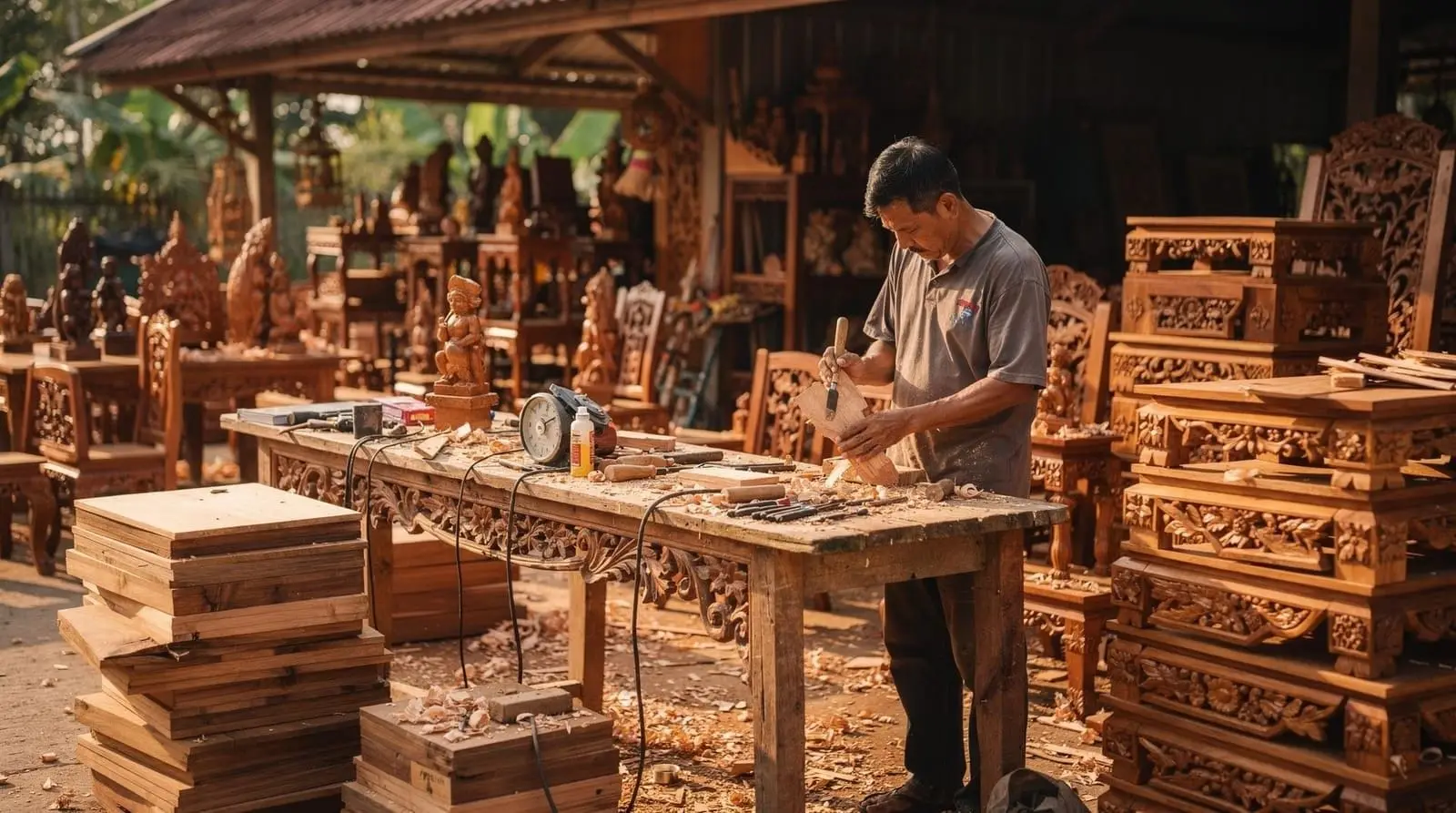
- Working carving workshops — some shops keep craftsmen visibly working on pieces on the premises, giving visitors a chance to see the carving process rather than just the finished product, which is arguably the more interesting reason to visit if you’re not planning to buy furniture.
Book a woodcarving workshop, cooking and massage retreat if you’d rather learn the craft hands-on than just browse the showrooms — a multi-day format that pairs a guided carving class with a local stay, cooking, and spa time.
Getting to Baan Tawai
The village is straightforward to reach from central Chiang Mai, though it’s far enough out that a dedicated trip (or a combination with another Hang Dong stop) makes more sense than a quick detour.
- Grab or taxi: The most common way in, roughly 30-35 minutes from the Old City.
- Rental scooter or car: Practical if you’re combining Baan Tawai with Grand Canyon Hang Dong, Royal Park Rajapruek, or Wiang Kum Kam, all within a similar southwestern corridor.
- If you’re seriously furniture shopping: consider arranging a driver for a few hours rather than a one-way Grab, since comparing multiple showrooms and then needing transport back with (or without) purchases is easier with someone waiting than trying to hail a return ride from a quiet village road.
Shopping at Baan Tawai: what to actually expect
This is the part worth being honest about before you go, since Baan Tawai’s scale and sales approach genuinely differ from a typical Chiang Mai night market stall.
- The scale is wholesale, not boutique. Many showrooms are set up to sell to interior designers, hotels, and bulk buyers as much as to individual tourists, which means large inventories, less curated browsing, and sales staff who are used to negotiating on furniture-scale purchases rather than a single souvenir.
- Bargain politely, and expect it to be expected. Prices on furniture and larger décor pieces are rarely fixed the way a small souvenir’s might be; a respectful back-and-forth is the normal way business is done here, not an awkward imposition. Smaller souvenir items sometimes have more fixed pricing, but it’s still worth asking.
- Shipping is commonly available and worth asking about upfront if you’re seriously considering furniture — most established showrooms have experience arranging international shipping, though costs and timelines vary considerably and are worth getting in writing before committing to a purchase.
- Quality varies significantly between shops. Some showrooms sell genuinely well-crafted, solid teak pieces; others lean toward faster, lower-quality production aimed at price-sensitive buyers. If craftsmanship matters to you, it’s worth comparing a few shops rather than buying at the first one you walk into.
- Not every shop welcomes browsing without buying, though this varies by individual shop rather than being a village-wide norm — reading the room (and the staff’s body language) as you enter is a reasonable approach if you’re not sure.
Comparing Baan Tawai to other Chiang Mai craft stops
Chiang Mai’s handicraft scene isn’t limited to Baan Tawai, and it’s worth knowing how the village fits alongside the other options if crafts are a theme of your trip.
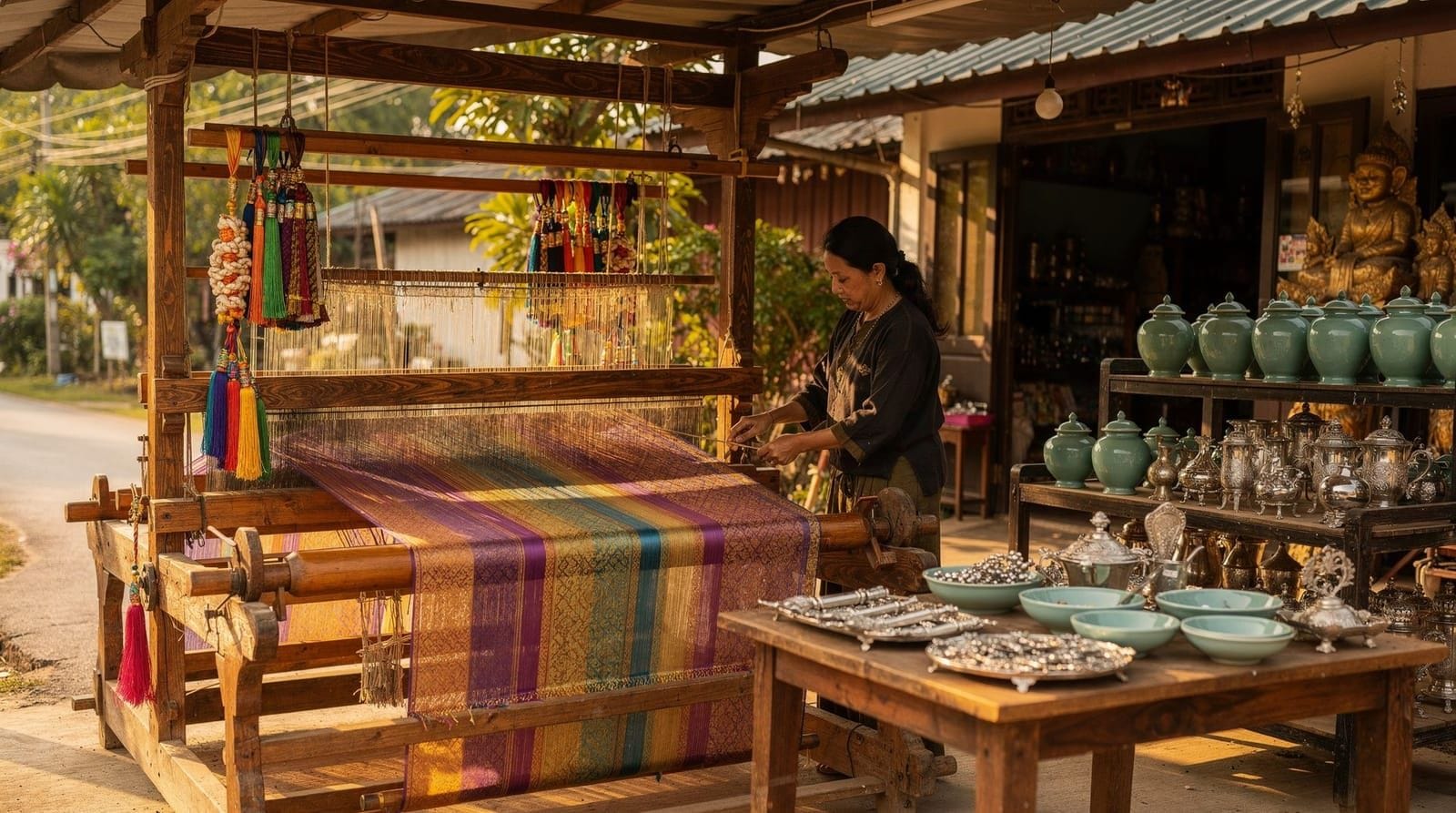
- San Kamphaeng crafts road, on the opposite side of the city, covers a broader mix of crafts — silk weaving, celadon pottery, silverwork — along a single stretch of road, rather than Baan Tawai’s woodcarving specialization.
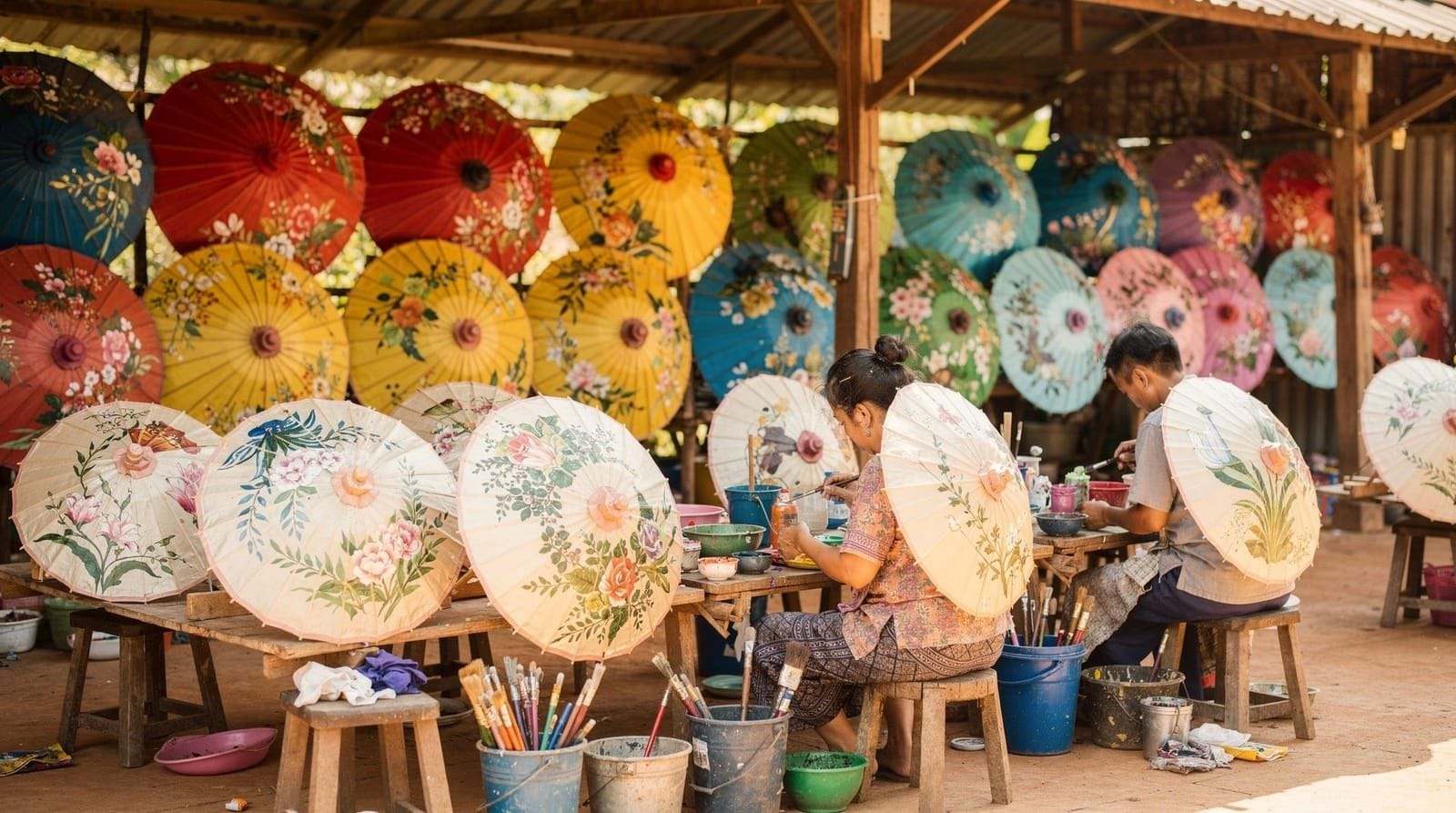
- Bo Sang umbrella village, also near San Kamphaeng, focuses narrowly on hand-painted paper and silk umbrellas, a very different craft from Baan Tawai’s woodworking.
- Baan Tawai’s specialization in wood — furniture, carving, and teak décor specifically — makes it the clear pick if that’s the craft you’re actually interested in, rather than a general handicraft sampler.
If your trip includes both sides of the city, San Kamphaeng and Bo Sang make one loop, and Baan Tawai — paired with the rest of Hang Dong — makes a separate, complementary one, rather than needing to squeeze all of Chiang Mai’s craft villages into a single day.
Combining with the rest of Hang Dong
Baan Tawai sits within easy reach of the district’s other attractions, and most visitors combine it with at least one other stop:
- Royal Park Rajapruek — the royal botanical garden, whose own Ho Kham Pavilion is itself a showcase of Lanna teak architecture, a natural pairing with Baan Tawai’s woodcarving focus.
- Grand Canyon Hang Dong — the flooded quarry and water park, a complete change of pace after a couple of hours of showroom browsing.
- Wiang Kum Kam — the excavated Lanna ruins, a quieter historical stop if you’d rather end the day with something reflective than more shopping.
A typical combination is a morning at Baan Tawai when showrooms are quieter and staff have more time to negotiate, followed by lunch and an afternoon at Royal Park Rajapruek or Grand Canyon.
If you’d rather browse a wider range of Buddha images and temple-ready décor alongside the furniture, some Baan Tawai carvers also produce pieces destined for temples, echoing the same craftsmanship visible at Wat Phra Singh’s Lai Kham chapel back in the Old City — worth a mental note if seeing carved teak in its intended devotional setting appeals to you as much as seeing it for sale.
The craft itself: how the carving is done
Watching an actual carving workshop is arguably the most interesting reason to visit Baan Tawai even if furniture shopping isn’t on your agenda. Traditional teak carving here starts with a rough-cut block, shaped first with larger tools to establish the basic form — a panel, a figure, a piece of furniture framing — before finer chisels and gouges bring out detail: floral motifs, mythological figures, or the elaborate scrollwork common on cabinet doors and decorative screens. Skilled carvers can spend anywhere from days to several weeks on a single elaborate piece, depending on complexity, and the price difference between a simple, quickly produced item and a genuinely intricate hand-carved showpiece reflects that labor difference more than it reflects any difference in wood cost. Some workshops use a combination of hand carving and machine-assisted roughing-out to speed up production on simpler pieces, while the most detailed decorative work remains hand-finished regardless of shop — asking a shop directly about their process is a reasonable way to gauge what you’re actually paying for.
A brief history of Baan Tawai as a craft village
Woodcarving in the Baan Tawai area traces back generations as a genuine local craft tradition, long before the village became the concentrated commercial handicraft center it is today. As demand grew — first domestically, then increasingly from Chiang Mai’s tourism and export markets — individual family workshops expanded and multiplied, and the village gradually formalized into the dense strip of showrooms visitors see now, with many shops still run by families connected to the original carving tradition even as the overall operation has scaled toward wholesale and export volumes. That evolution explains both the strip’s genuine craftsmanship at its better shops and its more commercial, less quaint atmosphere compared to smaller single-workshop craft stops elsewhere in the region — Baan Tawai grew into a full-scale industry rather than staying a small artisanal cluster.
Who Baan Tawai actually suits
It’s worth a final, honest sort before deciding whether to make the trip. Baan Tawai rewards visitors who are actually furnishing a home or genuinely curious about traditional teak carving as a craft — furniture buyers get real value from comparing showrooms and negotiating on pieces that would cost considerably more shipped from a Western retailer, and craft enthusiasts get a rare chance to watch skilled carving in progress rather than only seeing finished pieces in a shop window. It suits these visitors far better than it suits someone looking for a quick, charming half-hour stop between temples, since the village’s scale and sales-floor atmosphere reward time and engagement rather than a fast walk-through. If your Chiang Mai itinerary is tight and shopping isn’t a real interest, it’s reasonable to prioritize other Hang Dong stops — Royal Park Rajapruek’s gardens or Grand Canyon’s water park — over a dedicated Baan Tawai visit.
Practical tips
- Bring cash for smaller purchases, though larger furniture showrooms are more likely to accept cards or bank transfer for bigger transactions.
- Take photos and note shop names if you’re comparing multiple showrooms before deciding on a larger purchase — the strip is long enough that it’s easy to lose track of where you saw a particular piece.
- Ask directly whether antiques are genuine or reproduction. Reputable shops will tell you plainly; treat vague or evasive answers as a signal to look elsewhere.
- Get shipping quotes in writing, including estimated delivery time, before paying for anything you can’t carry home yourself.
- Go on a weekday morning if you want a calmer pace for browsing and more unhurried bargaining conversations with shop staff.
Beyond wood: other crafts at Baan Tawai
While woodcarving and furniture dominate the village’s identity and the bulk of its showroom space, a handful of shops along the strip also carry related handicrafts that pair naturally with a wood-focused décor theme — woven rattan and bamboo furniture, textiles, and ceramic or pottery pieces sold alongside the carved teak. These aren’t the village’s main draw and shouldn’t be the reason to make the trip on their own, but they’re worth a glance if you’re furnishing a room and want complementary pieces beyond carved wood specifically, saving a separate trip to a dedicated textile or ceramics market elsewhere in the Chiang Mai area. Shops carrying this wider mix tend to cluster toward the edges of the main strip rather than its busiest central section, so a bit of walking beyond the first few showrooms usually turns up a broader range than a quick stop at the entrance would suggest.
Frequently asked questions about Baan Tawai
What is Baan Tawai known for?
It’s Thailand’s best-known woodcarving and handicraft village, with dozens of showrooms specializing in carved teak furniture, antiques, home décor, and smaller wood souvenirs.
How do I get to Baan Tawai from Chiang Mai?
By Grab, taxi, or your own car or scooter, roughly 30-35 minutes south of the Old City, just south of Hang Dong town.
Is Baan Tawai good for casual browsing, or only for serious shoppers?
Both are possible, but the village’s wholesale-scale showrooms suit serious shoppers — especially anyone looking at furniture — better than a casual, boutique-style browse. An hour is enough to see the workshops and get a feel for the place even without buying.
Do I need to bargain at Baan Tawai?
Bargaining, done politely, is expected and normal, especially on furniture and larger décor pieces. Smaller souvenirs sometimes have more fixed pricing, but it’s still worth asking.
Can I ship furniture home from Baan Tawai?
Most established showrooms can arrange international shipping, though costs and timelines vary considerably between shops — get a written quote before committing to a purchase.
How long should I spend at Baan Tawai?
1.5 to 3 hours for a proper browse; longer if you’re comparing multiple showrooms for a significant furniture purchase.
How does Baan Tawai compare to San Kamphaeng’s crafts road?
Baan Tawai specializes specifically in woodcarving and furniture, while San Kamphaeng covers a broader mix of crafts including silk, celadon, and silverwork. Pick based on which specific craft interests you more.
Can I combine Baan Tawai with other Hang Dong attractions?
Yes — Royal Park Rajapruek, Grand Canyon Hang Dong, and Wiang Kum Kam are all within a similar corridor, making a combined half or full day practical with a car or scooter.
Are the antiques at Baan Tawai genuine?
It varies by shop — some sell genuine period pieces, others sell reproductions clearly marketed as such, and some are less transparent. Ask directly and be prepared to walk away from vague answers if authenticity matters to your purchase.
Is Baan Tawai only for buyers, or can I visit just to look around?
You can absolutely visit without buying anything — the working carving workshops in particular are interesting to watch regardless of purchase intent, and most shop staff won’t pressure a browsing visitor who’s clearly just looking. That said, the village’s real character comes through more if you engage with at least a few shops rather than walking the strip without stopping.
Top experiences
Bookable activities with verified prices and instant confirmation on GetYourGuide.