Baan Tawai woodcarving village: a shopping guide
Chiang Mai: Local Stay, Woodcarving Class, Cooking & Massage
Duration: Multi-day
What's actually worth buying at Baan Tawai, and how do I shop it well?
Small carved souvenirs (animal figures, bowls, wall panels) are the easiest purchase for most visitors, priced roughly 100-500 THB, while furniture and larger carved pieces are priced individually and often shippable internationally for an added fee. Polite bargaining is expected on anything beyond small fixed-price souvenirs, and comparing two or three showrooms before committing to a larger purchase is the single best way to avoid overpaying.
Baan Tawai is a genuinely large-scale destination, and the honest truth is that most visitors leave slightly unsure whether they bought well or overpaid. This guide is built specifically around that gap - not what Baan Tawai is, which the destination page already covers, but how to actually shop it: what’s realistically worth buying at different budget levels, how negotiation works in practice, how to judge whether a piece is genuine teak or a cheaper substitute, and what shipping a larger purchase home actually involves.
Quick answer: Small carved souvenirs - animal figures, bowls, wall panels - run roughly 100-500 THB (~$3-14) and are the easiest first purchase. Furniture and larger carved pieces are priced individually, often into the tens of thousands of THB, and are commonly shippable internationally for an added fee. Bargaining, done politely, is expected on anything beyond small fixed-price items, and comparing two or three showrooms before a larger purchase is the single most effective way to shop Baan Tawai well.
Getting to Baan Tawai and planning your time
Baan Tawai sits just south of Hang Dong town, roughly 18-20 km south of Chiang Mai’s Old City, about 30-35 minutes by Grab or private driver. Because the village is spread across a genuinely long strip of showrooms rather than a compact walkable block, arriving with your own transport, or a driver willing to wait, makes the shopping process considerably easier than trying to hail fresh rides between stops. Budget 1.5-3 hours for a proper browse across a handful of showrooms, and closer to a half day if you’re seriously comparing multiple shops before a large furniture purchase.
Weekday mornings are the best time to shop seriously - showrooms are quieter, and staff generally have more time and patience for the kind of unhurried negotiation that larger purchases benefit from, compared to a busy weekend afternoon.
What’s actually worth buying, by budget
- Under 500 THB (~$14): small carved animal figures, decorative bowls, simple wall panels, and other suitcase-friendly souvenirs. Quality varies, but even modestly priced pieces here are usually genuinely wood-carved rather than machine-stamped plastic.
- A few thousand THB: mid-size decorative panels, carved boxes, small stools or side tables - a reasonable entry point if you want a real furniture-scale piece without committing to shipping logistics.
- Tens of thousands of THB and up: full cabinets, dining tables, elaborately carved showpieces - the kind of purchase that requires comparing multiple showrooms, getting a firm price in writing, and arranging shipping before you commit.
Book a woodcarving workshop, cooking and massage retreat if you’d rather learn the craft hands-on and come away with something you carved yourself, rather than only shopping finished pieces.
How to negotiate at Baan Tawai without feeling awkward
Bargaining at Baan Tawai is a normal, expected part of doing business, not an imposition on the seller, but it helps to approach it with a bit of structure rather than guessing.
- Ask the price first, without offering your own number. Let the shop anchor the conversation.
- Compare a similar piece at a second shop before committing, even a rough mental comparison, so you have a sense of the going rate rather than negotiating blind.
- Make a counter-offer that’s a genuine, respectful reduction - typically 10-25% below the initial asking price on furniture-scale items - rather than an extreme lowball that can sour the interaction.
- Be willing to walk away. A seller unwilling to move at all on a large purchase isn’t necessarily being unfair, but a fair number of Baan Tawai showrooms do have room to negotiate, and a polite willingness to walk toward another shop is often what unlocks a better price.
- Confirm the final price includes everything you expect - packing, and shipping if applicable - before paying, since add-on costs can otherwise surface after you’ve already agreed on a headline number.
Smaller souvenir items sometimes carry more fixed pricing than furniture does, but it’s still reasonable to ask.
Spotting genuine teak and real hand-carving
Baan Tawai’s showrooms vary considerably in the quality and authenticity of what they sell, and a few practical checks help you judge what you’re actually paying for.
- Weight and feel. Genuine teak has a distinctive oily texture and is noticeably heavier than many of the softer substitute woods sometimes used in lower-cost pieces.
- Grain and color. Teak typically shows a warm golden-brown to dark brown tone with a fairly tight, straight grain, rather than the paler, looser grain of cheaper substitutes.
- Tool marks versus uniformity. Genuinely hand-carved detail shows small, natural irregularities - slightly uneven depth, minor asymmetry between repeated motifs - while machine-routed or mass-produced pieces tend toward a suspiciously perfect uniformity across repeated elements.
- Ask directly about the wood species and process. Reputable shops will tell you plainly whether a piece is solid teak, a teak veneer over a cheaper base wood, or an entirely different timber, and whether it was hand-carved, machine-assisted, or a combination. Vague or evasive answers are a reasonable signal to look elsewhere if authenticity matters to your purchase.
Antiques and reproductions: asking the right questions
Baan Tawai’s shops sell both genuine antiques and deliberate reproductions, and quality and authenticity vary considerably between shops. The reasonable approach is directness: ask specifically whether a piece is being sold as a genuine period antique or a reproduction, and expect a straight answer from a reputable dealer. Reproductions aren’t a problem in themselves - many are well-made and honestly priced as such - but a shop unwilling to clarify which you’re being offered is worth treating with more caution, particularly if the price implies genuine antique status.
Shipping a larger purchase home
Because furniture and large carved pieces don’t travel in a suitcase, most established Baan Tawai showrooms offer international shipping directly from the shop, packing and sending purchases for an additional fee on top of the item price.
- Get a written quote covering both shipping cost and estimated delivery time before paying for the item itself.
- Ask about insurance in case of damage or loss in transit, since coverage terms vary by shop and shipping provider.
- Confirm the delivery method - sea freight is typically slower and cheaper, while air freight costs more but arrives faster - and choose based on how urgently you need the piece.
- Keep a copy of the invoice and shipping agreement, useful if any dispute arises after the piece has left the shop.
Smaller items - carved souvenirs, small boxes, decorative bowls - are usually straightforward to pack yourself in carry-on or checked luggage, and most shops will wrap fragile pieces securely for transport if asked.
Watching the carving process before you buy
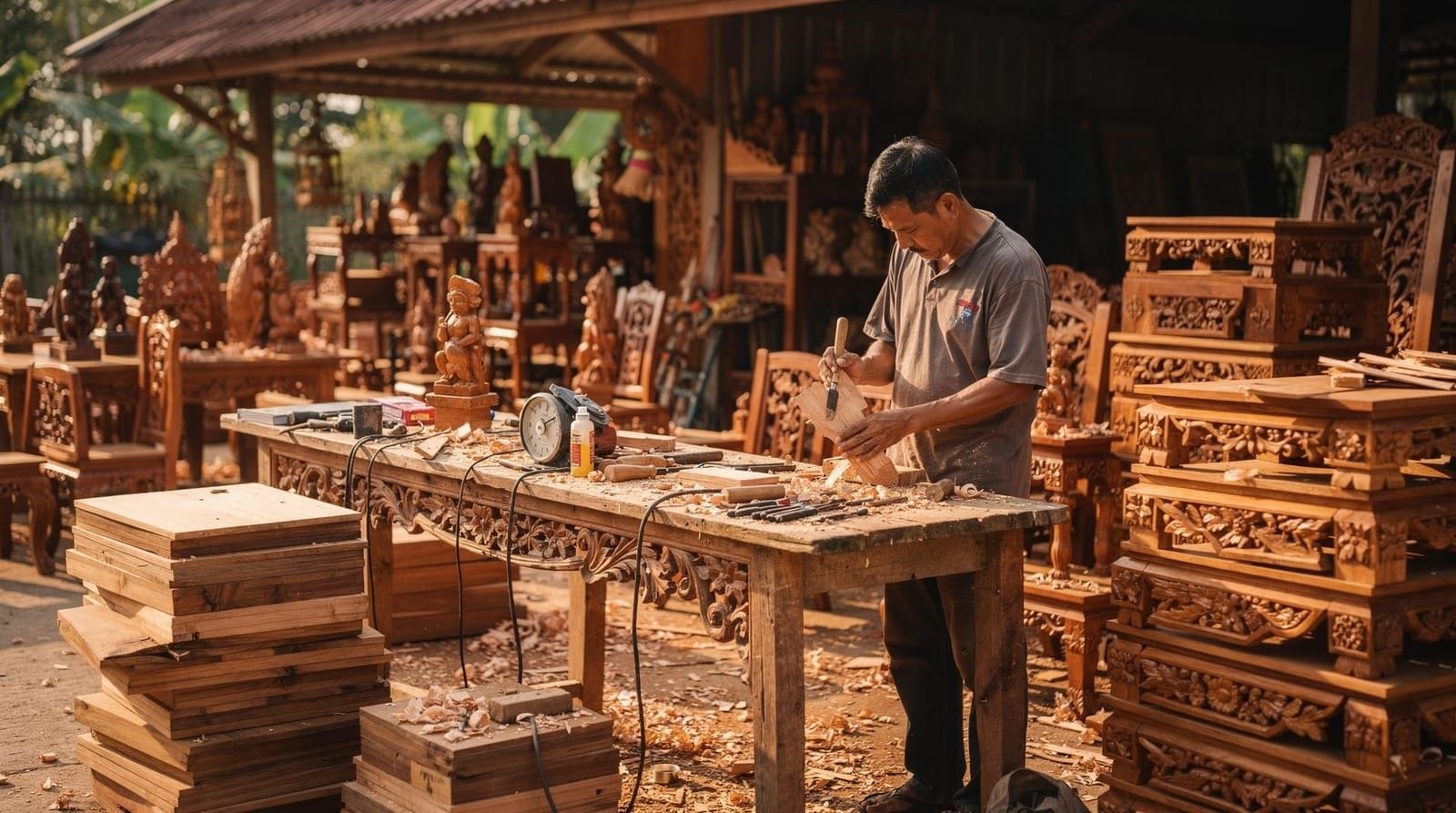
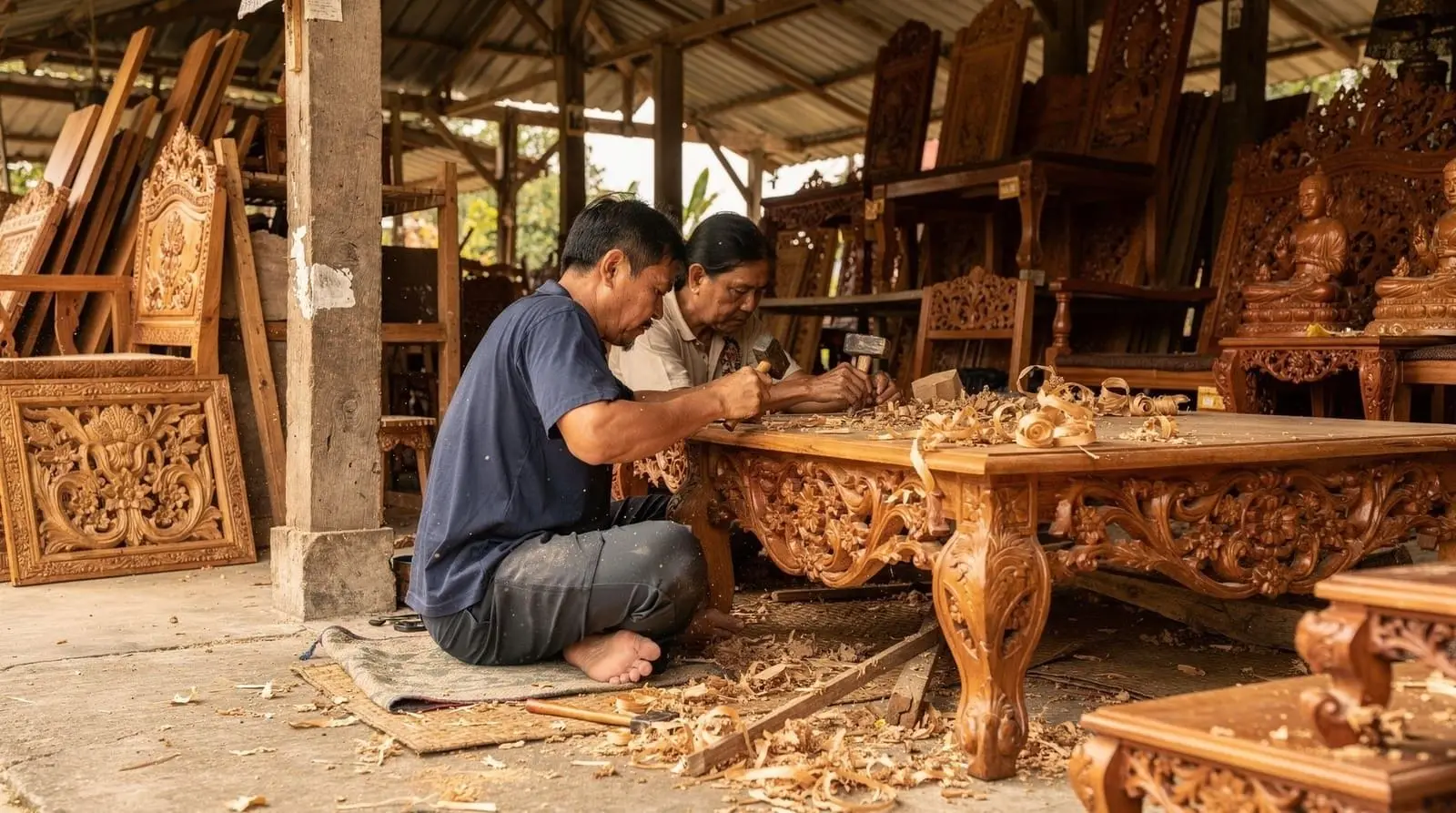
Even if you’re not planning a purchase, the working carving workshops at several Baan Tawai showrooms are worth a stop in their own right. Traditional teak carving starts with a rough-cut block, shaped first with larger tools to establish the basic form before finer chisels and gouges bring out detail - floral motifs, mythological figures, or the elaborate scrollwork common on cabinet doors and decorative screens. Watching this in person gives a much clearer sense of why prices vary as much as they do between a simple, quickly produced item and a genuinely intricate hand-carved showpiece: it’s almost entirely down to the labor time involved rather than any meaningful difference in raw material cost.
Why Baan Tawai’s scale differs from other Chiang Mai craft stops
It’s worth understanding why Baan Tawai feels different from a typical Chiang Mai souvenir street before you start shopping, since that scale directly shapes how negotiation and buying work here. The village grew from a genuine local woodcarving tradition into what’s now a large, semi-formalized handicraft market, with many showrooms set up to sell to interior designers, hotels and bulk buyers as much as to individual visitors. That means large inventories, less curated browsing, and sales staff accustomed to negotiating on furniture-scale purchases rather than a single souvenir - a genuinely different sales environment than the smaller, single-workshop feel of Bo Sang or the San Kamphaeng crafts road, where woodcarving also appears but at a noticeably smaller scale. If woodcarving specifically, at real volume and price range, is your priority, Baan Tawai is the more useful destination of the two; if you want a broader mix of crafts in one stop, the crafts road covers more ground.
A sensible shopping route for a first visit
If you’re not sure where to start, a workable approach is: walk the main strip once without buying anything, noting two or three showrooms whose stock and visible workshop activity genuinely interest you; return to the most promising one first for a closer look and, if a purchase seems likely, ask about pricing and negotiate; then check a second shop with comparable pieces before finalizing anything larger than a small souvenir. This avoids both extremes - overpaying at the first shop out of momentum, or spending your whole visit comparison-shopping without ever actually buying anything you liked.
Consider a guided bicycle tour into the Lanna countryside if you’d rather see the wider rural district around Hang Dong at a slower pace before or after a dedicated Baan Tawai shopping stop.
Combining a shopping visit with the rest of Hang Dong
Most visitors don’t treat Baan Tawai as a full day on its own, and it’s worth planning it as part of a wider Hang Dong loop rather than a standalone round trip. A sensible sequence: a weekday morning at Baan Tawai while showrooms are quiet and staff have time to negotiate, lunch nearby, then an afternoon at Royal Park Rajapruek - whose own Ho Kham Pavilion is itself a showcase of Lanna teak architecture, a natural pairing with the morning’s woodcarving focus - or Grand Canyon Hang Dong if you want an activity-heavy change of pace after a couple of hours of showroom browsing.
History-minded visitors sometimes end the day at Wiang Kum Kam, the excavated ancient Lanna capital in the same general corridor, a quieter and more reflective close to a day that started with wholesale-scale shopping.
What to bring for a Baan Tawai shopping trip
- Cash for smaller purchases, though larger showrooms increasingly accept cards or bank transfer for bigger transactions.
- A notebook or phone for photos and notes, useful for comparing pieces and prices across multiple showrooms without losing track of where you saw something.
- A rough budget in mind before you arrive, since the range between a small souvenir and a full furniture piece is wide enough that having a target helps you negotiate with more confidence.
- Patience for a slower sales process on larger items - genuine negotiation on furniture-scale purchases takes longer than a quick souvenir transaction, and rushing it rarely gets you a better price.
Frequently asked questions about shopping at Baan Tawai
What’s the easiest first purchase at Baan Tawai?
A small carved souvenir - an animal figure, decorative bowl, or wall panel - typically 100-500 THB, requiring no negotiation strategy or shipping arrangement.
Should I pay by cash or card?
Bring cash for smaller purchases, since not every shop accepts cards, though larger furniture showrooms increasingly accept cards or bank transfer for bigger transactions.
How do I compare quality between showrooms quickly?
Take photos and note shop names as you browse, then compare weight, grain and finish on similar pieces across two or three shops before deciding - the strip is long enough that it’s easy to lose track of where you saw a particular piece otherwise.
Is it worth visiting Baan Tawai if I’m not planning to buy furniture?
Yes - the working carving workshops and smaller souvenir sections are worth a look regardless, though the village’s scale and sales-floor atmosphere are built more around serious shoppers than casual browsers.
How does Baan Tawai’s woodcarving compare to what’s used in Chiang Mai’s temples?
The same underlying craftsmanship - hand-carved teak detail - appears in temple woodwork like Wat Phra Singh’s Lai Kham chapel back in the Old City, just applied to devotional rather than commercial pieces.
What should I combine with a Baan Tawai shopping trip?
Wiang Kum Kam’s ancient ruins or Royal Park Rajapruek’s gardens both sit in the same general Hang Dong corridor, making a natural half-day pairing with a morning of shopping.
Are Baan Tawai prices actually cheaper than buying similar furniture at home?
Often yes, particularly for solid teak furniture and detailed hand-carved pieces, since labor costs in Thailand are considerably lower than in most Western furniture markets - but the total cost only makes sense once shipping, and any import duty in your home country, is factored in. Getting a full landed-cost estimate before committing to a large piece avoids an unpleasant surprise later.
Can I visit multiple showrooms in a single afternoon?
Yes, though the village’s showrooms are spread along a genuinely long strip rather than clustered tightly together, so a car or driver waiting between stops makes covering several showrooms in an afternoon far more practical than trying to walk the entire distance.
Is it normal for shops to let me browse without any sales pressure?
Generally yes at Baan Tawai’s better-established showrooms, though it varies by shop rather than being a uniform village-wide norm - reading the room as you enter, and being clear that you’re browsing rather than buying immediately, is a reasonable approach if you’re unsure.
What’s the single most useful habit for shopping Baan Tawai well?
Comparing before committing. Whether it’s a 200 THB carved souvenir or a large dining table, a few minutes spent looking at a comparable piece in a second showroom, or simply asking a second shop what a similar item costs, is the most reliable way to know whether a given price and quality level is actually reasonable.
Top experiences
Bookable activities with verified prices and instant confirmation on GetYourGuide.