Getting around Chiang Mai: songthaews, Grab, tuk-tuks and walking
What is the best way to get around Chiang Mai day to day?
For short hops inside the Old City or Nimman, walk or flag a red songthaew (shared truck-taxi, roughly 30-40 baht per person). For anything further, cross-town, or after dark, open the Grab app — fares are fixed in advance and typically run 60-150 baht. Tuk-tuks work well for short novelty rides if you negotiate the price first. Chiang Mai has no BTS, MRT or metro of any kind — all city transport runs on roads.
Why Chiang Mai’s transport system looks different from Bangkok’s
Visitors who’ve spent time in Bangkok first sometimes carry over an assumption that doesn’t hold here: there is no BTS Skytrain, no MRT, no light rail of any kind in Chiang Mai. The city’s transport has stayed road-based for decades, built around shared pickup trucks rather than fixed rail lines, and that shapes almost every practical decision about getting from A to B — where you choose to stay, how you budget your days, and how much slack to build into your schedule.
The good news is that the resulting system is cheap, flexible and easy to learn within a day or two. This guide covers the full toolkit — songthaews, Grab, tuk-tuks, rental scooters, bicycles and walking — with real prices and the honest trade-offs of each, plus how to think about getting to and from the city itself.
The five ways to move around the city
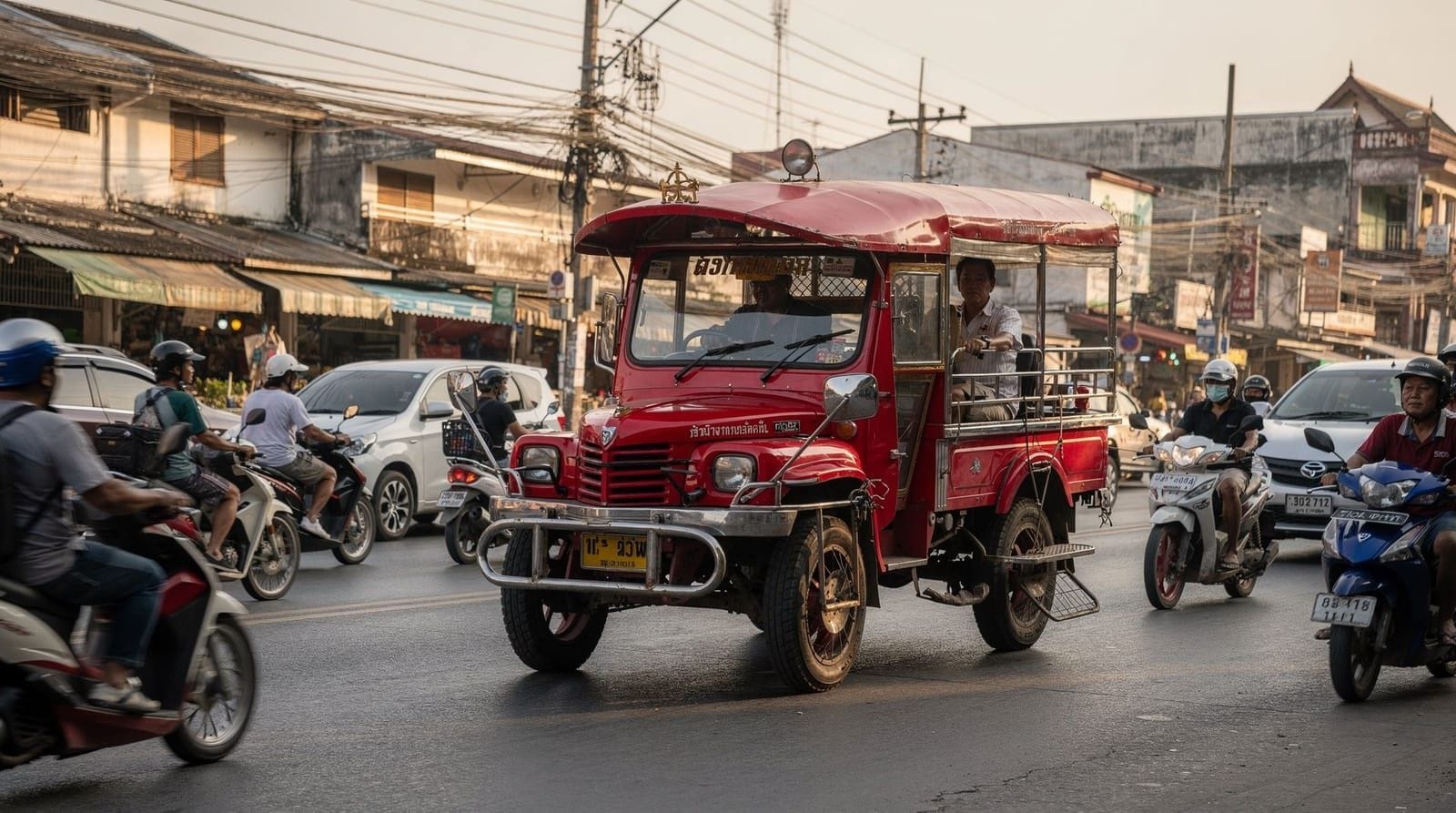
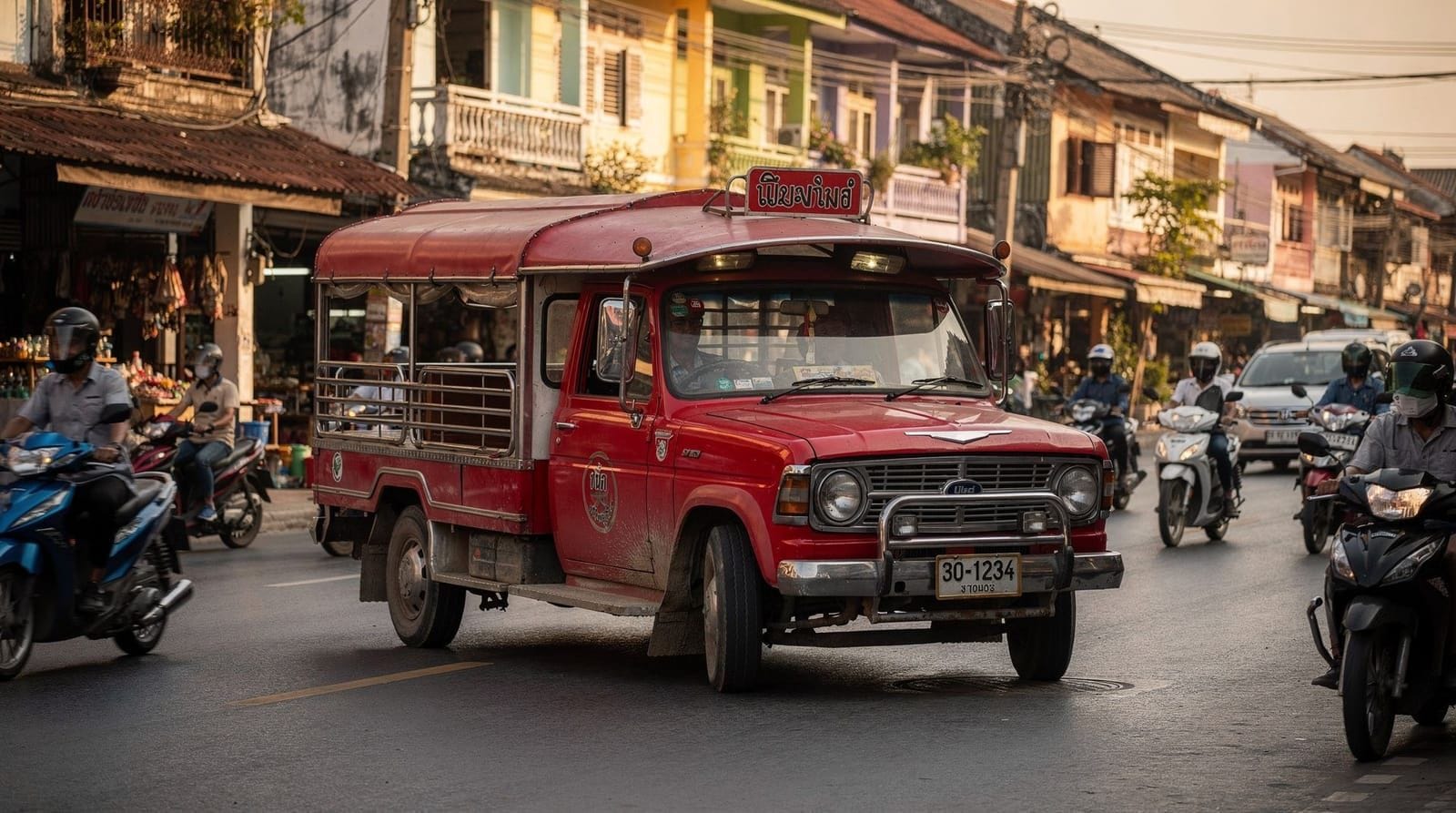
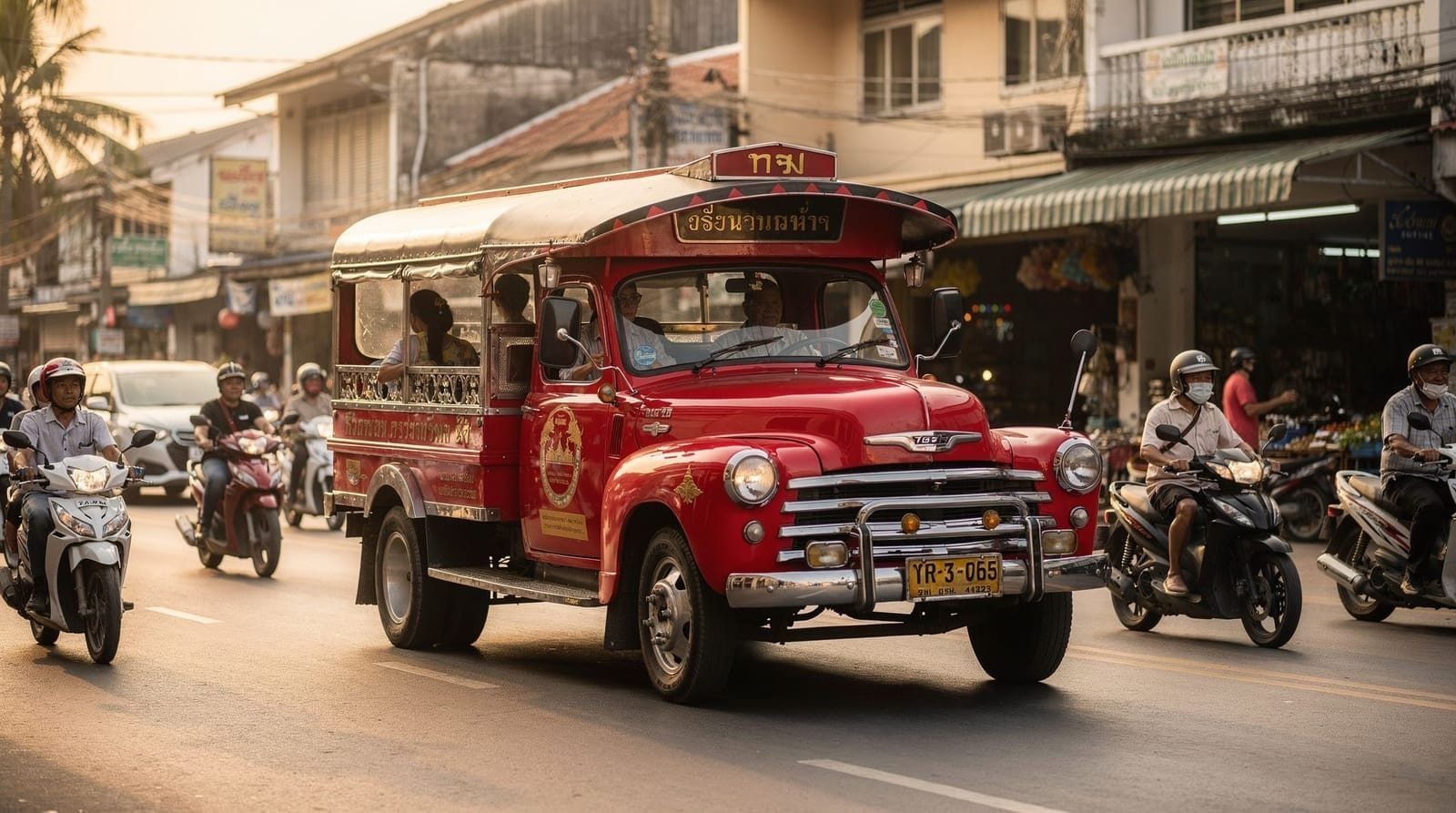
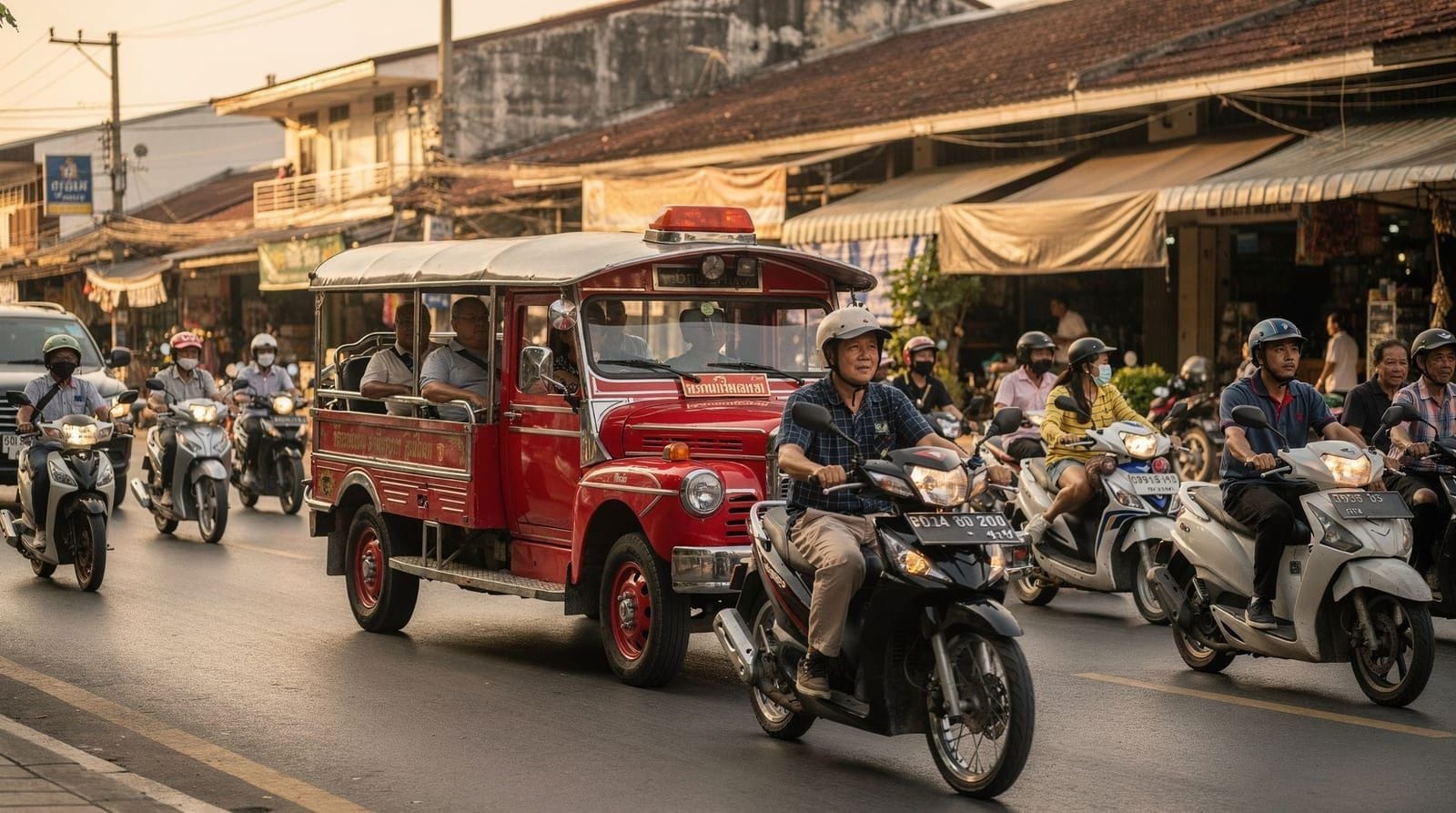
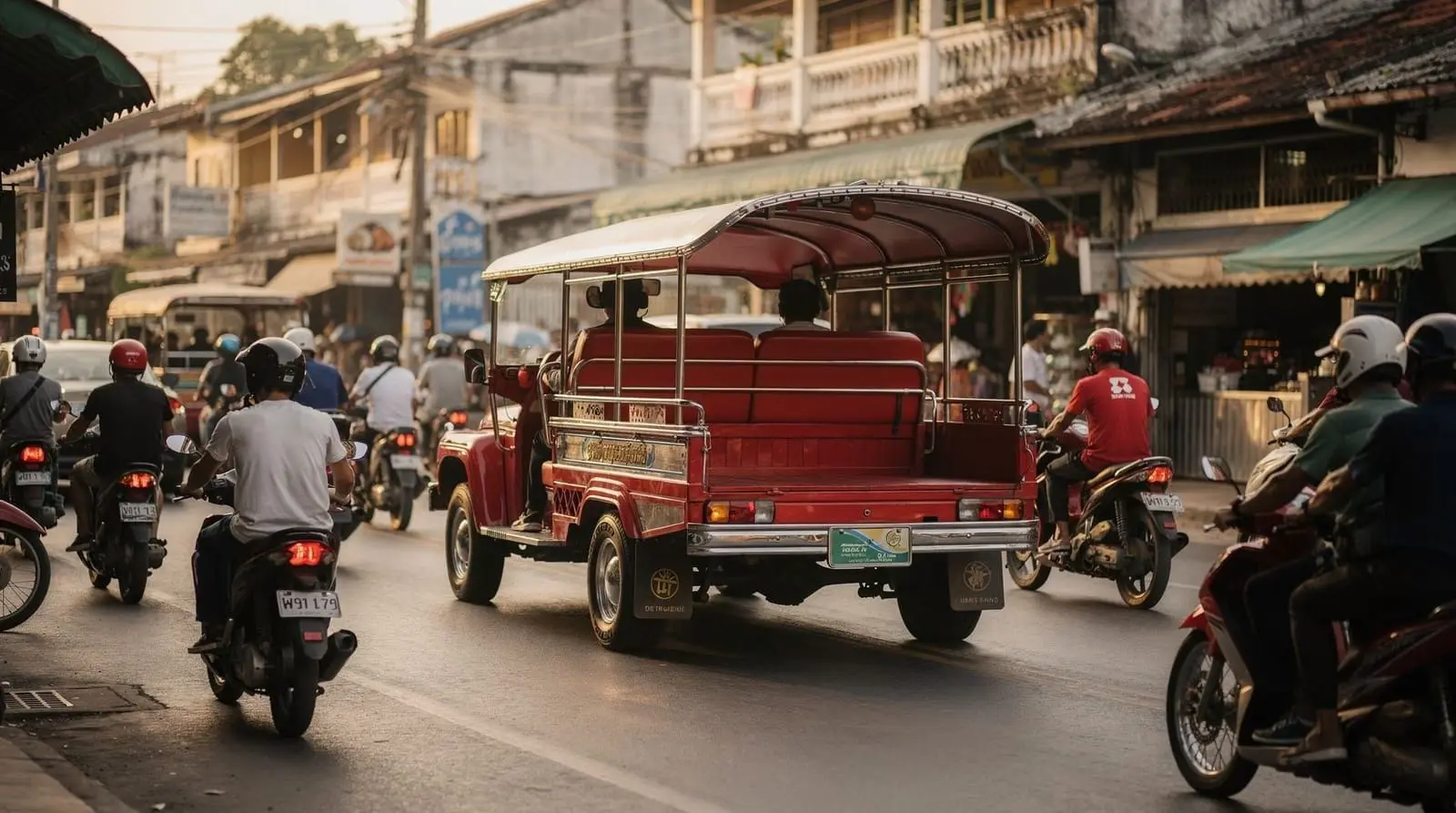
Red songthaews (rot daeng). Shared pickup trucks with two facing benches in a covered bed, painted red and running informally around the city rather than on a fixed timetable. Flag one from the roadside, tell the driver where you’re headed through the window, and if it’s roughly on their route they’ll wave you in for a shared fare of about 30-40 baht per person. If your destination is out of the way, the driver may offer to charter the whole truck to you directly for a higher agreed price — useful with luggage or after dark. Full mechanics in the songthaew guide.
Grab. The ride-hailing app most visitors default to once they’ve tried it once. You enter a destination, get a fixed fare upfront (commonly 60-150 baht for an in-town trip), and a car or motorbike-taxi arrives to a pinned location. No negotiating, no language barrier, no uncertainty about the final price. The trade-off is that Grab drivers sometimes can’t navigate into the Old City’s narrowest one-way sois, so you may need to walk a short distance to a main road. Full detail in the Grab app guide.
Tuk-tuks. Three-wheeled open-air taxis, more of a short-hop novelty than a primary transport mode these days. No meter — agree the fare before you get in, typically around 100-150 baht for a short in-town trip. They’re fun for a five-minute hop between the Night Bazaar and a nearby restaurant, less practical for anything requiring precision or a fixed budget.
Rental scooters and motorbikes. The most flexible option and the one that earns its cost most clearly on day trips outside the city — Doi Suthep, Mae Rim, San Kamphaeng — rather than purely for in-town errands. Typical rental runs 200-300 baht per day. This is also the option with the most honest caveats: a valid motorcycle license and International Driving Permit, a helmet, real insurance, and awareness of the passport-holding deposit scam some shops still run. See the renting a car or scooter guide for the full checklist before booking anything.
Bicycles and walking. The Old City is compact — roughly 1.5 km on each moated side — and genuinely walkable, with most temples, cafés and guesthouses within 15-20 minutes of each other on foot. Bicycles extend that range comfortably to Nimman or the riverside on quieter back streets, and several guesthouses rent them by the day for a modest fee.
A quick cost comparison
| Option | Typical in-town fare | Best for |
|---|---|---|
| Red songthaew (shared) | 30-40 baht (~$0.85-1.15) | Short hops, budget travel, meeting locals |
| Grab (car) | 60-150 baht (~$1.70-4.30) | Predictable pricing, cross-town, after dark |
| Tuk-tuk | 100-150 baht (~$2.85-4.30), negotiated | Short novelty rides |
| Rental scooter | 200-300 baht/day (~$5.70-8.60) | Day trips, multi-stop days, flexibility |
| Bicycle rental | Roughly 50-100 baht/day (~$1.45-2.85) | Old City and Nimman on quiet streets |
| Walking | Free | Anything within the Old City |
None of these require advance booking or apps beyond Grab, and it’s entirely normal to mix methods across a single day — walk to breakfast, Grab to a temple, songthaew back for dinner.
Choosing based on where you’re staying
Your base shapes which of these you’ll lean on most. Travellers staying inside the Old City can walk to most sights and only need transport for trips further out. Those based in Nimman will use Grab or a songthaew more often for Old City temple visits, since the two areas sit a few kilometres apart. Riverside stays near the Night Bazaar put you within easy reach of both by short Grab ride. The full trade-offs by neighbourhood are covered in the Old City vs Nimman guide.
Getting to Chiang Mai in the first place
Most visitors arrive one of three ways. Chiang Mai International Airport (CNX) sits just 3 km from the Old City, making it one of the more conveniently placed airports of any regional hub in Thailand — a taxi or Grab from the terminal to an Old City hotel runs about 15-20 minutes and roughly 150 baht. Full arrival logistics are in the airport to city transport guide.
The overnight sleeper train from Bangkok is the scenic option — 11-13 hours through the central plains and into the northern hills, arriving at Chiang Mai’s small riverside station a short Grab ride from the centre. It’s slower than flying but a genuinely enjoyable way to arrive, especially in an upper berth with a window.
VIP buses from Bangkok (operators like Nakhonchai Air run comfortable overnight coaches) are the budget option, taking roughly 10-12 hours. Domestic flights from Bangkok and other Thai cities take under 90 minutes and are often the cheapest option in absolute terms if booked ahead.
Getting to day trips and other northern towns
Once you’re in Chiang Mai, reaching day-trip destinations is a different logistics question from getting around the city itself. Minivans departing from Chang Phueak Bus Station or the Arcade Bus Station run to Pai, Chiang Rai, Chiang Dao and Mae Hong Son, alongside private car options and guided tours that handle the driving for you. Two of the most-asked routes get their own dedicated guides: Chiang Mai to Pai transport and Chiang Mai to Chiang Rai transport. For destinations closer in like Doi Suthep, a rental scooter, a chartered songthaew, or a half-day tour all work well without needing a dedicated minivan station.
Honest scam warnings
A handful of overcharging patterns show up often enough to name directly. Tuk-tuk and songthaew overcharging targets visitors who don’t know a fair price — always ask “how much” before getting in, and don’t be afraid to say no and try the next driver if the number sounds inflated. Gem-shop and tailor detours occasionally get worked into a “too good to be true” tuk-tuk or private-car deal, where a driver offers a suspiciously cheap or free ride in exchange for a short stop at a shop that pays them commission — politely decline any itinerary that includes an unplanned shopping stop. Scooter rental shops holding your passport as a deposit is a well-known risk, since it gives the shop leverage to claim inflated “damage” fees when you return the bike; a cash deposit or credit card hold is the safer alternative, covered in full in the renting guide.
A realistic day of mixed transport
A typical Chiang Mai day might look like this: walk from an Old City guesthouse to breakfast, Grab to Doi Suthep for a morning temple visit (round trip roughly 300-500 baht by Grab or chartered songthaew, or self-drive by rented scooter), songthaew back into town for lunch near Warorot Market, an afternoon walk through the Old City temples, then Grab out to Nimman for dinner and a coffee, followed by a songthaew or Grab back to the hotel. Total transport spend for a day like that rarely exceeds 500-700 baht (roughly $14-20) for two people, and none of it requires booking more than a few minutes ahead.
Cash, cards and what transport actually costs to carry
Almost every transport option in this guide expects Thai baht cash rather than cards — songthaew drivers, tuk-tuk drivers and even some Grab drivers prefer cash for small in-town fares, and none of them run a card machine the way a taxi in a Western city might. Carrying a mix of small notes (20s, 50s and 100s) covers a full day of mixed transport without ever needing exact change from a driver who may not have it. A useful rule of thumb: budget roughly 100-300 baht per person per day for transport if you’re mixing songthaews and occasional Grab rides, more like 300-500 baht if you’re leaning heavily on Grab for cross-town trips, and 200-300 baht per day flat if you’ve rented a scooter instead. None of these numbers require withdrawing large sums at once — small, frequent ATM withdrawals work fine given how little each individual ride costs.
How the rainy and burning seasons change your transport choices
Chiang Mai’s weather calendar affects transport decisions more than first-time visitors expect. During the rainy season (roughly June-October), sudden downpours make open-air songthaews and tuk-tuks considerably less pleasant, and Grab becomes the more comfortable choice simply because the car has a roof and windows that seal properly — some visitors also notice Grab fares tick up slightly during a heavy downpour as demand spikes citywide. During the dry-season burning period (roughly February-April), when agricultural burning across the region pushes air quality down, spending less time in an open songthaew bed and more time in an air-conditioned Grab car is a reasonable way to reduce smoke exposure on longer trips, particularly for anyone with respiratory sensitivities.
Transport with kids, luggage or mobility considerations
Families travelling with young children generally find Grab the most practical default, since car seats aren’t standard in songthaews or tuk-tuks and a private car offers more control over a fussy or sleepy child than a shared truck bed with strangers. Larger luggage — more than a single backpack or small suitcase per person — also tips the balance toward Grab or a chartered songthaew rather than trying to squeeze bags into a shared truck alongside other passengers’ bags. Travellers with mobility limitations should note that songthaews require climbing into a truck bed with no ramp or step assistance, which can be genuinely difficult for anyone with limited mobility; Grab, with its standard car doors and seats, is the more accessible choice in almost every case.
A realistic week’s transport budget
For a typical week split between Old City sightseeing, a couple of Nimman evenings, and one or two day trips to nearby destinations like Doi Suthep or San Kamphaeng, a reasonable transport budget for two people runs somewhere around 1,500-2,500 baht (roughly $43-71) for the week if relying mainly on songthaews and Grab, or meaningfully less if a rented scooter replaces most of those individual rides for a flat daily rate. This doesn’t include the separate, larger transport costs of reaching multi-day destinations like Pai or Chiang Rai, which are covered in their own dedicated guides and run considerably higher given the distances involved.
Language and communication on the road
None of Chiang Mai’s transport options require Thai fluency, but a small amount of preparation smooths every interaction. Saving your accommodation’s name and a nearby landmark in both English and Thai script (many hotel booking confirmations already include this) makes showing a driver your destination far more reliable than attempting to pronounce an unfamiliar street name aloud. Google Maps or Maps.me both work well offline once downloaded in advance, useful for confirming you’re headed the right direction during a songthaew ride or double-checking a Grab driver’s route without needing constant data. Drivers across every option in this guide are used to visitors who don’t speak Thai, and pointing, showing a phone screen, or naming a well-known temple or market all work as reliable fallbacks.
Building transport into your daily rhythm
Rather than treating transport as a separate logistics problem to solve each morning, most visitors settle into a rhythm within the first day or two: walk for anything within the Old City, songthaew or Grab for anything requiring a real ride, and a rented scooter only if the day involves multiple stops spread across a wider area, like a loop through Mae Rim’s gardens and elephant sanctuaries. Thinking in these terms — distance and number of stops, rather than defaulting to one method for the whole trip — tends to produce both a cheaper and less stressful experience than committing to a single transport mode for an entire visit.
Putting it all together
The underlying theme across every option in this guide is that Chiang Mai’s transport rewards flexibility rather than commitment to a single method. A visitor who arrives expecting a single “best” answer — the way a metro pass might function as the default in a rail-connected city — will find the actual answer is closer to “it depends on the specific trip.” Short Old City hop: walk or songthaew. Cross-town or after dark: Grab. Multi-stop day outside the centre: rented scooter. Getting to another town entirely: the dedicated route guides linked throughout this page. Holding all of these as live options, rather than picking one on day one and sticking with it regardless of the trip, is what makes Chiang Mai’s decentralised, road-based system work as well as it does in practice.
Frequently asked questions about getting around Chiang Mai
Do I need to download Grab before I arrive?
It helps — download the app and add a payment method before landing so it’s ready to use from the airport. Grab works with an international phone number and most major cards, plus cash if you prefer paying the driver directly.
Are there fixed bus routes or a public bus network in Chiang Mai?
Not in the sense most visitors expect from a Western city — there is no dense fixed-route public bus grid comparable to Bangkok’s BMTA system serving the city core for casual sightseeing. Songthaews function as the informal, flexible substitute, running shared routes without a printed timetable.
Is it normal to negotiate the fare before getting in a songthaew or tuk-tuk?
Yes, and expected — neither runs a meter, so agreeing a number (or confirming the shared per-person rate) before you climb in avoids any argument at the destination.
What’s the fastest way to get from the Old City to Nimman?
Grab, typically 10-15 minutes and 60-100 baht depending on traffic and exact pickup point. A shared songthaew covers the same route for less but with less certainty on timing.
Can I rely on transport running late at night?
Grab operates late into the night reliably. Songthaews and tuk-tuks become less frequent after roughly 10-11pm, especially outside the main tourist areas, so plan a Grab as backup for late returns.
Is it worth renting a scooter just for the Old City?
Generally no — the Old City’s one-way moat roads and dense pedestrian and tourist traffic make walking or Grab more practical for that specific area. A scooter pays off more clearly once you’re heading to Doi Suthep, Mae Rim or further day-trip territory.