Night Bazaar vs. Sunday Walking Street: which one suits you
Chiang Mai: Evening Local Street Food Market Tour
What's the real difference between the Night Bazaar and Sunday Walking Street?
The Night Bazaar runs every night on Chang Khlan Road and is dominated by souvenir stalls and food courts at a real tourist markup. Sunday Walking Street runs only on Sundays along Ratchadamnoen Road inside the Old City, is considerably bigger, and mixes genuine local shoppers with visitors across handicrafts, art and street food at generally better prices.
Ask a handful of Chiang Mai visitors which market they went to and you’ll get the same two answers on repeat: the Night Bazaar, because it’s the one every hotel and guidebook mentions first, and Sunday Walking Street, because someone told them it’s the “real” one. Both reputations are broadly earned, but the two markets solve different problems, and treating them as interchangeable leads to a genuinely worse evening than picking deliberately.
Quick answer: the Night Bazaar on Chang Khlan Road runs every night and is heavier on souvenir stalls and clothing at a real tourist markup. Sunday Walking Street runs only on Sundays along Ratchadamnoen Road inside the Old City, is significantly larger, and mixes a genuinely local crowd with visitors across handicrafts, art and food, generally at better value. If your dates allow it, Sunday Walking Street is the stronger single choice; if they don’t, the Night Bazaar is a perfectly reasonable fallback.
Frequency: the deciding factor for most trips
This is the single biggest practical difference. The Night Bazaar runs 365 nights a year, which makes it the default choice whenever your schedule doesn’t line up with a Sunday. Sunday Walking Street exists only on Sunday evenings, closing Ratchadamnoen Road to traffic from roughly 4pm to 10-11pm. If your entire Chiang Mai stay happens to miss a Sunday, the comparison is somewhat academic — the Night Bazaar is simply what’s available.
Scale and what’s actually for sale
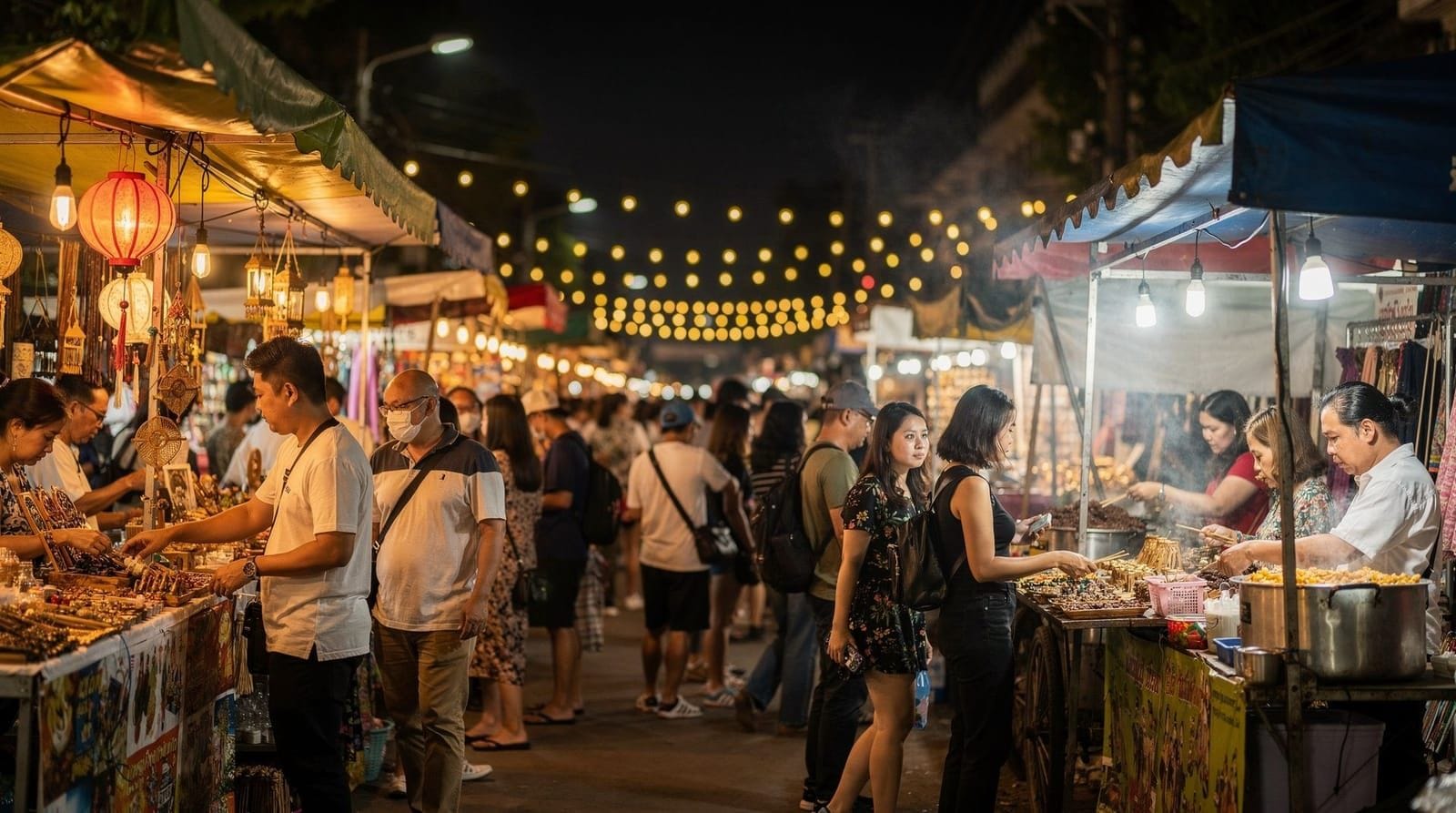
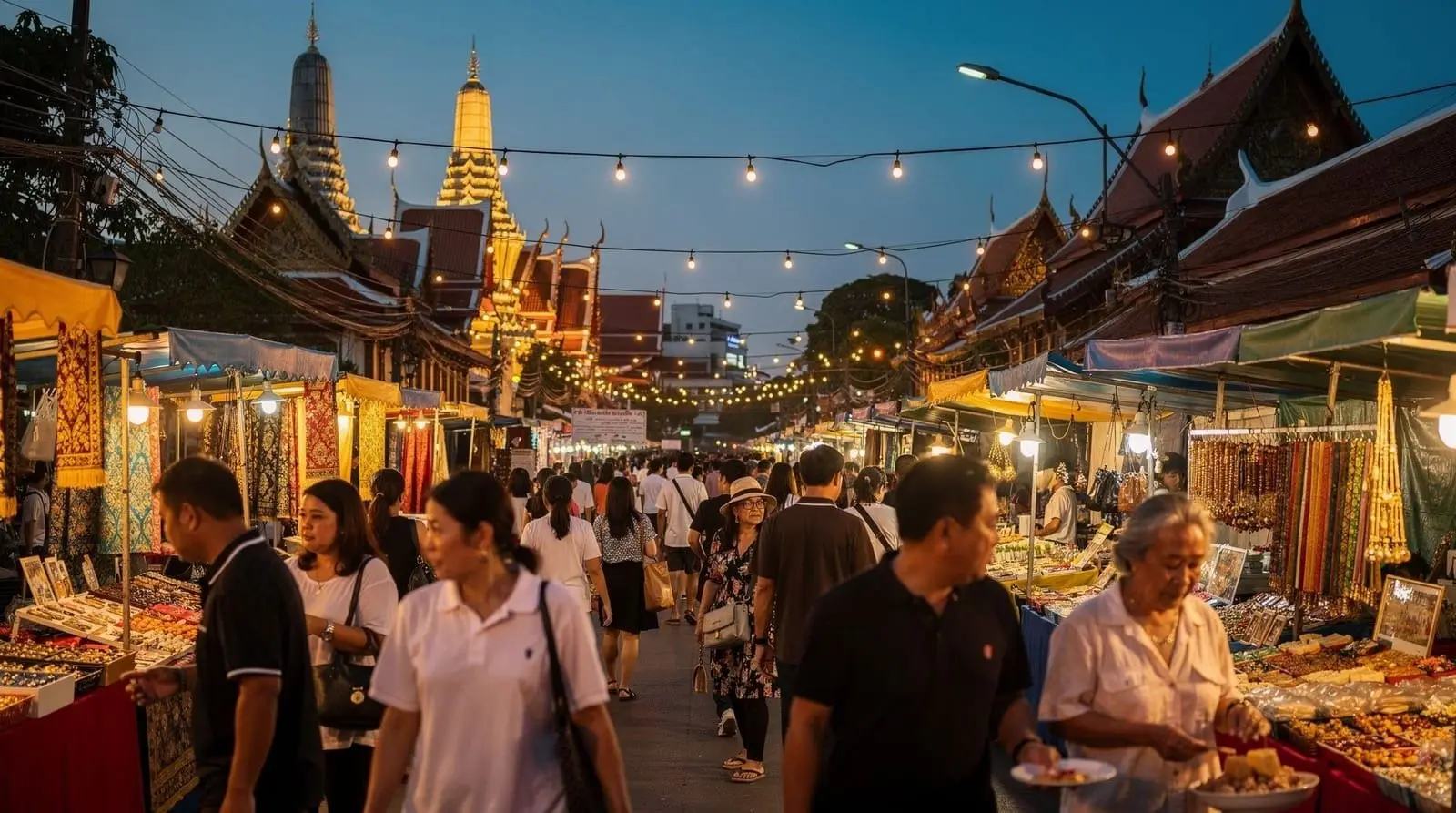
Sunday Walking Street runs the full 1.5 km length of Ratchadamnoen Road plus several side streets, giving it noticeably more ground and more stalls than the Night Bazaar’s Chang Khlan Road strip. The inventory differs too: Sunday’s market leans toward handicrafts, local art, hand-painted goods and textiles, with a visibly higher share of genuinely handmade items among the general souvenir mix. The Night Bazaar skews toward clothing, phone cases, wood carvings and the same broadly generic tourist-market inventory found in similar markets across Thailand — not without exceptions, but the ratio tips further toward mass-produced stock than at Sunday’s market.
Evening local street food and market tour is a way to sample either market’s food with a guide doing the ordering, useful if unfamiliar dishes feel like a barrier to eating well at either one.
Price: the honest comparison
Bargaining works at both, but the starting point differs — Night Bazaar vendors, accustomed to steady tourist foot traffic and less price competition from locals shopping alongside you, tend to open higher and concede less than Sunday Walking Street stalls, where a real mix of Thai and visiting shoppers keeps pricing somewhat more grounded. Comparable items (a printed sarong, a wooden carving, a set of magnets) will often run meaningfully cheaper at Sunday Walking Street after negotiation than at the Night Bazaar, even accounting for haggling at both. See the bargaining etiquette guide for how to negotiate at either.
Food: where the gap is widest
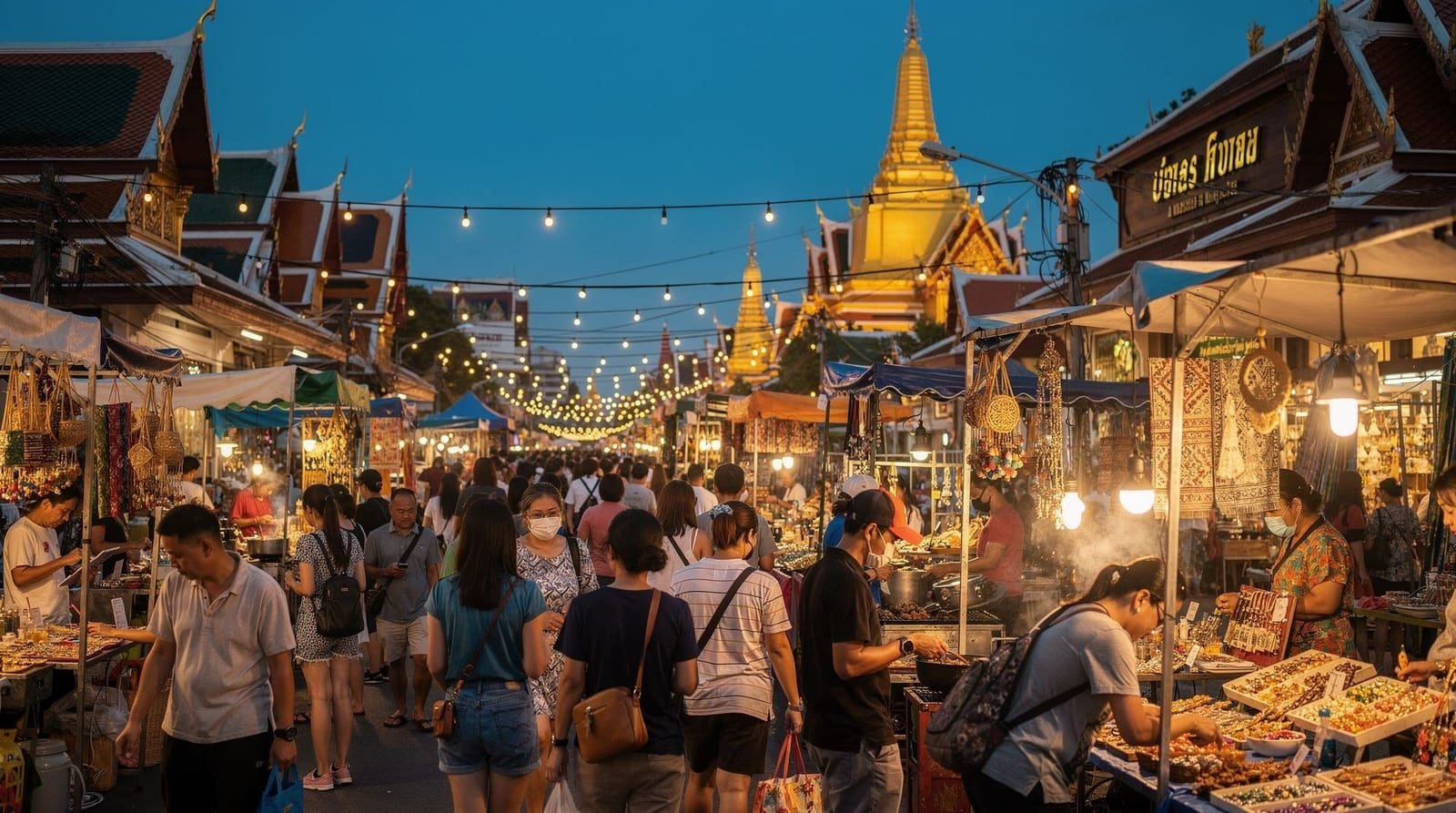
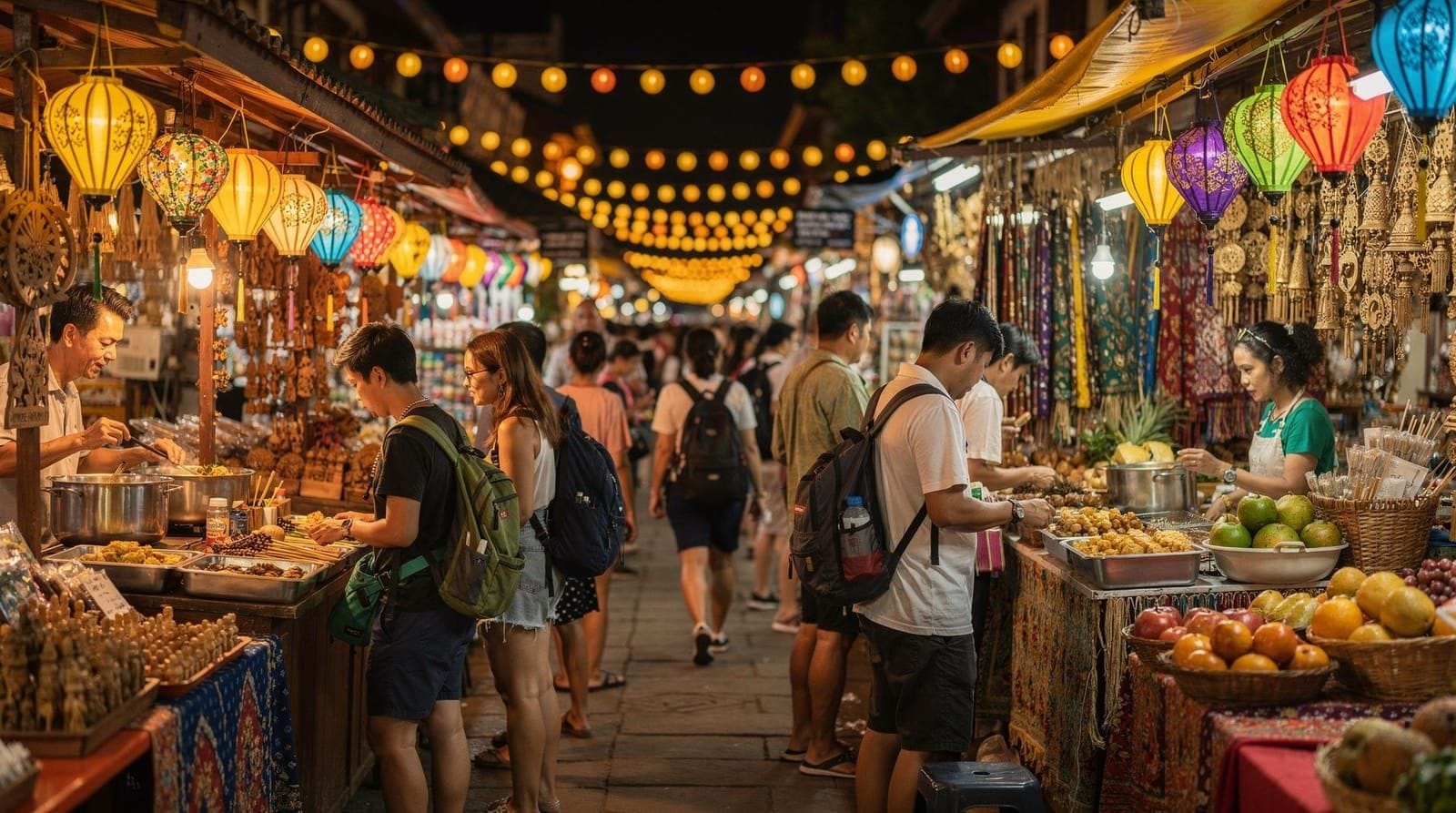
This is arguably the clearest differentiator. Sunday Walking Street’s temple courtyards — Wat Chedi Luang’s grounds especially — turn into genuine open-air food courts on market night, with a rotating cast of vendors selling northern Thai specialties at 40-80 THB per dish. The Night Bazaar’s food options run through the adjacent Kalare and Ploen Ruedee food courts, which are more convenient if you’re staying in that area but run a real 20-40% premium over Sunday Walking Street or Warorot Market prices for broadly comparable dishes.
Temples and street food night tour by tuk-tuk combines a look at some of the Old City’s temples with a food-focused evening, a natural pairing if you’re doing Sunday Walking Street on the same night.
Crowd and atmosphere
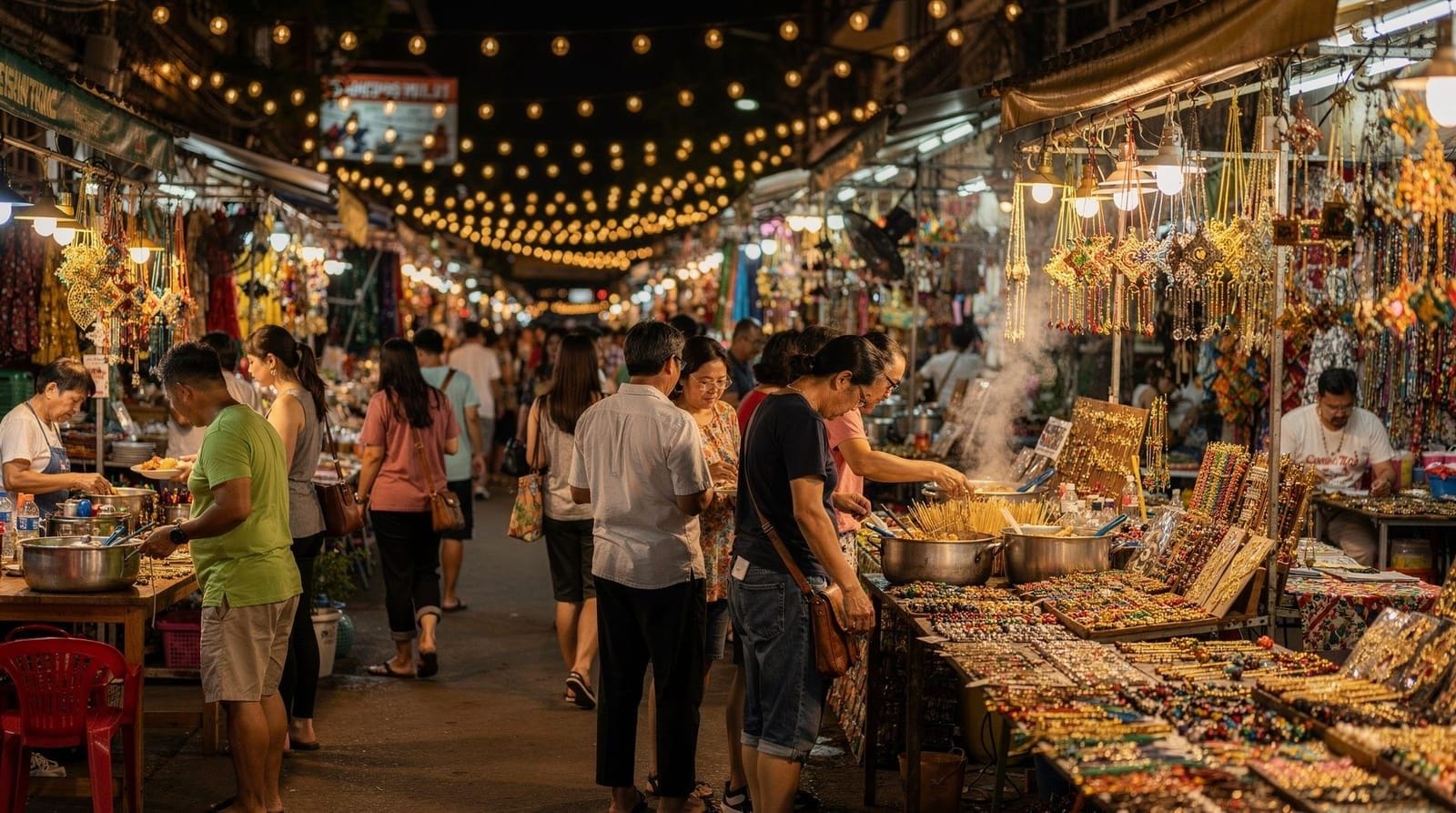
Both markets draw real crowds, but the character differs. Sunday Walking Street’s crowd is a genuine mix — Thai families from Chiang Mai and neighboring provinces make up a significant share of shoppers alongside visitors, which shows in the everyday household goods and snacks aimed at local shoppers scattered among the tourist-facing stalls. The Night Bazaar’s crowd skews more heavily toward visitors and the vendors’ pitch reflects that, with more active calling-out and a generally more transactional feel.
Walking food tour through the market is worth considering for either market specifically for crowd navigation — a guide typically times the route to hit food stalls before the worst of the crush, which matters more at Sunday Walking Street’s peak 6-9pm density than at the Night Bazaar’s more spread-out evening flow.
Getting there
The Night Bazaar sits on Chang Khlan Road, reachable by songthaew (30-50 THB) or Grab (50-80 THB) from the Old City, or a 15-20 minute walk from Tha Phae Gate. Sunday Walking Street starts right at Tha Phae Gate and is walkable from anywhere inside the Old City — genuinely more convenient if you’re staying within the moat, since the road closure means Grab and songthaew drop-offs happen at the perimeter rather than inside the market itself.
What each market does well
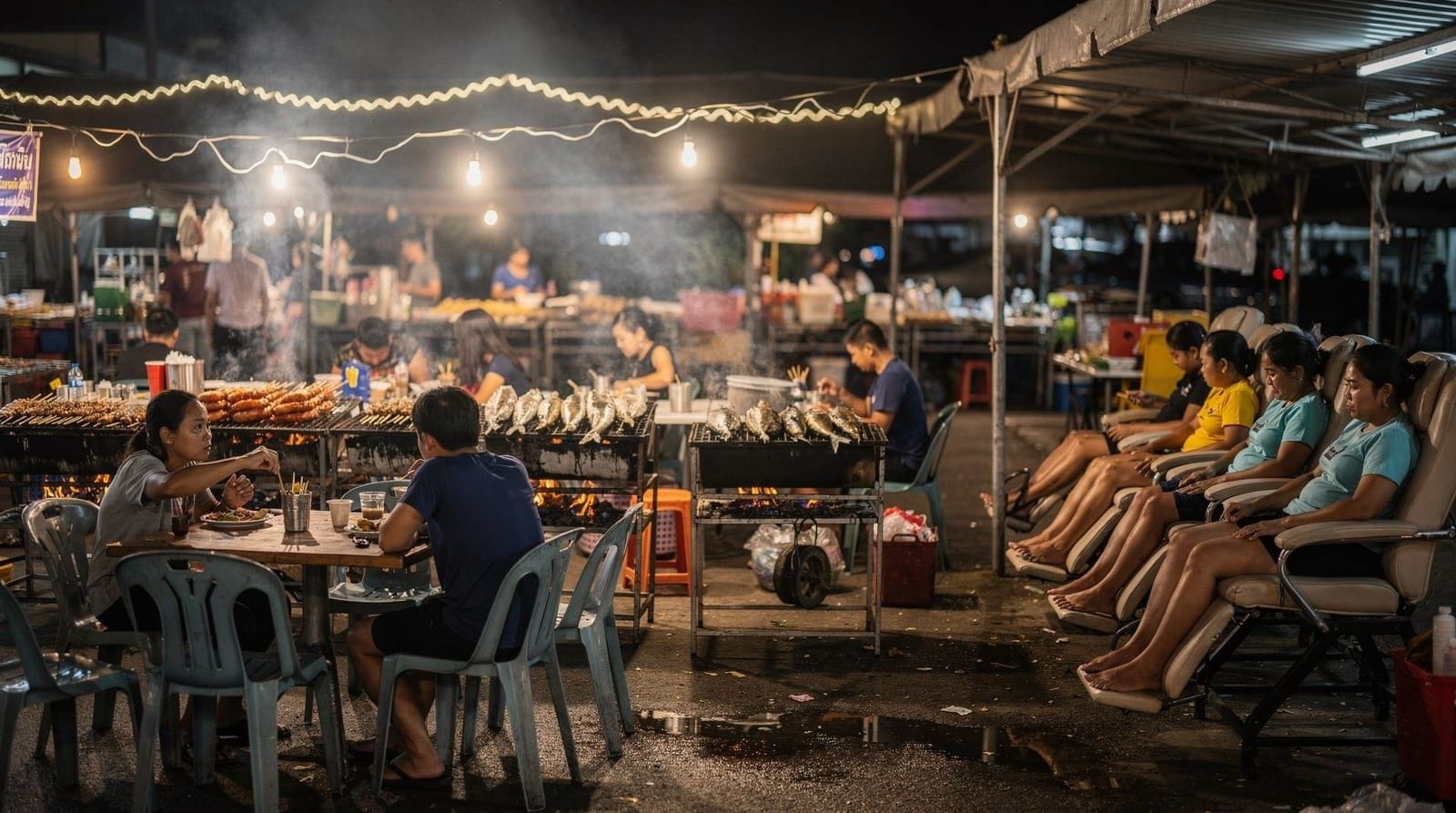
Neither market is objectively “better” across every measure — they serve different needs. The Night Bazaar wins on reliability: it’s there every single night, requires no planning around the calendar, and sits within a cluster (alongside Anusarn Market next door) that also covers seafood dinners and massage. Sunday Walking Street wins on scale, price, food quality and a genuinely more local atmosphere, at the cost of only being available one evening a week.
The history behind each market’s character
Understanding roughly how each market came to be helps explain why they feel so different today. The Night Bazaar grew organically along Chang Khlan Road over decades as Chiang Mai’s tourism industry expanded, driven largely by the steady stream of hotel guests staying in the surrounding area rather than by any single civic decision — which is part of why its inventory skews so heavily toward what sells reliably to visitors rather than what reflects the city’s own craft traditions. Sunday Walking Street, by contrast, was formalized by the municipality in the early 2000s from what had been a smaller, looser gathering of vendors along the same Ratchadamnoen Road corridor, growing over two subsequent decades into today’s scale while retaining a genuinely mixed local-and-visitor crowd. That different origin story is a big part of why one market feels engineered for tourism and the other feels like a civic tradition that visitors are welcome to join.
If you’re short on time and can only pick one
For a trip of three nights or fewer where only one evening can realistically be spared for a market, the deciding question is simple: does your visit include a Sunday? If yes, take it — Sunday Walking Street delivers more of everything that makes these markets worth visiting in the first place. If no, the Night Bazaar is a perfectly reasonable single stop, particularly paired with a dinner at neighboring Anusarn Market to round out the evening with better food than the immediate Night Bazaar food courts offer. Neither choice wastes an evening; the difference is one of degree rather than one being a mistake and the other a triumph.
What visitors most often get wrong
The most common mistake is assuming these two markets are roughly interchangeable and picking whichever one happens to be more convenient on a given night without considering what you actually want from the evening. A visitor prioritizing serious souvenir shopping who ends up at the Night Bazaar on a whim, when their trip actually included a free Sunday they didn’t realize was available, often comes away with a middling impression of Chiang Mai’s markets overall — not because the markets are unimpressive, but because they visited the wrong one for what they wanted. Checking your itinerary for a Sunday before committing to a market plan is a small step that meaningfully changes the outcome.
A final honest note
Neither market is a mistake to visit, and this comparison shouldn’t be read as a verdict that one is good and the other bad. The Night Bazaar earns its popularity through sheer convenience, and plenty of visitors have a perfectly satisfying evening there without ever comparing it to Sunday Walking Street. The point of this guide is simply to make the choice a deliberate one rather than a default — knowing what each market actually delivers means you can pick based on what you want from the evening rather than which one happened to come up first in a guidebook or a hotel concierge’s recommendation.
Practical decision checklist
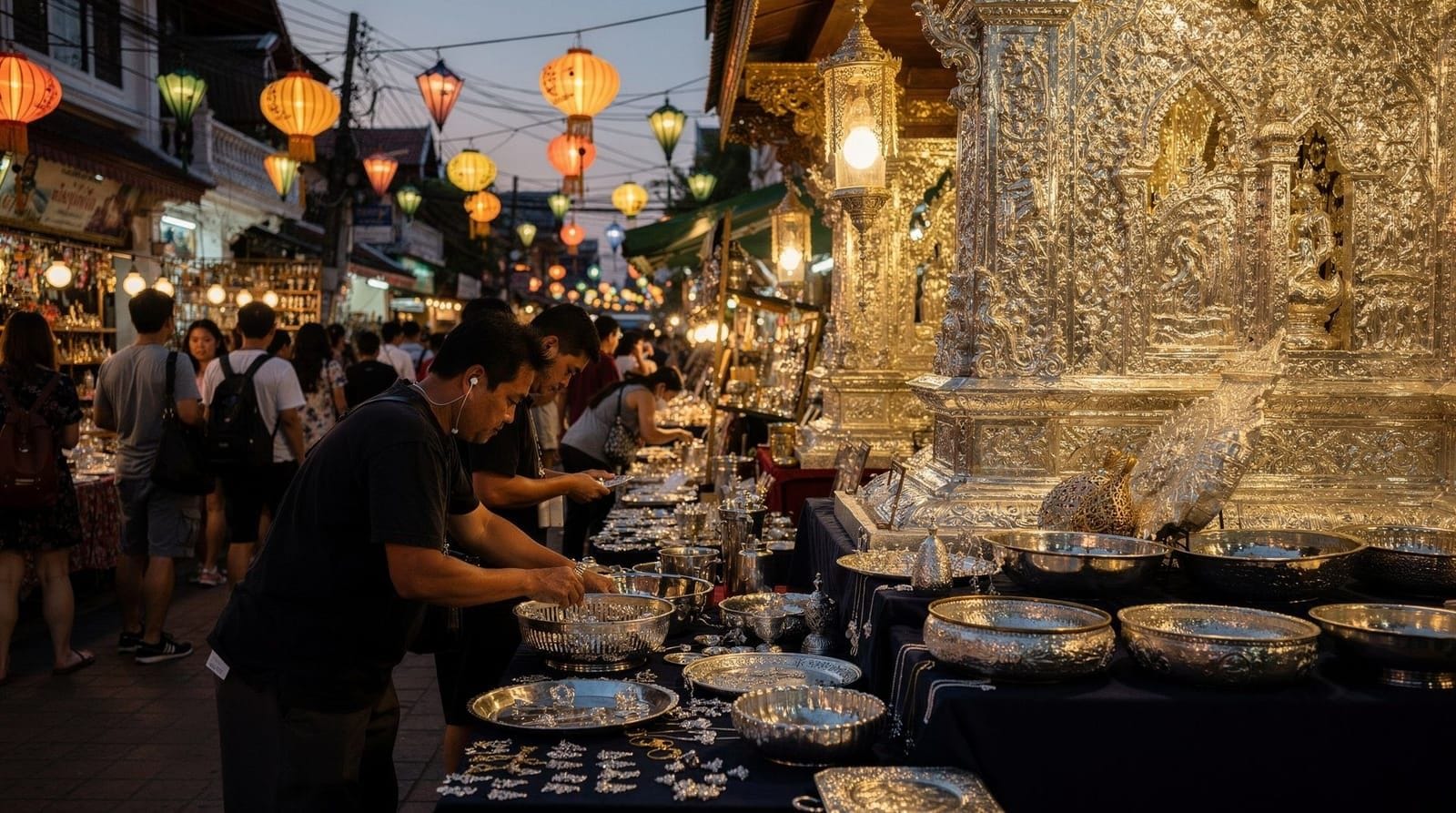
A short checklist helps make the choice quickly rather than mulling it over: does your trip include a Sunday evening? If yes and souvenir variety or food quality matters to you, go there. Is tonight the only night you have, and it’s not a Sunday? Go to the Night Bazaar, and consider pairing it with dinner at neighboring Anusarn Market rather than eating at the Night Bazaar’s own food courts. Is silver jewelry specifically your shopping goal? Neither of these two is the best answer — Saturday Walking Street on Wualai Road is the more purpose-built stop, covered in its own guide.
A side-by-side summary
| Factor | Night Bazaar | Sunday Walking Street |
|---|---|---|
| Runs | Nightly | Sundays only |
| Scale | One street (Chang Khlan Rd) | 1.5 km plus side streets |
| Goods | Clothing, souvenirs, food courts | Handicrafts, art, textiles, food |
| Price vs. baseline | 20-40% above | Roughly at baseline |
| Crowd | Mostly visitors | Genuine local-visitor mix |
| Best for | Convenience, any night | Value, variety, atmosphere |
Accessibility and mobility considerations
Both markets are flat and, in the Night Bazaar’s case, largely paved sidewalk with regular pedestrian traffic year-round, making it the more predictable option for anyone with mobility considerations since it never faces a single peak-crowd night the way Sunday Walking Street does. Sunday Walking Street closes an entire road to vehicles, which in principle makes it accessible ground, but crowd density from around 6pm onward genuinely narrows the walkable path and makes navigation harder for wheelchair users or anyone needing more space to move. Arriving early at either market — before 5pm at Sunday Walking Street, any reasonable hour at the Night Bazaar — is the more realistic way to visit comfortably if mobility is a factor.
Traveling with kids
Both markets can work as family outings, but the practical experience differs. The Night Bazaar’s more spread-out, always-open format means there’s no particular rush or crowd peak to plan around, making it easier to arrive, eat, browse a little and leave whenever the visit runs its course. Sunday Walking Street can be a genuinely memorable family evening — street performers, varied food and general spectacle tend to hold children’s attention — but strollers become difficult to maneuver once the crowd thickens past 6-7pm, and families report better results arriving early, eating in a temple food court, and leaving before the market’s peak density sets in.
A note on weather
Chiang Mai’s rainy season, roughly June through October, affects both markets, but differently. The Night Bazaar’s Kalare and Ploen Ruedee food courts offer partial covering that keeps the evening going through a shower with only minor disruption. Sunday Walking Street is almost entirely open-air along Ratchadamnoen Road, and a heavy downpour can clear the market with little warning, sometimes within twenty minutes of the rain starting. If your trip falls within rainy season and a Sunday evening is the only one available, it’s worth having the Night Bazaar’s covered food courts in mind as a backup plan in case the walking street gets rained out.
Souvenir quality: a closer look
Beyond the general “handicrafts versus clothing” distinction, it’s worth being specific about what each market actually does well. Sunday Walking Street’s strongest categories are hand-painted umbrellas and paper goods tracing back to Bo Sang village, original local artwork sold directly by artists, and textiles with genuine handwoven irregularity rather than a uniform machine finish. The Night Bazaar’s strongest categories are practical, lower-cost items — printed clothing, bags, phone accessories — where authenticity matters less because nobody’s buying them expecting handmade craftsmanship in the first place. Matching your shopping goal to the market’s actual strength, rather than expecting either one to excel at everything, produces a better outcome than treating them as interchangeable.
Combining both into one trip
For visitors with more than a couple of nights in the city, doing both markets on their respective natural nights — the Night Bazaar whenever convenient, Sunday Walking Street specifically on a Sunday — gives a genuinely useful basis for comparison rather than relying on secondhand opinion, including this guide’s. A practical sequence: use the Night Bazaar for an orientation stroll early in the trip, when you’re getting a feel for the city and don’t yet know what you want to buy, then save serious souvenir shopping for Sunday Walking Street once you’ve had a chance to see what’s actually on offer across the city and know what’s worth the money.
Which one should you actually pick
If your trip includes a free Sunday evening, default to Sunday Walking Street — it delivers more of everything that makes a Chiang Mai night market worth visiting, at generally better value. Save the Night Bazaar for a weeknight when Sunday isn’t an option, or treat it as a quick post-dinner stroll rather than the main event of your evening. Visitors with both a Saturday and Sunday free might also consider the quieter, silver-focused alternative at Saturday Walking Street on Wualai Road, covered in its own guide.
Frequently asked questions about the Night Bazaar and Sunday Walking Street
Which market has better food?
Sunday Walking Street, by most honest accounts, thanks to its temple-courtyard food courts. The Night Bazaar’s Kalare and Ploen Ruedee food courts are more convenient but run a real premium for similar dishes.
Which market is easier for a first-time visitor?
The Night Bazaar, since it runs nightly with no calendar-checking required. Sunday Walking Street requires your visit to land on a Sunday but rewards the planning.
Is one market safer than the other?
Both are busy, well-lit and heavily trafficked, with similar risk levels — Sunday Walking Street’s denser peak crowds slightly raise pickpocket risk from crowding rather than from the area itself.
Can I do both in the same trip?
Yes — they run on different schedules and offer different experiences, so doing both (if your dates allow a Sunday) is a reasonable and common choice.
Which is better for souvenir shopping specifically?
Sunday Walking Street generally, for both selection and price, with a stronger showing of genuinely handmade goods.
Does the Night Bazaar have anything Sunday Walking Street doesn’t?
Reliability, plus a compact food-and-massage cluster via neighboring Anusarn Market that runs every night of the week.
How much walking is involved at each?
Sunday Walking Street covers more ground (1.5 km plus side streets) than the Night Bazaar’s single street, so expect a longer outing if you’re trying to see the full route.
Is either market good for buying gifts to bring home?
Both work, but Sunday Walking Street’s handicrafts and local art generally make more distinctive gifts than the Night Bazaar’s more generic souvenir stock.
Top experiences
Bookable activities with verified prices and instant confirmation on GetYourGuide.