Money, ATMs and currency in Chiang Mai: a practical guide
How should I handle money in Chiang Mai?
Carry 1,000-2,000 THB (about USD 28-55) in cash for daily spending at markets, songthaews and small restaurants, and use a card with low or no foreign transaction fees for hotels, malls and larger restaurants. ATMs charge a standard 220 THB (about USD 6) foreign-card fee per withdrawal, so withdraw larger amounts less often rather than smaller amounts frequently.
Money in Chiang Mai works on a hybrid cash-and-card system that catches out visitors who arrive expecting either a fully cashless trip or, at the other extreme, one where cash handles everything. Cards work fine at hotels, malls and larger restaurants; cash remains essential at markets, for songthaews, and at small family-run restaurants and street stalls. This guide covers realistic ATM fees, where to exchange currency, how much cash to carry daily, and the tipping norms that differ meaningfully from Western defaults.
The short version: carry 1,000-2,000 THB (about USD 28-55) in cash for a typical day’s spending, use a card with low foreign transaction fees for bigger purchases, and withdraw larger amounts less often from ATMs to minimize the standard per-transaction fee charged to foreign cards.
Cash versus card: what actually needs which
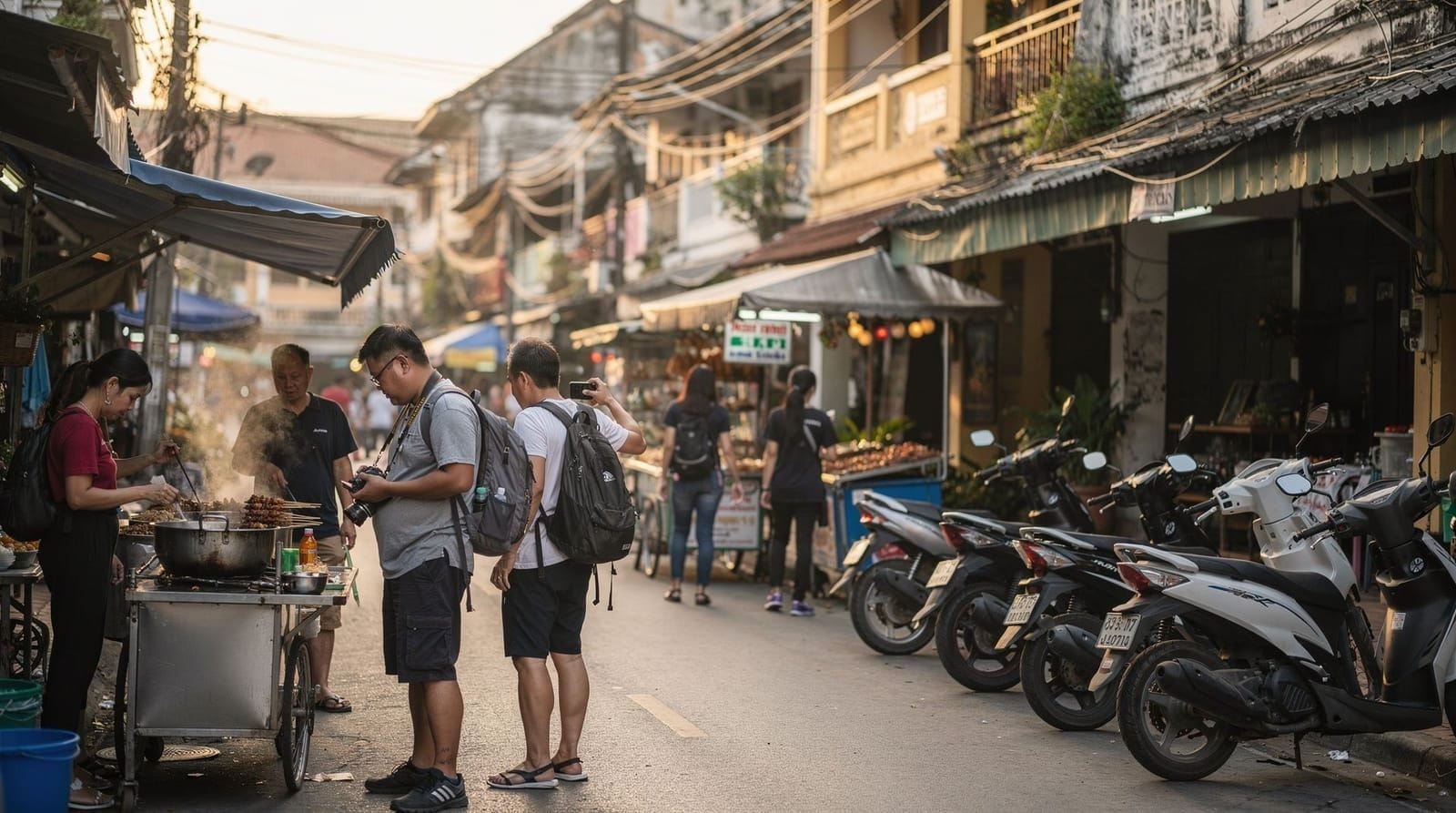
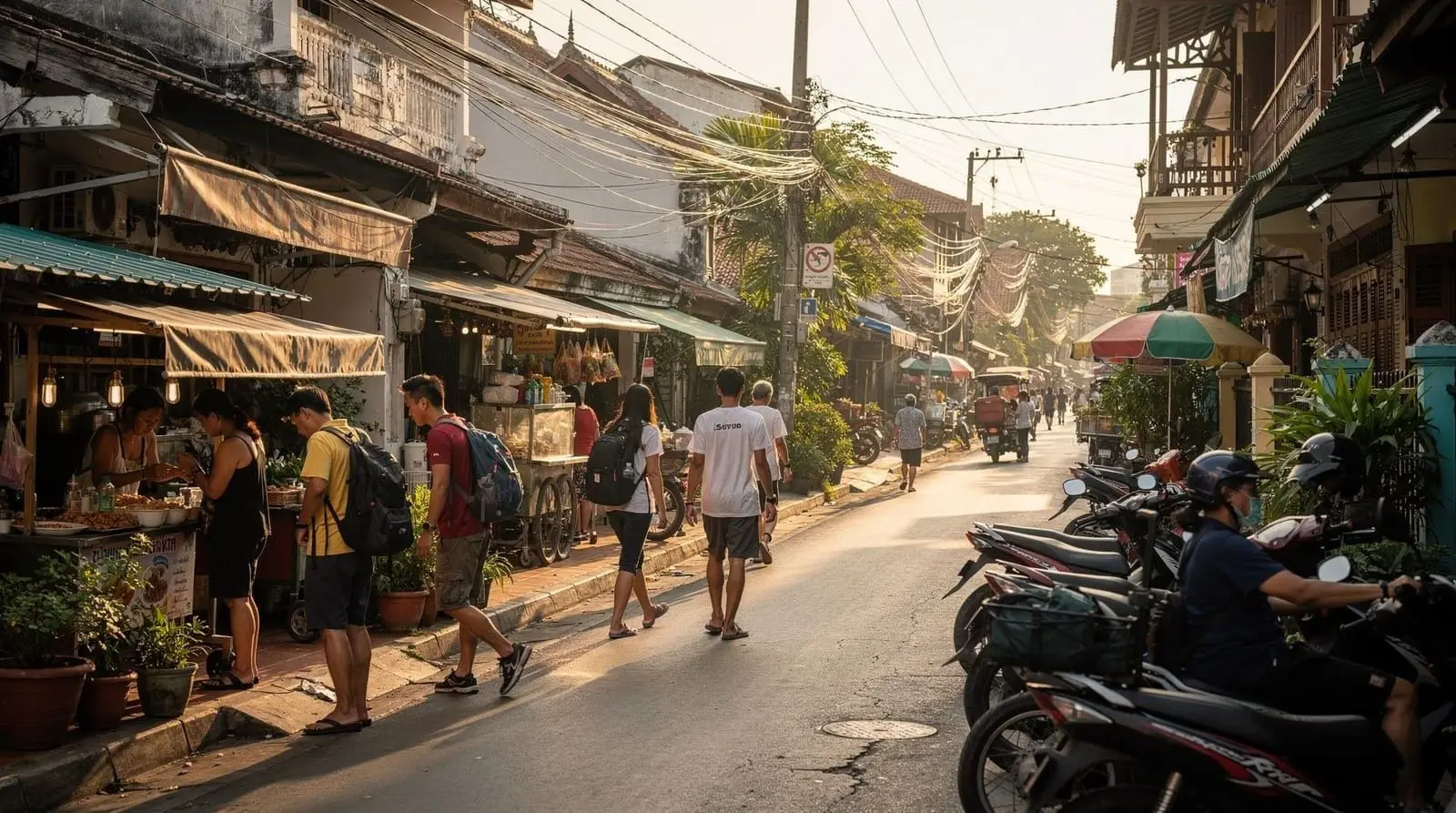
Thailand’s tourism-facing businesses have become considerably more card-friendly over the past decade, but the split between cash-only and card-friendly spending in Chiang Mai still follows a fairly predictable pattern. Hotels, malls, larger and mid-range restaurants, and established shops in areas like Nimmanhaemin generally accept cards without issue, often including contactless and mobile payment options. Markets — Warorot Market, the night markets, Sunday Walking Street — songthaews, small family-run restaurants, and most street food stalls remain cash-only or cash-preferred, since card terminal fees eat meaningfully into already thin margins on lower-priced goods and meals.
This split means a mostly-card trip isn’t realistic in Chiang Mai the way it might be in a major Western city — carrying a reasonable amount of daily cash is simply part of how the city works, not a sign of an unusually cash-dependent destination.
ATM fees: what to actually expect
Nearly every ATM in Chiang Mai charges foreign cards a standard withdrawal fee, commonly around 220 THB (about USD 6) per transaction, regardless of the amount withdrawn — a flat fee rather than a percentage. This is on top of whatever fee or foreign-transaction charge your home bank applies, which varies considerably by bank and card type; checking your specific card’s foreign ATM fee policy before travelling is worth the five minutes it takes. Because the Thai-side fee is flat per transaction rather than scaled to the withdrawal amount, the most cost-effective approach is withdrawing a larger sum less frequently rather than making several smaller withdrawals across a trip — withdrawing 6,000-10,000 THB every few days rather than 2,000 THB daily can save a meaningful amount in cumulative fees over a longer stay.
Bank-branded ATMs (Bangkok Bank, Kasikorn, Siam Commercial Bank and others) are the standard option and widely available throughout the Old City, Nimmanhaemin and every mall. A small number of cards from banks with international fee-free partnerships avoid the local withdrawal fee entirely — worth checking if you’re choosing a travel card specifically for a Southeast Asia trip, since the savings across a longer stay can be substantial.
It’s worth noting that ATM availability in Chiang Mai is dense enough that finding one is rarely the challenge — most streets in the Old City and Nimmanhaemin have multiple machines within a short walk, and every mall has several. The practical decision is less about locating an ATM and more about how often you withdraw, given the flat per-transaction fee structure described above. Some travellers also check their specific ATM’s screen carefully before confirming a withdrawal, since a small number of machines default to a “dynamic currency conversion” option that converts to your home currency at a worse exchange rate than simply withdrawing in Thai baht and letting your own bank handle the conversion — always choosing to be charged in THB rather than your home currency when an ATM offers the choice avoids this extra, avoidable cost.
How Chiang Mai’s cash culture compares within Thailand
Chiang Mai’s cash-and-card split is broadly similar to the rest of Thailand outside Bangkok’s most upscale, internationally-oriented districts, though it leans slightly more cash-friendly than the country’s biggest coastal resort areas, where a higher concentration of large international hotel chains and tourist-oriented restaurants has pushed card acceptance further. If your Thailand trip also includes Bangkok or the southern islands, expect a broadly similar cash routine throughout — carry a comparable daily cash amount, use the same ATM-fee logic, and don’t assume Chiang Mai is unusually cash-dependent compared with the rest of a typical Thailand itinerary. The main practical difference travellers notice moving between destinations is exchange rate and ATM fee consistency — both are governed by the same national banking rules regardless of which Thai city you’re withdrawing in.
Currency exchange: where to get a fair rate
For exchanging cash rather than withdrawing from an ATM, dedicated currency exchange counters generally offer better rates than hotel front desks or airport kiosks, which tend to build in a wider margin given their captive, convenience-driven customer base. SuperRich, a well-known Thai exchange chain with branches in Chiang Mai (both of the differently branded SuperRich chains operate here), is a commonly used reference point for competitive rates, and comparing rates at two or three counters before exchanging a larger sum is worth the few minutes it takes given how much rate differences can add up on bigger amounts. Airport exchange counters are the most convenient but typically the least competitive rate, reasonable only for exchanging a small amount to cover your first hour or two before reaching a better option in the city.
Bringing a modest amount of home currency or USD specifically to exchange isn’t necessary given how accessible ATMs are, but it’s a reasonable backup if your card has any issue on arrival — a small emergency cash reserve in a widely accepted currency covers that scenario without needing to rely entirely on a single card working correctly.
How much cash to carry day to day
A realistic daily cash carry for most travel styles runs 1,000-2,000 THB (about USD 28-55), covering songthaew fares, market food, small shop purchases, and a buffer for anything unplanned. This isn’t the total daily spend — hotel bills, larger restaurant meals and bigger purchases are frequently handled by card on top of this cash figure — but it’s the amount that needs to be physically in your pocket or bag for the parts of daily life that remain cash-first. Carrying meaningfully more than this daily is rarely necessary given how widely available ATMs are throughout the city, and it increases the (still modest) risk of loss or theft without a corresponding benefit.
Breaking large notes is worth doing proactively rather than reactively — a 1,000 THB note is difficult for a small street stall to break, so getting a mix of smaller denominations from an ATM withdrawal (where possible) or by making one larger purchase at a convenience store early in the day smooths out the rest of the day’s small cash transactions considerably.
Tipping: what’s actually expected
Tipping in Chiang Mai is appreciated rather than obligatory, and over-tipping by Western habit is unnecessary and adds up across a trip without changing the service you receive. Restaurants rarely add a service charge outside upscale hotel dining, and rounding up the bill or leaving small change is standard rather than a fixed percentage — 20-50 THB on a typical meal reads as generous. Massage therapists and spa staff commonly appreciate a tip of 50-100 THB given modest base wages in the industry. Tour guides and drivers on day trips typically receive 100-200 THB per person for a full day if service was good, though this remains genuinely optional. Hotel housekeeping is one area where a small daily tip (20-50 THB) is a meaningful, appreciated gesture given wage structures in Thai hospitality, though it’s far from universal practice and nobody comments if you skip it.
Card safety and common issues
A handful of practical card issues come up often enough to plan around. Notify your bank of your Thailand travel dates before departure to avoid a fraud-prevention block on your first transaction — a surprisingly common first-day problem that’s easily avoided with a two-minute call or app notification beforehand. Carry at least two payment methods (a primary card and a backup, ideally from different banks or networks) in case one has any issue, since a single-card trip leaves no fallback if something goes wrong. Use ATMs attached to bank branches or in well-lit, populated locations such as malls rather than isolated stand-alone machines, and check for any visible tampering before inserting your card — standard precautions rather than anything specific to unusual risk in Chiang Mai. Some smaller vendors and a minority of restaurants add a small surcharge (commonly 3%) for card payments to cover their own processing fees — worth asking about upfront if the amount is significant, since paying cash avoids it entirely.
Digital payment apps and QR codes
Thailand has widely adopted QR-code-based mobile payments, and many restaurants, shops and even some market stalls display a QR code for direct bank transfer payments from Thai banking apps. As a foreign visitor without a Thai bank account, this system is mostly not directly usable, though some international payment apps have begun supporting compatible QR payments in Thailand — worth checking if your regular payment app has added this functionality before your trip, since it continues to expand. For most visitors, though, a standard international card and cash remain the reliable, universally accepted combination rather than depending on QR-based systems designed primarily for the local banking ecosystem.
Budgeting money logistics into your trip
Money logistics are one of the smaller but genuinely important pieces of Chiang Mai trip planning, and they connect directly to a few other practical decisions. Our full budget guide covers what a realistic daily spend looks like by travel style, building on the cash-and-card handling covered here. Our visa and entry requirements guide covers a related paperwork consideration — some entry categories occasionally ask for evidence of sufficient funds, worth being aware of alongside your general money planning. And our SIM card and internet guide covers the parallel first-hour task of getting connected, useful for checking exchange rates, finding the nearest ATM, or confirming a card payment went through while you’re still getting oriented.
Understanding Thai baht denominations
Thai baht comes in a handful of note and coin denominations worth recognizing quickly, since fumbling with unfamiliar currency at a market stall or songthaew slows down every transaction in the first few days. Banknotes run 20 THB (green), 50 THB (blue), 100 THB (red), 500 THB (purple) and 1,000 THB (grey-brown), with the 1,000 THB note being genuinely difficult for small vendors to break, as mentioned above. Coins come in 1, 2, 5 and 10 THB denominations, plus smaller satang coins (25 and 50 satang, worth a fraction of a baht) that see limited practical use and are sometimes rounded away entirely at small transactions. Learning to recognize note colors at a glance, rather than reading the numerals under time pressure at a busy market stall, is a small skill that makes the first couple of days noticeably smoother.
Common money mistakes worth avoiding
A handful of recurring mistakes show up in first-time visitors’ money handling in Chiang Mai. Arriving with no cash at all and assuming an ATM will be immediately available and working at the airport is usually fine but not guaranteed — carrying a small amount of home currency or a modest amount of pre-exchanged THB as a buffer avoids being stuck if a machine is temporarily out of service. Exchanging a large amount of cash at the airport out of convenience, rather than withdrawing from an ATM or using a proper exchange counter once in the city, typically costs more than necessary given airport counters’ wider margins. Assuming a Western-style 15-20% tip is standard practice, rather than the considerably lighter local tipping norms covered above, means over-tipping throughout a trip without any expectation from the recipients that you do so. And not notifying your bank of travel dates, leading to a blocked card on day one, remains one of the most common and entirely avoidable first-day frustrations reported by visitors.
Group and family money management
Travelling with a partner, family or group changes the practical money logistics somewhat. Splitting cash withdrawals so more than one person in the group carries a meaningful amount, rather than concentrating all the trip’s cash in a single wallet, reduces the impact of any single loss or theft and speeds up group transactions like paying for a shared meal or a group songthaew ride. For families, giving older children a small personal cash allowance in baht — rather than handling every purchase through a parent’s wallet — is a low-stakes way to practice basic budgeting and currency familiarity during the trip, and simplifies small purchases like snacks or souvenirs considerably. Groups splitting larger costs (a private tour, a multi-person taxi, a shared meal) commonly settle up in cash at the end of the day or activity rather than complicating a card payment with an even split, which is both simpler and avoids any card processing surcharge on the total.
Long-stay and digital nomad banking considerations
Visitors staying a month or more, including Chiang Mai’s substantial digital nomad population, sometimes find it worth exploring options beyond repeatedly paying foreign-card ATM fees on every withdrawal. Some international banks and travel-focused fintech cards offer genuinely fee-free foreign ATM withdrawals as a core feature, which can save a meaningful amount across a long stay’s worth of cash needs — worth researching and potentially arranging before travelling if a longer stay is planned. Opening a Thai bank account is possible for some long-stay visa categories but generally requires a longer-term visa and proof of address rather than being available to standard tourist entries, and isn’t something most visitors need to pursue for a trip of a few weeks or less. Our trip-planning guide touches on the broader long-stay logistics picture beyond money specifically.
A simple first-day money routine
For a straightforward first day: withdraw a moderate amount of cash from an airport or hotel-adjacent ATM shortly after arrival (enough for 2-3 days rather than the whole trip, to limit any single-withdrawal risk while you’re still getting oriented), notify your bank of your travel dates before you fly so the withdrawal isn’t flagged, and keep a card as backup for anything beyond typical daily cash spending. From there, top up cash every few days from an ATM as needed, keeping the per-transaction fee in mind by withdrawing reasonably large amounts each time, and rely on cards for accommodation, larger restaurant meals and bigger purchases throughout the rest of the trip. Our how many days to spend in Chiang Mai guide and full trip-planning guide tie this money routine into the rest of what to sort out before and during your stay, and getting it right in the first 24 hours removes one of the small recurring frictions that can otherwise nag at an entire trip.