Chiang Mai budget guide: real daily costs for 2026
How much does a day in Chiang Mai cost?
Budget travellers can manage on roughly 800-1,200 THB per day (about USD 22-33), mid-range travellers should plan for 2,000-3,500 THB (about USD 55-97), and luxury travellers typically spend 5,000 THB or more (USD 140+) per person per day, all figures at an approximate rate of 36 THB to the US dollar. Accommodation and big-ticket activities like elephant sanctuaries or day trips are the main variables between the three tiers.
Chiang Mai’s reputation as one of Southeast Asia’s most affordable travel destinations holds up in practice, though the gap between a genuinely frugal day and a comfortable mid-range one is bigger than most generic “cheap Thailand” advice suggests. This guide breaks daily costs down by category and travel style, using real 2026 baht figures with an approximate USD conversion (roughly 36 THB to the dollar — check a live rate before changing money, since it moves).
The short version: budget travellers can get by on 800-1,200 THB (about USD 22-33) a day, mid-range travellers should plan for 2,000-3,500 THB (USD 55-97), and luxury travellers typically spend 5,000 THB (USD 140) or more per person per day. Accommodation is the single biggest variable between these tiers — food and local transport vary far less than most visitors expect.
Accommodation: the widest cost range
A basic guesthouse or hostel dorm bed in the Old City or near Nimmanhaemin runs 250-450 THB a night for a dorm bed, or 400-700 THB for a simple private room with a fan or basic air conditioning. Mid-range travellers should expect 1,200-2,800 THB a night for a comfortable three-star hotel or a well-reviewed boutique guesthouse with air conditioning, hot water and reliable wifi — plentiful in both the Old City and Nimmanhaemin. Luxury accommodation, including riverside resorts and design-forward boutique hotels, runs from around 5,000 THB up to 15,000 THB or more a night, still typically cheaper than equivalent quality in Bangkok or on the southern islands.
Prices shift meaningfully with the season: cool season (November through February) is peak demand and peak pricing, while rainy season (June through October) sees the same rooms drop 20-30% with plenty of availability. Our guide comparing the Old City and Nimman as a base covers specific price bands and streets within each neighborhood in more detail.
Food: the category where budget travel genuinely works
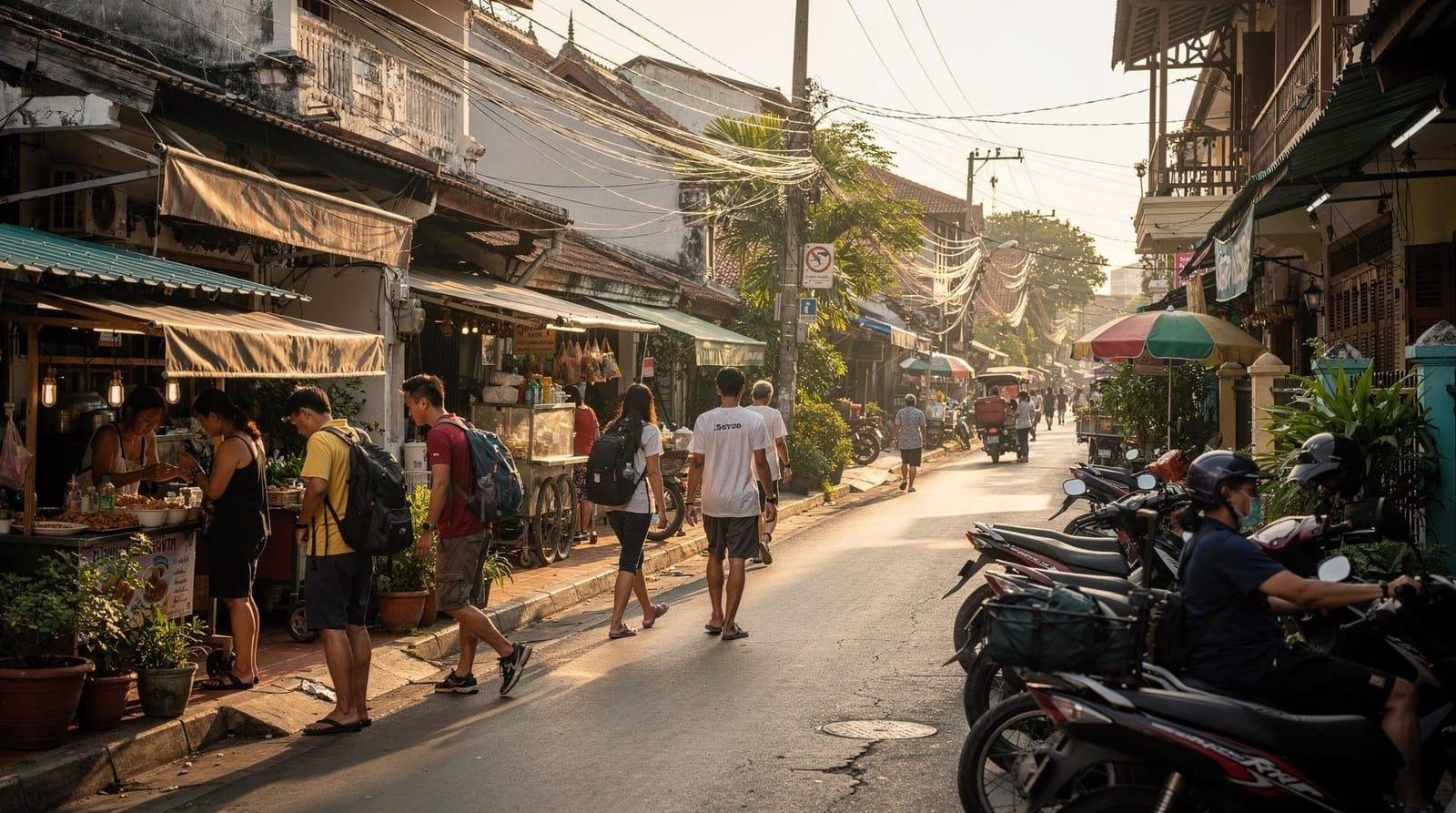
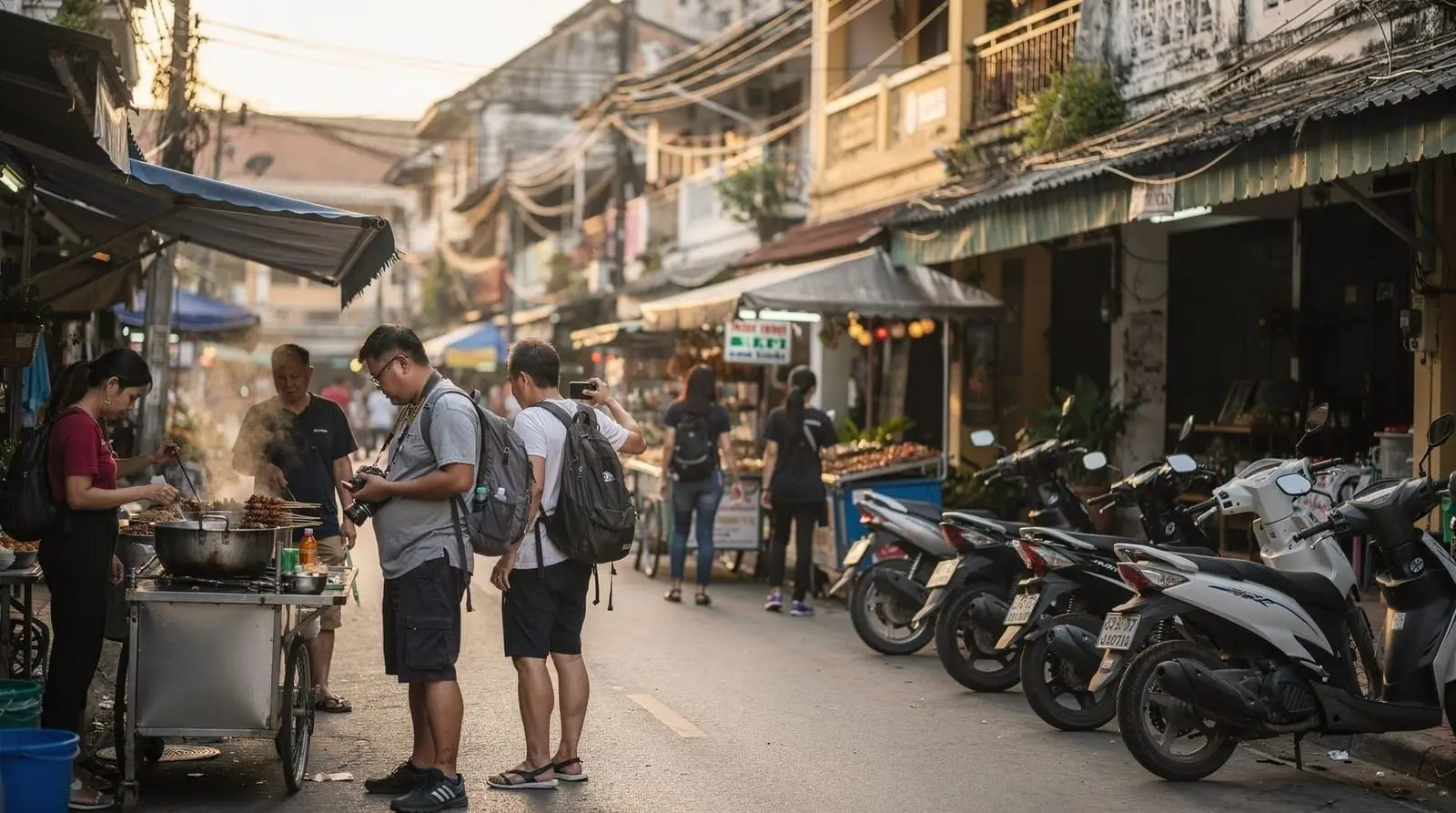
Chiang Mai’s street food and market scene makes eating well on a tight budget straightforward in a way that’s not always true elsewhere. A street food meal — noodles, a rice dish, a portion of khao soi — typically runs 40-80 THB (about USD 1.10-2.20). A casual sit-down restaurant meal runs 100-250 THB, and a nicer restaurant dinner with drinks runs 300-600 THB per person. Even luxury travellers rarely need to spend more than 800-1,200 THB per person at Chiang Mai’s higher-end restaurants, which is considerably less than equivalent fine dining in most Western cities.
Realistic daily food budgets: 200-350 THB for a backpacker eating mostly street food and markets, 500-900 THB for a mid-range traveller mixing restaurants and street food, and 1,200 THB or more for a luxury traveller eating primarily at nicer restaurants. Night markets and day markets such as Warorot Market offer some of the best value-for-quality food in the city regardless of overall travel style.
Local transport: consistently cheap across all budgets
Getting around Chiang Mai costs roughly the same whether you’re a backpacker or a luxury traveller, since songthaews (the shared red trucks) charge a flat 30-40 THB per ride regardless of who’s riding. Grab rides across town typically run 60-150 THB depending on distance and time of day. A scooter rental runs 200-350 THB a day, useful for independent day trips but carrying real road-safety and licensing considerations worth weighing against the modest savings over booking a tour with transport included.
Airport transfers run 80-150 THB by Grab or metered taxi given how close the airport sits to the city center — one of the few areas where Chiang Mai is simply cheaper than most comparable cities by virtue of geography rather than pricing strategy.
Activities: where travel style diverges again
Activities are the second-biggest budget variable after accommodation. A half-day ethical elephant sanctuary visit with hotel pickup and lunch typically runs 1,500-2,500 THB (USD 42-70) per person — one of the pricier single activities in a typical itinerary, and widely considered worth it given the experience. A cooking class runs 900-1,800 THB depending on half-day versus full-day and market versus farm format. Temple entry fees are minimal or free at most sites, with a handful of the more elaborate temples charging 20-50 THB. Day trips booked with transport included — to Doi Inthanon, Chiang Rai or the sticky waterfalls — typically run 1,000-2,500 THB per person depending on distance and group size.
A realistic daily activities allowance: 0-300 THB for a backpacker doing mostly free and low-cost things (our free things to do guide covers exactly what’s available at no cost), 500-1,000 THB averaged across a mid-range trip that includes one or two paid activities every few days, and considerably more for a luxury traveller booking private tours and multiple premium experiences.
Sample daily budgets by travel style
Putting the categories together: a backpacker day totals roughly 800-1,200 THB (USD 22-33) — dorm or basic room, mostly street food, songthaews and walking, minimal paid activities. A mid-range day totals 2,000-3,500 THB (USD 55-97) — a comfortable hotel room, a mix of restaurant and street food meals, occasional Grab rides, and one paid activity every few days. A luxury day runs 5,000 THB (USD 140) or more — a boutique or resort room, restaurant dining throughout, private transport, and daily premium activities or spa treatments.
These figures cover accommodation, food, local transport and an averaged activities allowance, but not international flights, travel insurance, or one-off big-ticket day trips, which should be budgeted separately on top of the daily rate. Our full trip-planning guide and the free budget calculator on the tools page let you plug in your own number of nights and travel style for an instant total, and our guide on how many days to spend in Chiang Mai helps translate a daily rate into a realistic trip-length total.
One-off costs to budget separately
Beyond the daily rate, a handful of one-off costs belong in a separate line of the budget rather than folded into a per-day average. International flights vary enormously by origin and season and should be shopped independently of everything in this guide. Travel insurance for a typical 1-2 week Thailand trip runs modestly — check specifically that any scooter use, trekking or adventure activity you’re planning is covered, since standard policies sometimes exclude these by default. A Thailand entry requirement, where one applies to your nationality, and the mandatory Thailand Digital Arrival Card completed online before arrival are both covered in detail in our visa and entry requirements guide, and neither typically carries a significant cost for most nationalities. Day trips further afield — a Chiang Rai day tour, a Mae Hong Son loop, or a Golden Triangle excursion — run as one-off costs of 1,200-3,000 THB per person depending on distance and format, and are worth budgeting individually rather than averaging into a daily rate, since not every day includes one.
An eSIM or local SIM card is a small but recurring cost worth planning for specifically: figure 300-800 THB for a data package covering a typical 1-2 week stay, detailed in our SIM and internet guide.
Family budgets: what actually changes
Families traveling with children face a moderately different budget shape than the solo or couple figures above. Accommodation costs rise since most families need either a larger room or two connecting rooms rather than a single budget room, typically adding 30-50% to the nightly accommodation line even at the mid-range tier. Food costs per person often drop somewhat, since children’s portions and shared dishes reduce the per-head restaurant spend below adult rates. Activities remain a similar cost per person for anything the whole family does together — ethical elephant sanctuaries in particular are priced per person regardless of age in most cases, though some operators offer child discounts worth asking about when booking. Overall, families should budget the mid-range daily figure per adult and roughly 60-75% of that per child for a realistic family total, before any child-specific discounts.
Common overspending traps in Chiang Mai
A few patterns consistently push visitors’ actual spending above their planned budget, regardless of travel style. Booking every day trip and activity through a hotel front desk rather than comparing prices online typically costs 20-40% more for an identical tour, since front desks add a booking commission. Ordering exclusively at restaurants directly facing major tourist sights, rather than walking one or two streets back or into a market, routinely costs double for comparable food quality. Renting a scooter “just in case” and then barely using it wastes money that would have covered several Grab rides to the same places, and carries risk beyond the financial cost if you’re not genuinely comfortable riding one. And skipping a proper look at ATM withdrawal fees — covered in detail in our money, ATMs and currency guide — means paying an avoidable per-transaction fee on every single cash withdrawal across the trip rather than withdrawing larger amounts less frequently.
Digital nomad and long-stay monthly budgets
Travellers staying a month or more shift into a different budgeting frame entirely, and Chiang Mai’s reputation as an affordable long-stay base generally holds up. A one-bedroom condo in or near Nimmanhaemin with reasonable amenities typically runs considerably less per month than a comparable short-stay hotel room priced per night over the same period, which is the core economic logic behind the city’s long-running digital nomad scene. Add a coworking membership, motorbike rental, and a mostly local-restaurant-and-market diet, and many long-stay visitors report a comfortable monthly cost of living well below what the same lifestyle costs in most Western cities or in Thailand’s coastal hubs. The trip-planning guide linked above covers the visa and logistics side of a longer stay, which matters more for this kind of budget than any of the daily figures above.
Solo versus group and family cost-sharing
Travelling with a partner or in a group changes the per-person math more than solo travellers sometimes expect, mainly through accommodation and transport. A double room typically costs only slightly more than a single room at the same property, which roughly halves the per-person accommodation cost for two people sharing versus travelling solo. Grab and taxi rides split three or four ways cost a fraction per person of what a solo traveller pays for the same trip, making groups meaningfully cheaper per head for anything beyond walking distance. Activities booked as a private tour rather than joining a group tour become far more cost-competitive with three or four people splitting the private rate, sometimes landing close to the per-person group-tour price while getting a private, more flexible experience. Solo travellers should budget accommodation and private transport closer to the top of each range given they’re not splitting these costs, while food and most group-tour activities cost the same per person regardless of group size.
How Chiang Mai compares to the rest of Thailand
Within a broader Thailand trip, Chiang Mai sits at the more affordable end of the spectrum. Coastal hubs and the southern islands typically run 20-40% higher for equivalent accommodation and often carry additional costs for boat transfers, marine park fees and pricier restaurant scenes catering to a more upscale international crowd. Bangkok sits somewhere in between — cheaper street food and transport than the islands, but pricier accommodation in central, well-located areas than Chiang Mai’s equivalent. This makes Chiang Mai a natural place to spend a larger share of a fixed multi-city Thailand budget without feeling like you’re compromising on quality, and a sensible base for travellers trying to stretch a longer trip across more days on a set total budget.
Exchange rates do shift over time, and the approximate 36 THB to the dollar figure used throughout this guide should be checked against a live rate before any major cash exchange or when comparing prices while actually in-country — a rate shift of even a few percent changes the effective cost of a longer trip meaningfully more than any single money-saving tip above.
Money-saving moves that don’t feel like compromises
A handful of choices lower the daily cost noticeably without meaningfully reducing what the trip delivers. Eating at markets and street stalls rather than tourist-facing restaurants near major sights costs a fraction of the price for comparable or better food — locals eat at the same stalls, which is usually the best sign of quality. Travelling in rainy season (June-October) rather than cool season cuts accommodation costs by 20-30% for the same rooms, with the trade-off of occasional afternoon downpours that rarely derail a full day. Walking or using songthaews instead of Grab for short distances inside the Old City or Nimmanhaemin saves meaningfully over a full trip without costing much time. And booking one well-chosen ethical elephant sanctuary visit rather than multiple animal-encounter activities keeps the single largest activity expense to one strong experience rather than several diluted ones.
Tipping: what’s expected and what isn’t
Tipping in Chiang Mai is appreciated but not obligatory in the way it is in North America, which is worth knowing since over-tipping by Western habit adds up unnecessarily across a trip. Restaurants rarely add a service charge outside upscale hotels, and rounding up the bill or leaving small change is standard practice rather than a fixed percentage — 20-50 THB on a typical meal is generous and well received. Massage therapists and spa staff commonly do appreciate a tip of 50-100 THB, since base wages in the industry are modest. Tour guides and drivers on day trips typically receive 100-200 THB per person for a full day if the service was good, though this is genuinely optional rather than expected. Hotel housekeeping and porters are the one place where a small daily tip (20-50 THB) is a meaningful gesture given the wage structure in Thai hospitality, though far from every visitor does this and nobody will comment if you don’t.
What genuinely isn’t worth cutting
A few corners are worth not cutting regardless of budget tier. Travel insurance that covers medical treatment and, if relevant, scooter use, is inexpensive relative to the cost of an uninsured hospital visit or evacuation and shouldn’t be skipped to save a small amount. An ethical elephant sanctuary, rather than a cheaper riding camp, costs somewhat more but is the right trade-off on animal welfare grounds alone, not just a budgeting one — our guide on why to avoid elephant riding covers the reasoning in full. And accommodation cheap enough to compromise on basic safety or cleanliness rarely saves enough to be worth the downside, particularly since decent budget options are widely available at the low end of the ranges above.
The money and SIM guides linked above cover two more practical costs — card fees and connectivity — that factor into the real total but are easy to overlook when budgeting from accommodation and food alone.