White Temple (Wat Rong Khun)
Chalermchai Kositpipat's all-white temple near Chiang Rai — the bridge of hands, the gold restroom building, and how to beat the crowds.
Chiang Rai White, Blue and Red Temple Tour
Duration: Full day
Quick facts
- Getting there
- ~13km south of Chiang Rai town (~20 min); ~3.5-4hr (~195km) from Chiang Mai
- Key sight
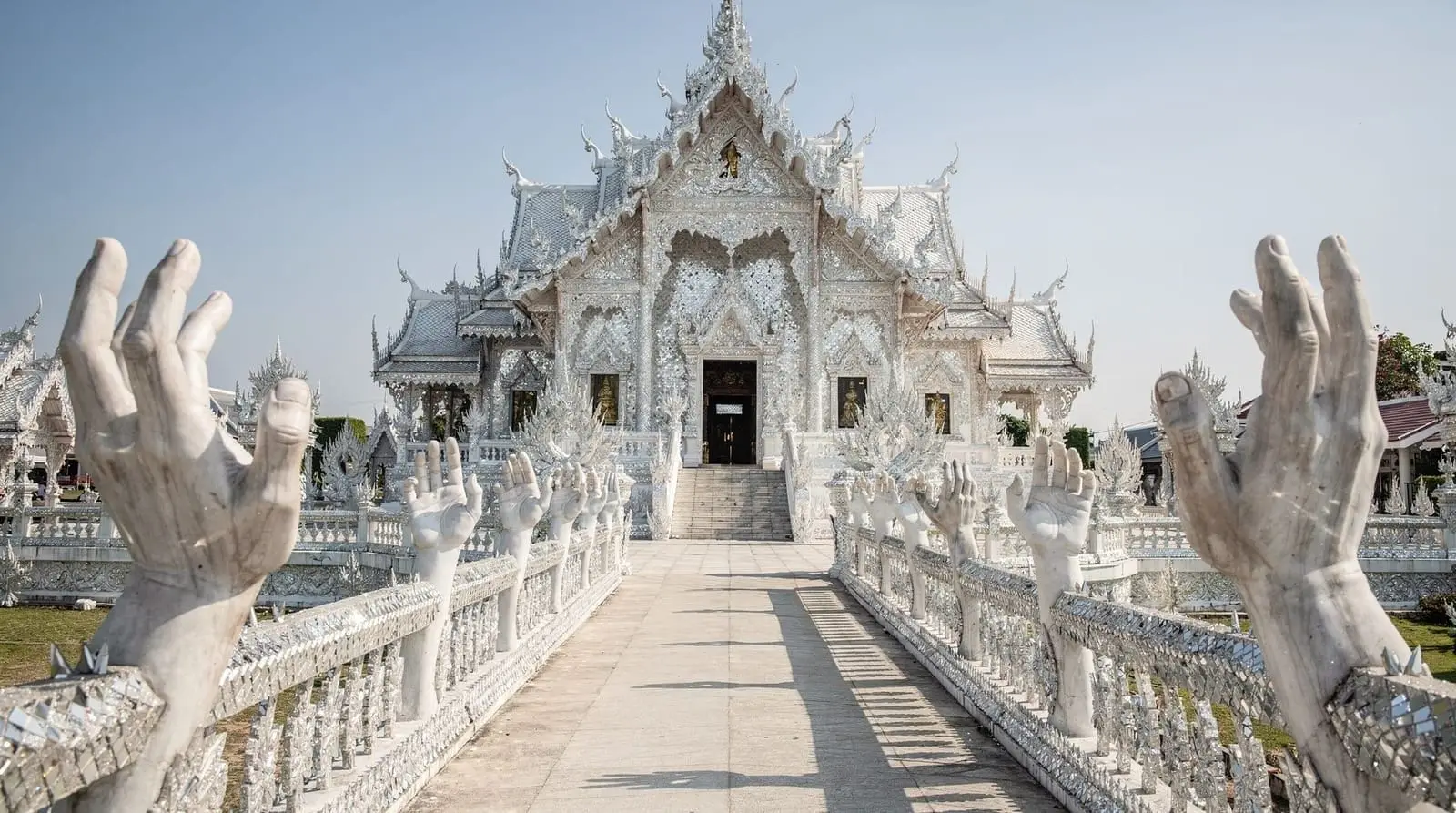
- The bridge of "hands of desire" leading to the white ubosot, and the gold-painted restroom building
- Time needed
- 45 minutes to 1.5 hours
- Best time
- At opening (usually 8am), before tour buses arrive from around 10am
- Cost / entry
- ~100 THB foreigner entry (~$2.80)
The White Temple is the single most photographed building in northern Thailand, and unlike most famous temples in the region, it isn’t old at all — it’s a living, unfinished work by a single artist, still under construction decades after it began.
Quick answer: Wat Rong Khun, universally known as the White Temple, is a contemporary Buddhist temple complex about 13km south of Chiang Rai town, designed and funded by Thai artist Chalermchai Kositpipat starting in 1997. Its all-white, mirror-mosaic exterior represents purity, and its most famous feature is a bridge over a sculpted sea of reaching hands — representing unrestrained desire — that visitors cross to reach the main ubosot (ordination hall). Entry runs about 100 THB (~$2.80) for foreign visitors, and the site is best visited at opening, since it draws heavy tour-bus crowds from mid-morning onward.
An artist’s temple, not an ancient one
Unlike Chiang Mai’s Old City temples or even Doi Suthep, the White Temple has no centuries-old history to draw on — it’s the ongoing personal project of Chalermchai Kositpipat, a Thai national artist who began rebuilding a dilapidated temple on the site in 1997 using his own funds, intending it as a merit-making act and a gift to Buddhism rather than a commercial venture. Construction is still not complete, and Chalermchai has stated the project will continue for decades, funded in part by temple donations and merchandise sold on-site, deliberately without accepting large corporate sponsorship in order to keep creative control over the design.
This context matters for visitors: the White Temple functions simultaneously as an active place of worship, a personal artistic statement, and one of the most visited attractions in Thailand, and the combination is unusual enough that it rewards a bit of background knowledge before arrival, rather than treating it as a purely decorative photo backdrop.
The bridge of hands and the crossing to the ubosot
The temple’s signature image, appearing on nearly every photograph and postcard of the site, is the approach to the main ubosot: a bridge crossing above a sculpted sea of pale, reaching hands, representing unrestrained desire and suffering, that visitors symbolically cross over on their way from the “cycle of rebirth” toward enlightenment. Guardian figures and demon sculptures flank sections of the approach, continuing the same cosmological narrative in increasingly elaborate mosaic and stucco work as you near the main hall itself.
Inside the ubosot, the artistic style shifts dramatically: rather than traditional Buddhist murals, the interior walls are painted with a striking, sometimes startling mural incorporating modern and pop-culture imagery — imagery has changed over the years as Chalermchai reworks sections of the interior, so don’t be surprised if photos you’ve seen online don’t perfectly match what’s inside on your visit. Photography is generally not permitted inside the ubosot itself, so the exterior mosaic work and the bridge crossing are where most visitors’ photos come from.
The gold building: not what it looks like
A short distance from the main white complex sits a solid gold-painted building that surprises almost every first-time visitor: it’s the site’s public restroom, deliberately built in a golden, ornate style as a piece of the artist’s overall vision — his stated reasoning being that even something as mundane as a restroom should be beautiful, and the contrast between the temple’s white purity and this gold structure representing worldly, physical needs is intentional rather than incidental. It’s become a minor attraction in its own right, and many visitors photograph the exterior even without needing to use the facilities.
Getting there from Chiang Rai and Chiang Mai
The temple sits about 13km south of Chiang Rai town center, roughly a 20-minute drive, making it an easy stop for anyone staying in the city overnight. From Chiang Mai, it’s a considerably longer trip — roughly 3.5-4 hours and 195km — which is why nearly every visitor from Chiang Mai sees it as part of a broader Chiang Rai day tour rather than a standalone destination.
Local songthaews and buses connect Chiang Rai town to the temple for independent travelers staying nearby, but the large majority of visitors arrive either as part of an organized tour or by private car/taxi arranged from Chiang Rai or Chiang Mai.
Crowds, timing, and why the order of your day matters
Tour buses from Chiang Mai typically arrive at the White Temple mid-morning, after the roughly 3.5-hour drive, meaning the site is at its most crowded from about 10am to early afternoon. If you’re staying overnight in Chiang Rai and can reach the temple at or shortly after its 8am opening, you’ll have a materially different experience — the bridge and main courtyard walkable without jostling for the same handful of photo spots.
If you’re on a Chiang Mai day tour and can’t control the exact arrival time, ask your operator whether the White Temple is the first or last stop of the day; an itinerary that visits at opening before continuing to the Blue Temple and Black House is preferable to one that saves it for a midday or afternoon slot. A Chiang Rai White, Blue and Red Temple tour is one of several standard combinations that includes the White Temple alongside two others in a single day.
Pairing with the Blue Temple and Black House
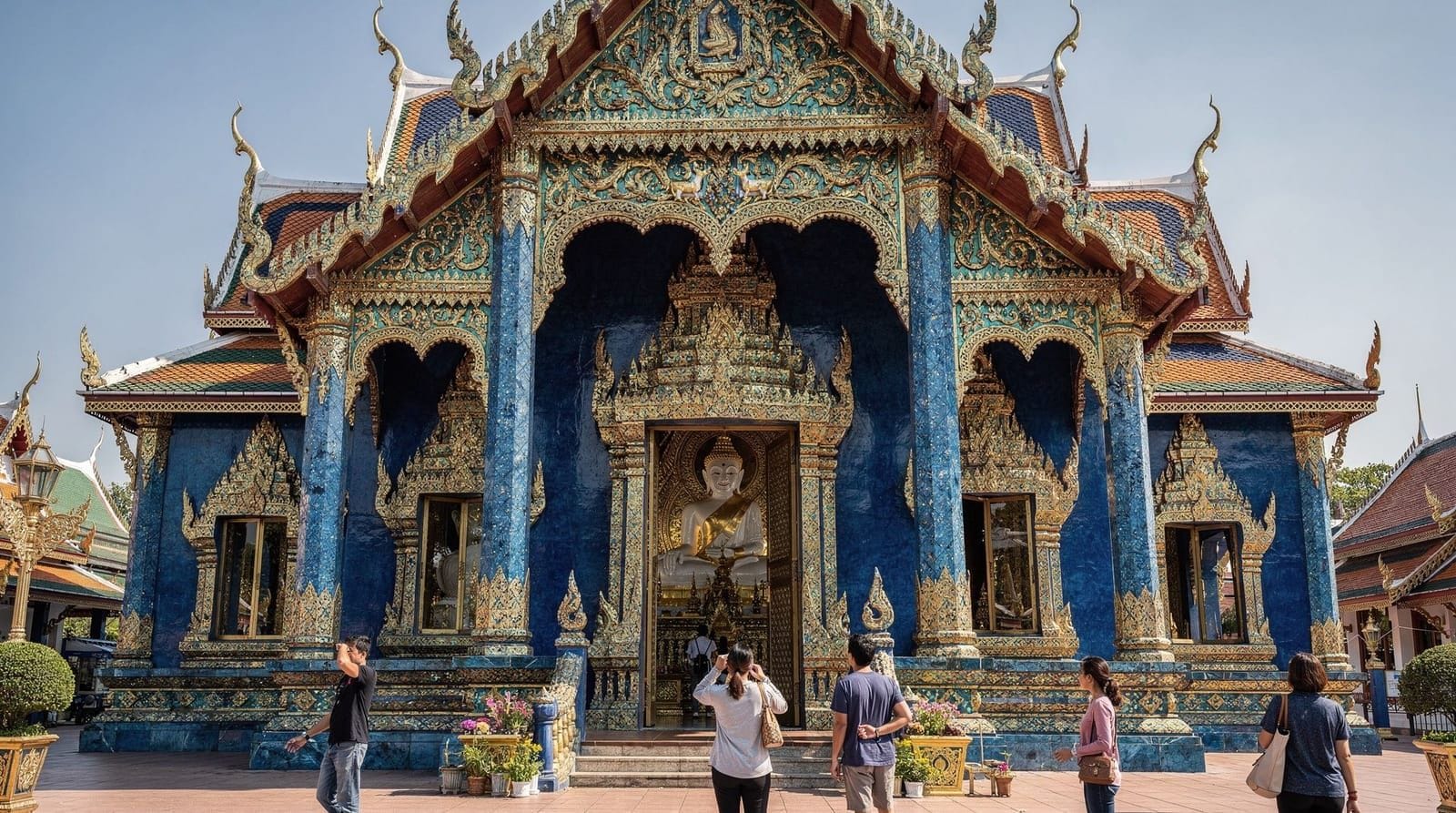
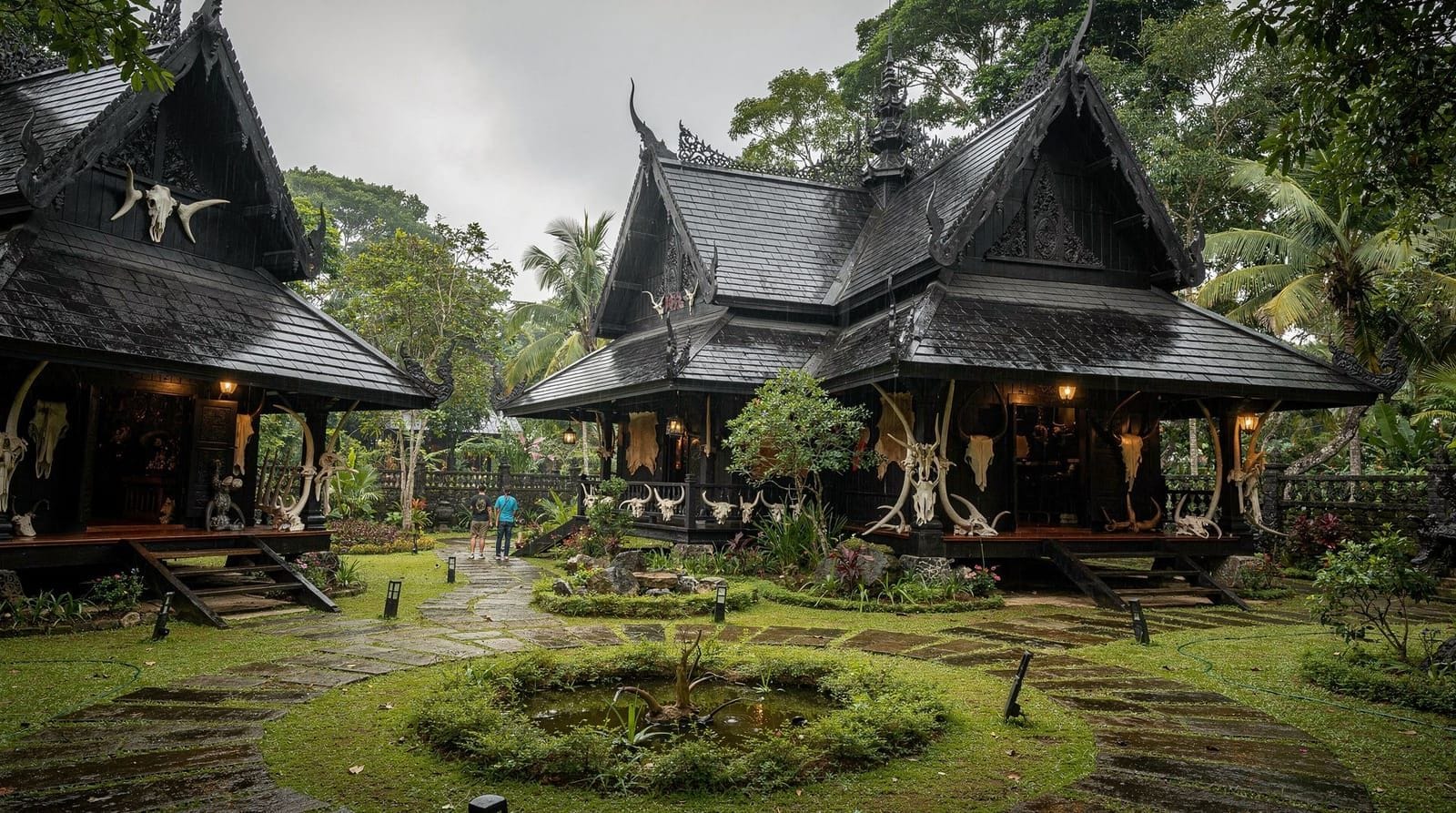
Because all three sites sit within a short drive of each other near Chiang Rai, they’re almost always visited together rather than as isolated stops. The Blue Temple offers a strikingly different color palette and a much smaller crowd, while the Black House — the late artist Thawan Duchanee’s dark, unsettling museum-residence — provides a deliberate tonal contrast to the White Temple’s pale serenity. A combined White Temple and Black House small group tour covers both in a more intimate group size than the larger standard coach tours, while a White, Blue and Black temples day tour covers all three plus transport logistics in one booking.
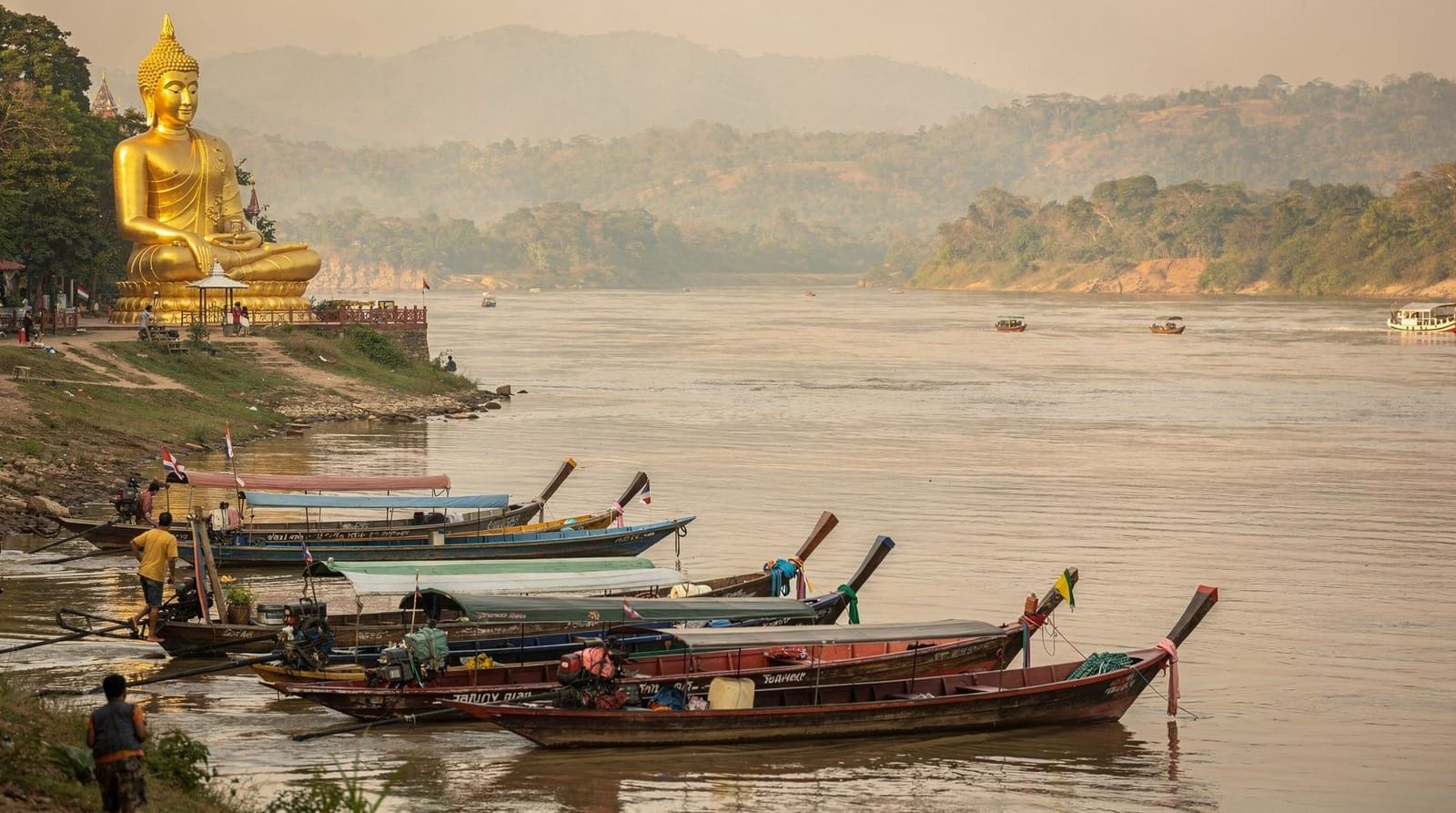
For travelers with a full day and interest in extending north to the Thailand-Laos-Myanmar border, a White Temple and Golden Triangle day trip combines the temple with a look at the Golden Triangle and the Mekong River, though this makes for a considerably longer day than the temple circuit alone.
The wider grounds and side buildings
Beyond the main bridge-and-ubosot approach that dominates most photos, the White Temple complex includes several smaller structures worth a slower look if your schedule allows: a bell tower painted in the same white-and-mirror style, a golden meditation hall, and an art gallery displaying some of Chalermchai Kositpipat’s other paintings and sketches related to the temple’s design. Visitors who treat the site as a quick 20-minute photo stop typically see only the bridge and main ubosot, missing this broader context of the complex as an evolving, multi-building artistic project rather than a single iconic structure.
A small pond near the entrance, populated with fish, and landscaped gardens throughout the grounds soften the otherwise stark white-and-mosaic palette, giving the site a more varied visual rhythm than photographs focused solely on the bridge tend to suggest.
Accessibility notes
The main approach to the ubosot, including the bridge itself, is paved and largely level, making it manageable for most mobility levels, though the bridge does have a slight incline and the surrounding areas can be busy enough at peak times to make navigating with mobility aids more difficult than the physical terrain alone would suggest. Visiting at opening, in addition to the crowd benefits already discussed, also means an easier, less congested walk for anyone who needs more space to move through the site comfortably.
A note on the artist and ongoing construction
Chalermchai Kositpipat has been explicit in interviews that the White Temple is intended as an act of religious merit rather than a personal monument, and that he has turned down offers of large-scale funding that might have accelerated construction but reduced his creative control over the final result. This is part of why the temple continues to evolve — sections you see completed on one visit may be joined by newly finished structures on a return trip years later, and mural content inside the ubosot has been reworked more than once since the temple opened to visitors. It’s worth knowing this isn’t a static historical site being preserved in amber, but an active, still-unfolding artistic project, which changes how you might think about a repeat visit even a few years apart.
Practical details for your visit
Modest dress applies as at any active Thai temple — shoulders and knees covered — and the walking surfaces around the bridge and courtyard are flat and largely accessible, though can get slippery when wet during the rainy season. The site includes a gift shop selling prints and merchandise that helps fund the ongoing construction, and while there’s no obligation to buy anything, it’s worth knowing that ticket and merchandise revenue genuinely supports the project rather than an unrelated commercial operator, given the temple’s independent, artist-funded status.
Because the temple sits along the main road between Chiang Rai town and the airport, it’s also a convenient final or first stop if your travel plans include flying rather than driving between Chiang Rai and Chiang Mai.
Weather and seasonal considerations
The White Temple’s white, mirror-mosaic surfaces reflect sunlight strongly, which makes clear-sky midday visits uncomfortably bright and glare-heavy for photography, reinforcing the case for an early morning visit on practical grounds beyond just crowd avoidance. During the February-to-April burning season, regional haze can dull the sharp white-against-blue-sky contrast that makes the temple’s best photographs so striking, while the November-to-February cool season typically offers the clearest air and softest light for both viewing and photographing the complex. Rain, common June through October, doesn’t close the site but can make the mosaic and stucco surfaces slippery underfoot, particularly around the bridge, so extra care is worth taking during the wetter months.
Comparing the White Temple to Chiang Mai’s Old City temples
Visitors splitting time between Chiang Mai and Chiang Rai sometimes wonder whether the White Temple is worth the long drive north if they’ve already seen Chiang Mai’s own temple circuit — Wat Phra Singh, Wat Chedi Luang, and Wat Chiang Man among them. The comparison is somewhat misleading, since the two experiences are fundamentally different in kind: Chiang Mai’s Old City temples are centuries-old religious sites with genuine Lanna-era history, while the White Temple is a contemporary artistic statement using Buddhist cosmology as its subject matter rather than an ancient structure being preserved. Travelers interested primarily in historical religious architecture may find the Old City temples more rewarding; those drawn to striking modern art with a religious theme will find the White Temple hard to match anywhere else in Thailand.
Combining a Chiang Rai day with the Golden Triangle
Travelers with a full day and an early start sometimes extend beyond the temple circuit to reach the Golden Triangle, about an hour north of Chiang Rai town at the point where Thailand, Laos, and Myanmar meet along the Mekong River. This adds meaningfully to an already long day trip from Chiang Mai, so it’s worth confirming with your tour operator whether the itinerary genuinely allows enough time at each stop rather than rushing through the White Temple to make up time for the additional distance north. If the Golden Triangle is a priority, consider whether an overnight in Chiang Rai, splitting the temple circuit and the Golden Triangle across two calmer days, might serve you better than cramming all four sights into a single very long day from Chiang Mai.
What to bring
Sun protection matters more than visitors expect at the White Temple, given how much of the reflective mosaic surface bounces light back at eye level across the open courtyard and bridge — sunglasses and a hat are worth carrying even on a partly cloudy day. Comfortable, closed-toe shoes suit the walk between the various buildings better than sandals, particularly if you’re combining the visit with the Black House’s more extensive grounds on the same day. A small amount of cash is useful for the gift shop and any food stalls near the entrance, since not every vendor accepts cards.
Frequently asked questions about the White Temple
What is the entry fee for the White Temple?
Around 100 THB (roughly $2.80) for foreign visitors.
How far is the White Temple from Chiang Rai town?
About 13km, roughly a 20-minute drive south of the town center.
Can I take photos inside the main temple building?
Generally no — photography is typically restricted inside the ubosot itself. The exterior mosaic work, bridge, and grounds are where visitors take most of their photos.
Why is there a gold building on the temple grounds?
It’s the public restroom, deliberately designed in an ornate gold style by the temple’s artist as part of his overall vision — a symbolic contrast to the white, pure main complex.
When is the best time to visit the White Temple?
At opening, around 8am, before tour buses from Chiang Rai and Chiang Mai arrive from mid-morning onward.
Is the White Temple an old historical site?
No — it’s a contemporary work, begun in 1997 by artist Chalermchai Kositpipat and still under construction, unlike most of the ancient temples found elsewhere in the region.
Can I visit the White Temple, Blue Temple, and Black House in one trip?
Yes, they sit within a short drive of each other near Chiang Rai and are almost always visited together on the same day, either independently or as part of a guided tour.
How much time should I budget for the White Temple?
Around 45 minutes to 1.5 hours, depending on crowd levels and how much time you spend at the bridge and courtyard for photos.
Top experiences
Bookable activities with verified prices and instant confirmation on GetYourGuide.