White temple vs blue temple: which Chiang Rai icon is worth your day trip
Chiang Rai White, Blue and Red Temple Tour
Duration: Full day
Should I visit the White Temple or the Blue Temple in Chiang Rai — or both?
Both, if you're already making the roughly 3-3.5 hour drive from Chiang Mai to Chiang Rai — they sit only about 15-20 minutes apart and pairing them costs little extra time. The White Temple (Wat Rong Khun) is the more famous and more elaborate of the two, but it's a contemporary art installation begun in 1997, not an ancient site; the Blue Temple (Wat Rong Suea Ten) is smaller, quieter, and equally striking in photographs, and it's a genuinely functioning temple rather than a single artist's ongoing project.
Chiang Rai’s two most photographed temples sit close enough together that almost nobody visits only one, and yet the comparison question comes up constantly, usually from travellers trying to decide whether a long day trip from Chiang Mai is worth it in the first place. The honest answer requires separating two different things people mean when they ask which is “better”: which one is more visually striking, and which one is more historically or spiritually significant. Those two questions have different answers, and knowing both changes how you plan the day.
Quick answer: The White Temple (Wat Rong Khun) is the larger, more famous, and more elaborate of the two, but it’s a contemporary art installation started in 1997 rather than an ancient site — worth knowing before you go so you’re not expecting centuries of history in the stonework. The Blue Temple (Wat Rong Suea Ten), about 15-20 minutes away, is smaller, free to enter, and offers an equally photogenic but calmer, more intimate experience. Since both sit within the same short drive from central Chiang Rai, almost every visitor sees both rather than choosing between them.
The confusion most travellers arrive with
A large share of first-time visitors assume, reasonably, that the White Temple — a temple this visually spectacular and this widely photographed — must be centuries old — the kind of accumulated history that produced Chiang Mai’s Wat Chedi Luang or Lampang’s Wat Phra That Lampang Luang. The White Temple is not that. It’s an active, unfinished construction project conceived and funded largely by a single living artist, Chalermchai Kositpipat, who began building on the site of a dilapidated older temple in 1997 and has continued expanding it since, funding the work substantially through his own art sales and the temple’s modest entrance fees. Knowing this in advance doesn’t make the temple any less worth seeing — if anything, it reframes the visit as seeing a monumental, still-evolving piece of contemporary religious art, which is arguably more interesting than mistaking it for an ancient site and being confused by details that don’t fit that expectation.
The Blue Temple, by contrast, is a genuinely functioning temple in a more conventional sense, though it too is a relatively recent construction — built in the 2000s and 2010s on the site of an older, abandoned temple compound, with the vivid blue-and-gold aesthetic being a distinctive design choice by the temple’s restorers rather than a traditional Lanna colour scheme. Neither temple, in other words, is “the old one” — but the Blue Temple carries itself more like a standard active wat, with fewer of the surreal, deliberately provocative artistic flourishes that define the White Temple experience.
What makes the White Temple visually distinct
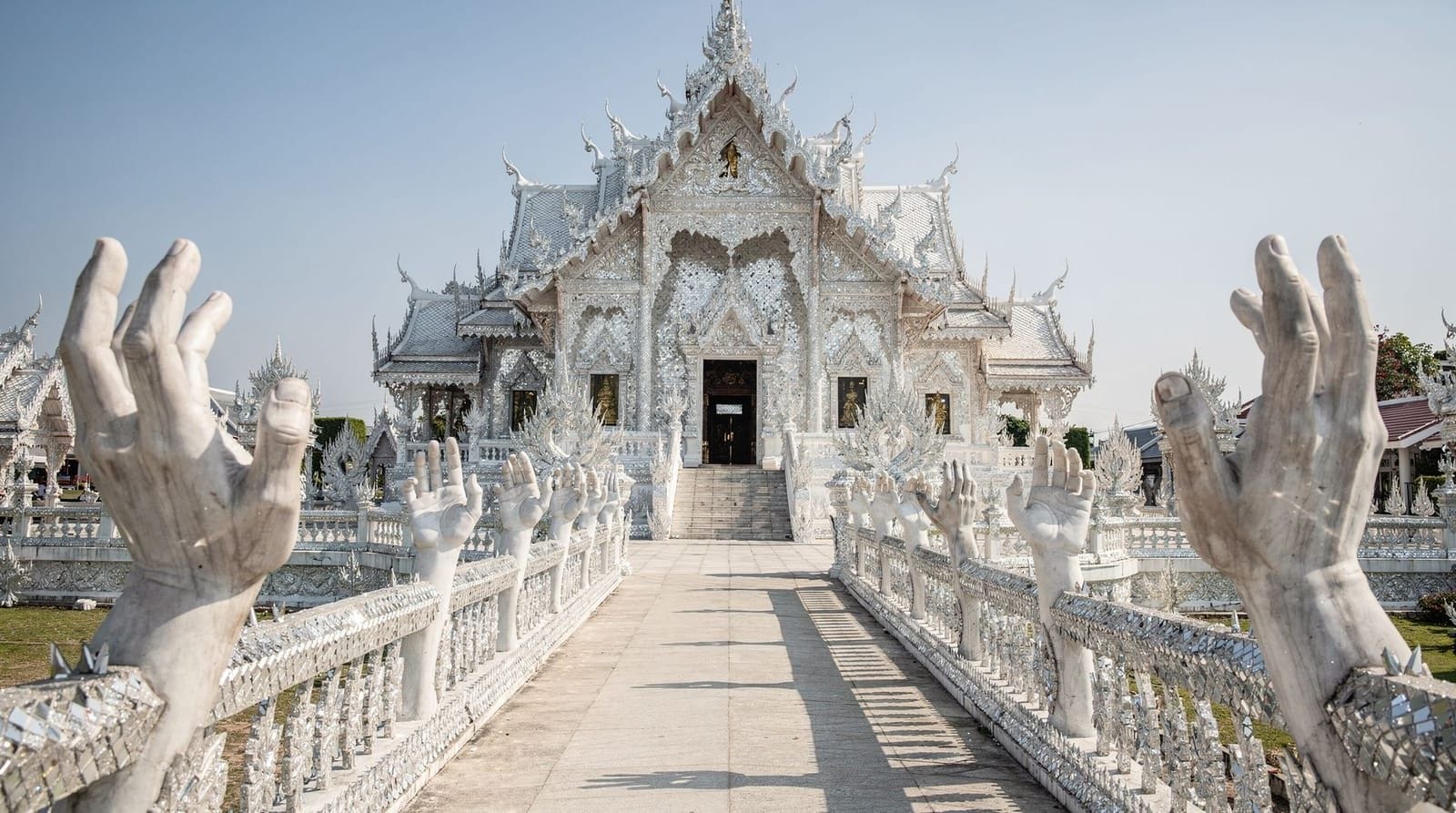
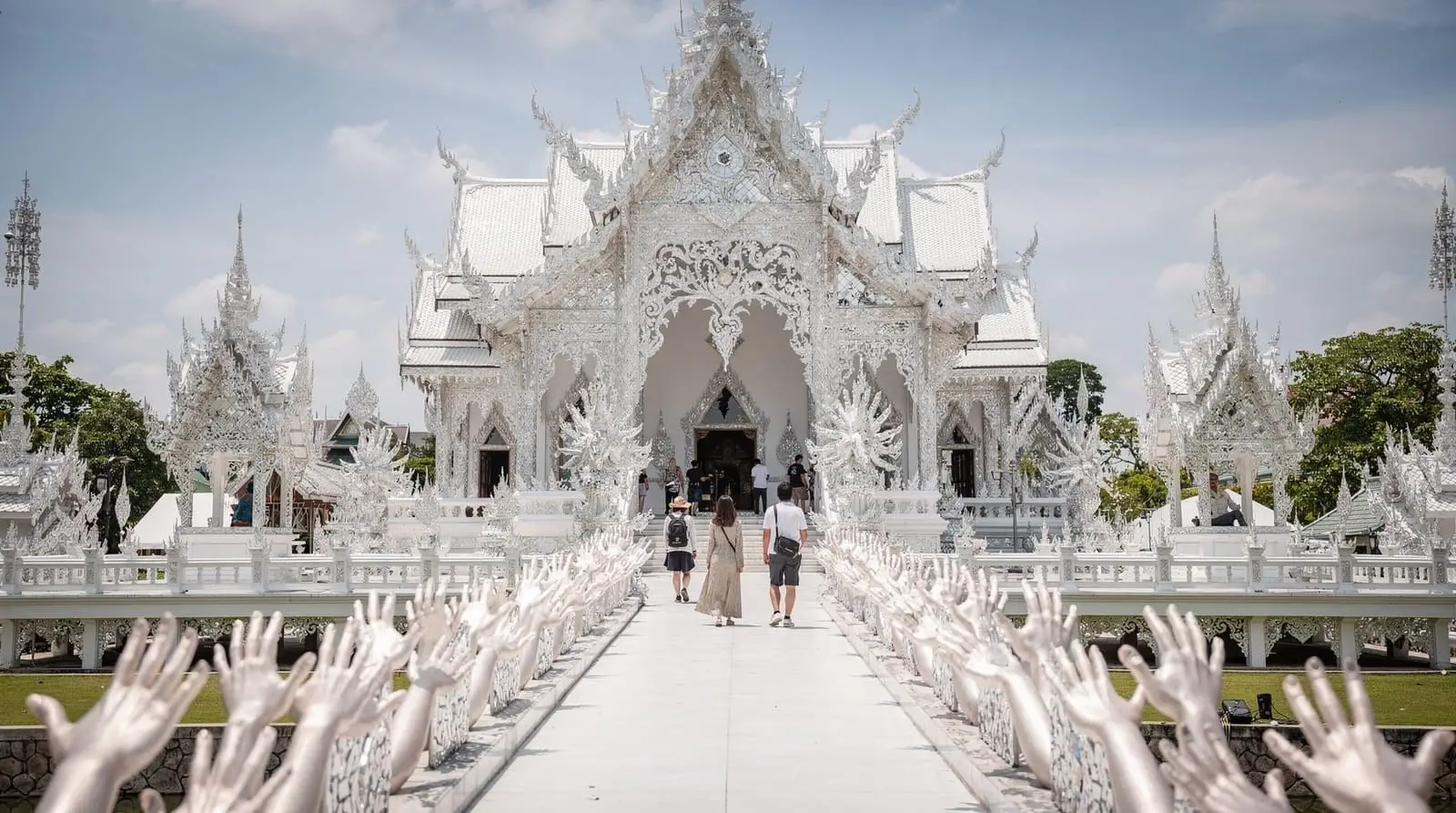
Wat Rong Khun’s exterior is built almost entirely in white stucco embedded with small pieces of mirrored glass, an effect designed to catch and scatter sunlight across the whole structure — from a distance it can look almost carved from ice or bone rather than built from conventional temple materials. The approach to the main ubosot crosses a small bridge flanked by hundreds of upward-reaching hands emerging from a sunken pit below, an installation representing unrestrained desire and suffering that visitors must symbolically cross over on the way to enlightenment. It’s a striking, slightly unsettling piece of religious symbolism rendered in a way no traditional temple attempts, and it’s the single most photographed element of the whole complex.
Inside the main hall, the artistic ambition continues in a different register: murals that blend traditional Buddhist iconography with contemporary and pop-culture imagery, changing periodically as the artist continues to add and revise the work. Interior photography is generally not permitted in this hall, both to protect the artwork and to preserve some sense of a working worship space amid the crowds, so most of what makes it onto social media is the exterior grounds and the golden Chalermchai Museum-style structure nearby, itself an eye-catching, entirely non-white counterpoint to the main temple’s palette.
What makes the Blue Temple worth the extra 15 minutes
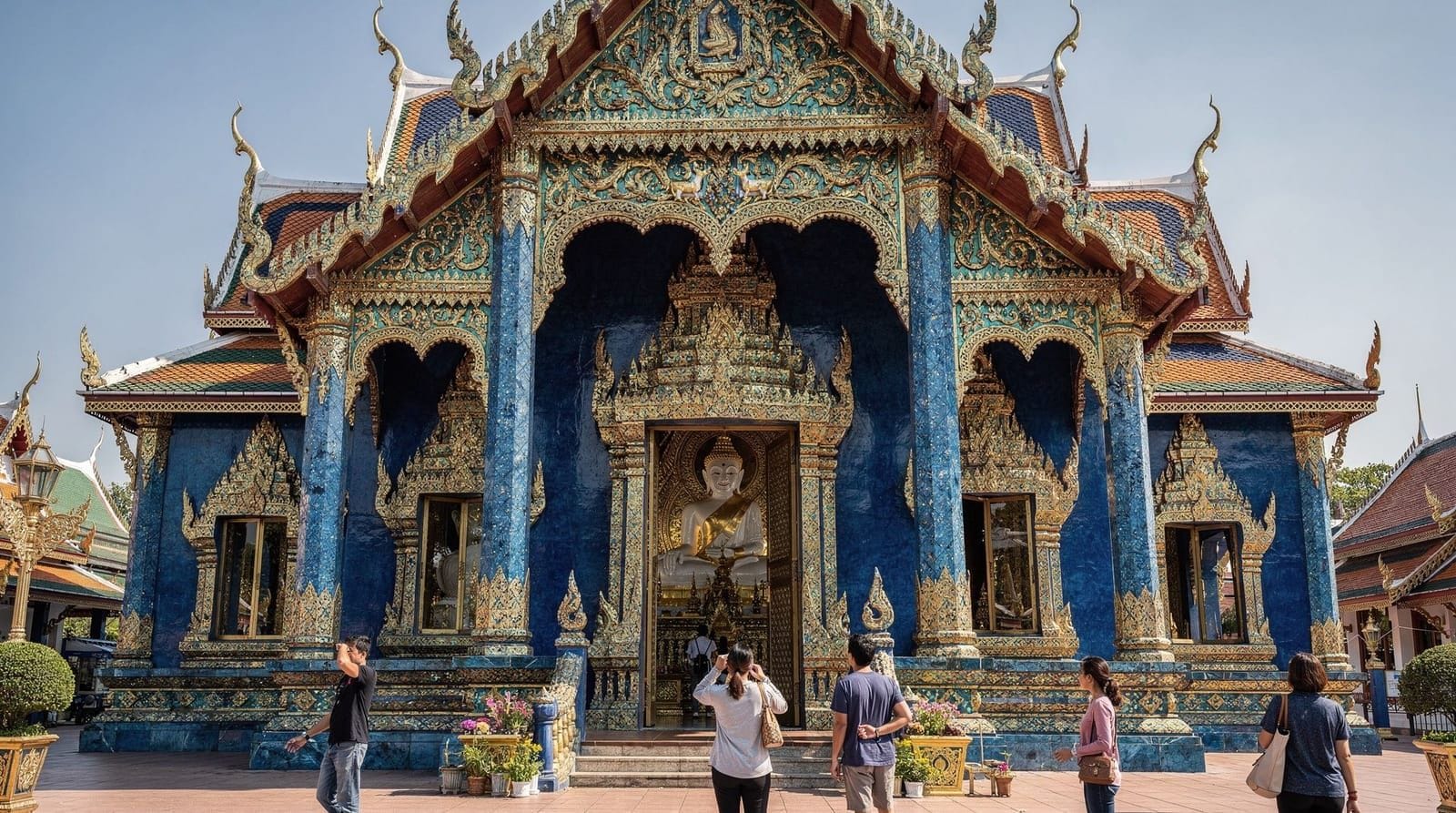
The Blue Temple trades scale for intimacy. Its ubosot is considerably smaller than the White Temple’s main hall, but the interior is saturated in deep cobalt blue accented with gold detailing on a large seated Buddha image and the surrounding wall murals, creating a visual density that photographs strikingly even in a comparatively compact space. Because the temple charges no entrance fee and receives markedly fewer visitors than the White Temple, it’s also simply easier to get a clean photograph without dozens of other visitors in frame — a practical consideration that matters more than it might sound for anyone hoping to come home with a few genuinely good shots rather than crowd-filled snapshots.
The name translates loosely to “temple of the dancing tiger,” referencing a local legend about tigers once roaming the area where the original, older temple stood before it fell into disrepair and was rebuilt in its current striking form. Unlike the White Temple’s overtly symbolic, art-installation approach, the Blue Temple reads more like a conventional active temple that simply happens to use an unusually vivid colour palette — worshippers visit for ordinary religious purposes alongside the steady trickle of photographers, giving it a somewhat calmer, more grounded atmosphere.
Distance, timing, and logistics from Chiang Mai
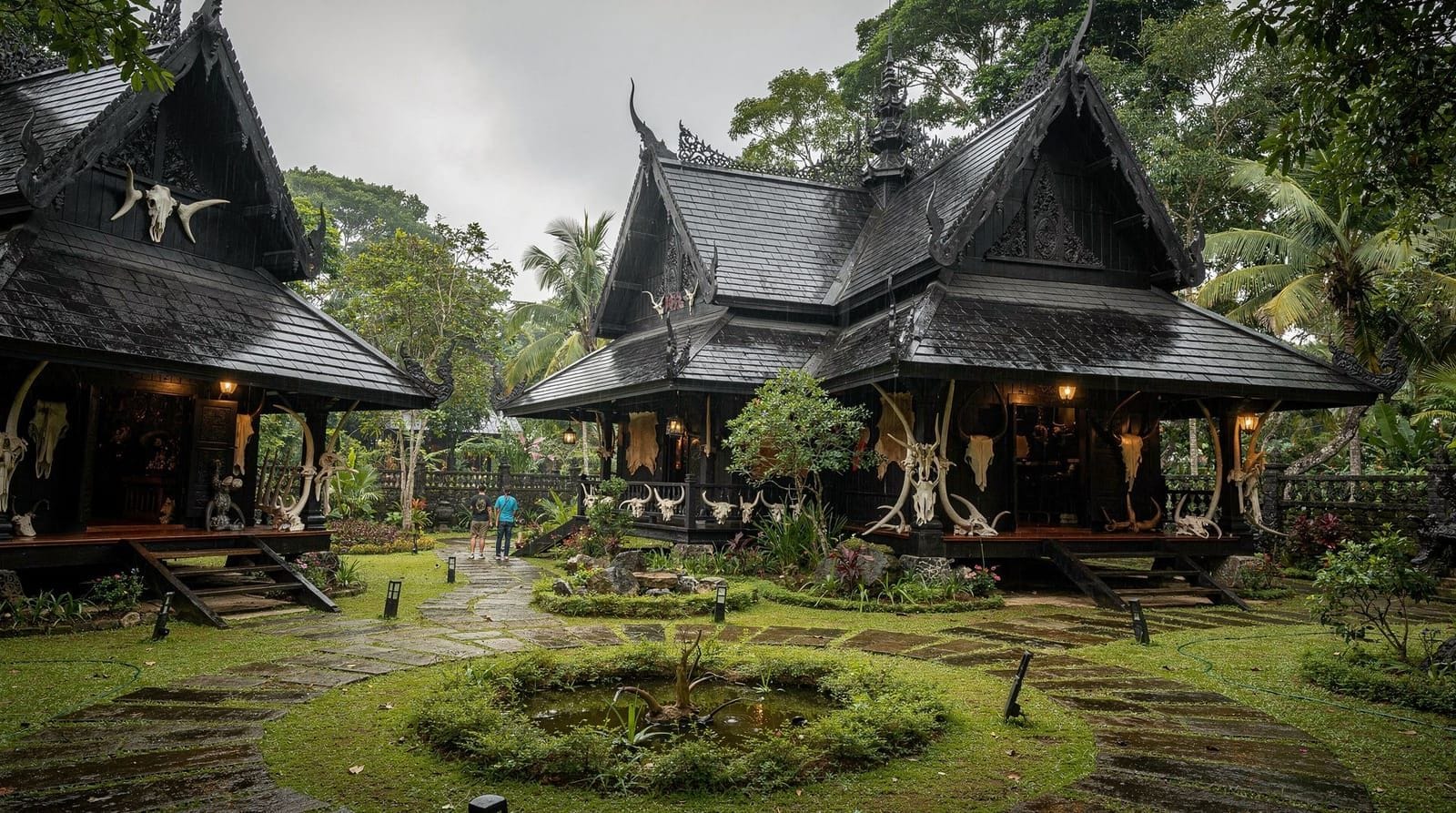
Chiang Rai sits roughly 3 to 3.5 hours by car from Chiang Mai — see our Chiang Mai to Chiang Rai transport guide for the full range of options — a genuinely long day-trip distance that’s worth weighing honestly before committing to a single-day round trip. Once in Chiang Rai, the White Temple and Blue Temple are only 15-20 minutes apart by car, and both sit within a similarly short distance of Chiang Rai town centre and the Black House (Baan Dam) museum, meaning a well-planned day covers all three without excessive backtracking.
Given the driving distance, a day trip from Chiang Mai realistically means 6-7 hours of driving alone, on top of however long you spend at each stop — a demanding but manageable single day if you leave early and have a driver rather than doing the drive yourself. A Chiang Rai white, blue and red temple tour from Chiang Mai handles this exact itinerary with transport included, which removes the fatigue of a long self-driven round trip on the same day you also want energy for walking around three temple complexes.
Travellers who’d rather not compress everything into one very long day sometimes choose to stay one night in Chiang Rai, splitting the driving across two calmer days and leaving more flexible time at each site — a reasonable option if your overall itinerary has the extra night to spare, though it’s not necessary to appreciate either temple properly.
Combining both temples (and the Black House) in one visit
Nearly every organised tour that reaches Chiang Rai includes both the White and Blue Temples, and most add the Black House as a third stop, since all three sit within a reasonably compact area and represent three distinct artistic visions worth seeing together. A White Temple, Black House and Blue Temple tour with lunch covers exactly this combination in a single organised day, with a meal included so you’re not scrambling to find food between stops. For travellers wanting the fullest possible day out of the trip, a Chiang Rai highlights day tour typically folds in additional stops such as the Golden Triangle or a hot spring alongside the core temple circuit, useful if you want to make the long drive count for more than just the temples themselves.
If your priority is efficiency and you’d rather not add a fourth or fifth stop to an already long day, a focused three-temple day trip with lunch keeps the itinerary tighter around just the White, Blue, and Black House sites, which for many travellers is the right level of ambition for a single day trip from Chiang Mai.
Which one should you prioritise if you’re short on time
If a scheduling issue genuinely forces a choice between the two — a very tight itinerary, a group with limited patience for temple stops, or transport constraints — the White Temple is the stronger single pick for most travellers, simply because it’s the more visually ambitious and more widely recognised of the two, and skipping it is more likely to feel like missing “the” Chiang Rai sight than skipping the Blue Temple would. That said, this scenario is rare in practice: because the two sit so close together, the marginal cost of adding the Blue Temple to a White Temple visit is small, typically adding 30-45 minutes total including the short drive between them, which is difficult to justify skipping given how differently each one photographs and how briefly the extra stop takes.
Crowds and best time to visit each
The White Temple, being the more famous of the two and the one most tour buses prioritise, gets noticeably busier by mid-morning through early afternoon, when large groups arrive in waves; an early arrival shortly after opening tends to give meaningfully clearer views and photographs before the crowds build. The Blue Temple sees a steadier, generally lighter flow of visitors throughout the day given it’s free and slightly less internationally famous, making it more forgiving of a mid-afternoon visit if your schedule doesn’t allow for an early start at both stops.
Weather-wise, the same broad seasonal patterns that apply to Chiang Mai apply to Chiang Rai — the cool season from November through February is the most comfortable for walking between outdoor courtyards and bridges at both sites, while the hot season from March through May can make the White Temple’s largely unshaded grounds genuinely uncomfortable by midday. Both temples remain fully open and worth visiting during the rainy season, though a covered itinerary alternative is worth having in mind if a downpour hits mid-visit.
Dress code and etiquette at both sites
Standard temple etiquette applies at both: shoulders and knees covered, and shoes removed before entering either main hall. The White Temple, given its higher visitor volume and stricter rules around its artistically significant interior murals, enforces its no-photography policy inside the ubosot more consistently than many temples, and staff do intervene if visitors attempt to photograph inside. The Blue Temple is somewhat more relaxed about interior photography given its smaller scale and lower visitor numbers, though the same basic respect — no flash near Buddha images, no loud conversation during active prayer — applies as it would at any Chiang Mai temple.
Is the long drive from Chiang Mai worth it just for these two temples?
Taken purely as a two-temple excursion, a 6-7 hour round-trip drive is a significant time investment relative to the roughly 90 minutes to two hours you’ll spend actually inside the two complexes. What tips the calculation in most travellers’ favour is that Chiang Rai offers several additional worthwhile stops within the same trip — the Black House, the Golden Triangle further north, and Chiang Rai town’s own night market and riverside area — meaning the day trip rarely has to justify itself on the strength of two temples alone. For travellers who’ve already spent meaningful time exploring Chiang Mai’s own temples and are looking for a genuinely different visual experience within a single well-organised day, the White and Blue Temple combination remains one of the most consistently recommended excursions in the entire region.
A brief history of each site
The land where the White Temple now stands held an older, considerably more modest temple that had fallen into disrepair by the mid-1990s. Chalermchai Kositpipat, already an established Thai artist by that point, took on the project of rebuilding it not as a restoration but as an entirely new artistic vision, funding construction primarily through his own painting sales rather than government or large-scale donor money. He has stated publicly that he intends the project to continue for decades and that it will likely not be fully complete within his own lifetime, which is part of why the complex keeps growing — new structures, including a golden restroom building and an expanding museum hall, have been added well after the original ubosot was completed, and further additions remain planned.
The Blue Temple’s history runs differently. The original temple on the site, once known simply as a modest local wat, had similarly fallen into disuse before a renovation effort beginning in the 2000s transformed it into its current striking blue-and-gold form, completed and opened to the public more fully in the mid-2010s. Unlike the White Temple, the Blue Temple’s rebuilding wasn’t the singular vision of one nationally known artist but a more collective local restoration effort, which partly explains why it functions more conventionally as an active neighbourhood temple alongside its role as a photogenic stop for visitors.
Practical differences worth knowing before you go
Beyond the visual and historical distinctions, a handful of practical details separate the two visits. The White Temple’s larger scale and higher visitor numbers mean queues can form at the entrance bridge during peak mid-morning hours, and the museum hall and gift shop areas add additional time if you want to see the complex in full rather than just the main ubosot and bridge. The Blue Temple’s smaller footprint means a visit rarely takes longer than 20-30 minutes even including photography time, making it easy to treat as a quick, unhurried stop rather than requiring the same time budgeting as the White Temple.
Restroom and food facilities are more developed at the White Temple given its higher tourist volume, including a small food court area near the car park, while the Blue Temple has more limited amenities on site, which is one more reason most itineraries treat it as a shorter add-on rather than a standalone destination for a full stop with a meal.
Photography tips specific to each temple
At the White Temple, the classic shot is the view across the bridge toward the main ubosot with the reaching hands visible below, best captured either early in the morning before crowds fill the frame or from an angle slightly off the main walking path where fewer visitors intrude. The mirrored glass inlays catch direct sunlight dramatically around midday, but the same midday sun can also wash out contrast in wider shots, so many photographers prefer the softer light of early morning or late afternoon for the full exterior.
At the Blue Temple, the interior shot of the seated Buddha against the deep blue and gold walls is the standout image, and because the space is smaller and less crowded, it’s considerably easier to get a clean, people-free frame here than inside the White Temple’s main hall — helped further by the fact that photography restrictions inside the Blue Temple’s main hall are generally lighter than at its more famous counterpart. Natural light through the hall’s windows tends to give the most flattering result without needing flash, which in any case should be avoided near the Buddha image out of basic respect.
Where each fits in a wider Chiang Rai itinerary
Both temples work well as the anchor stops of a broader Chiang Rai day, typically bookended by a stop at the Black House for contrast and, time permitting, a visit further north to the Golden Triangle where the borders of Thailand, Laos, and Myanmar meet at the Mekong River. Travellers who prefer a slower pace sometimes split these across an overnight stay in Chiang Rai itself, using the extra time to explore the town’s own night market and riverside area rather than compressing everything into a single long day trip from Chiang Mai.
Frequently asked questions about White temple vs blue temple: which Chiang Rai icon is worth your day trip
Is the White Temple an ancient temple?
How far apart are the White Temple and Blue Temple?
Which one is more photogenic?
Is there an entrance fee for either temple?
How long does each temple take to visit?
Can I do this as a day trip from Chiang Mai, or should I stay overnight in Chiang Rai?
Is the Black House (Baan Dam) worth adding to the same day?
Is photography allowed inside both temples?
Top experiences
Bookable activities with verified prices and instant confirmation on GetYourGuide.