Wat Phra That Lampang Luang: Lampang's revered wooden temple
From Chiang Mai: Lamphun and Lampang Temples Tour
Duration: Full day
What is Wat Phra That Lampang Luang, and is it worth the drive from Chiang Mai?
Wat Phra That Lampang Luang is a moated 15th-century temple complex about 100km south of Chiang Mai, built almost entirely from teak, and widely regarded by architecture specialists as the finest surviving example of classical Lanna temple design. It's worth the roughly 1.5-2 hour drive if you care about temples as historical structures rather than just photogenic ones — it sees a fraction of the visitors that Chiang Mai's central wats do, and nothing here has been rebuilt as a contemporary art piece.
Most visitors who make it to Lampang do so as a stopover between Chiang Mai and Bangkok, or as a quick add-on to a longer northern loop, and few of them realise that the province holds what many architectural historians consider the single best-preserved example of Lanna temple building anywhere in Thailand. Wat Phra That Lampang Luang sits about 18km outside Lampang town, behind an earthen moat and a set of naga-flanked stairs, largely unchanged in structure since the 15th century — a genuinely old building, not a restoration dressed up to look old.
Quick answer: Wat Phra That Lampang Luang is a moated 15th-century wooden temple complex roughly 100km (1.5-2 hours by car) south of Chiang Mai, built almost entirely from teak and widely regarded as the country’s finest surviving Lanna-style temple. It’s free to enter, sees comparatively few foreign visitors, and rewards travellers who want a genuinely historic building rather than a highly photogenic but modern one.
A temple that looks its age, on purpose
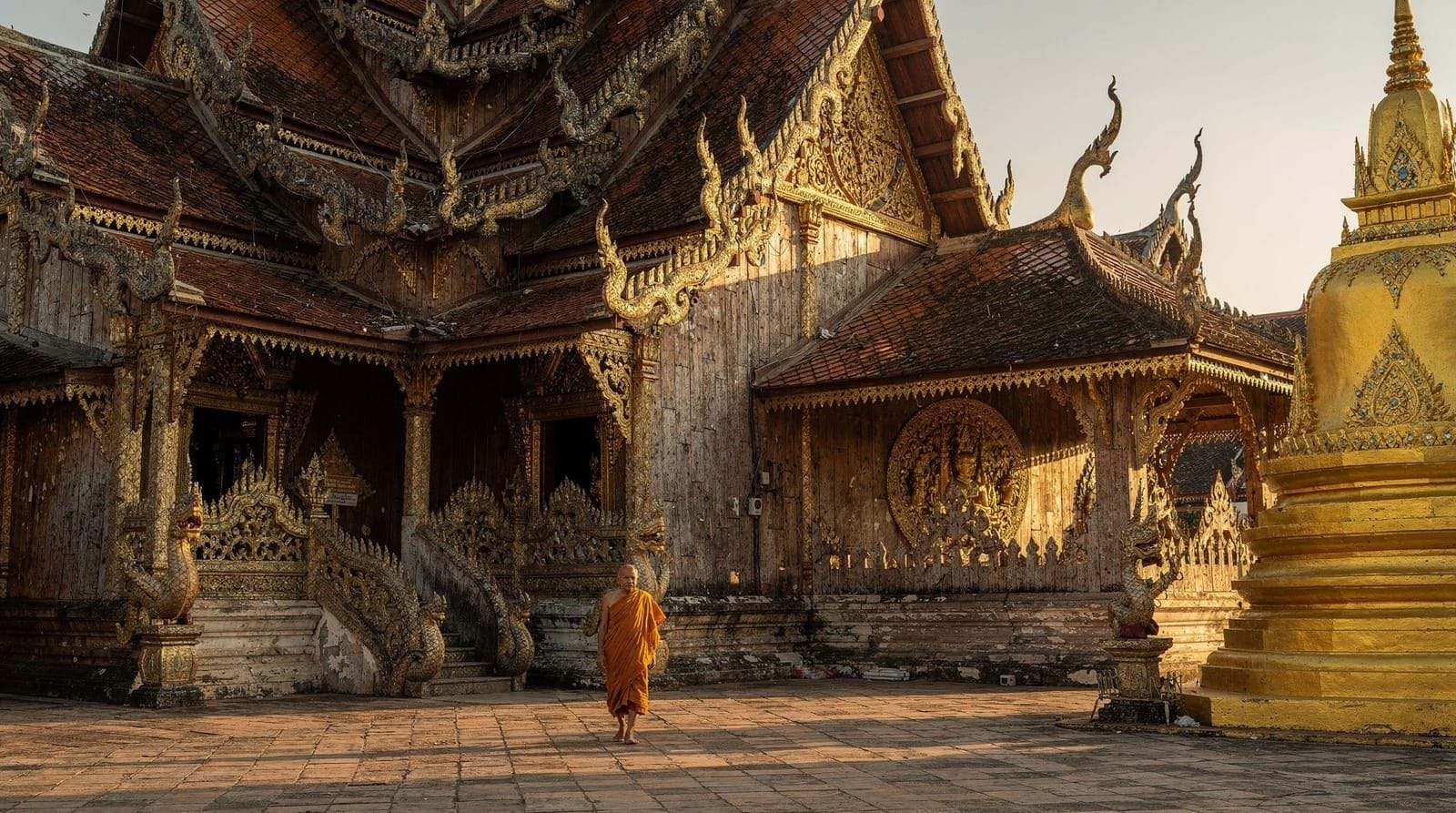
The first thing that separates Wat Phra That Lampang Luang from most of the temples travellers see around Chiang Mai’s old city is material. The main wihan — the open-walled assembly hall — is built almost entirely of dark, weathered teak, supported by thick wooden columns that have darkened and cracked gently over centuries rather than being replaced or painted over. Where a temple like Wat Chedi Luang shows its age through a partially ruined stone chedi, Lampang Luang shows its age through wood that has simply been standing, largely untouched, since the structure’s last major rebuild in the 1476.
That distinction matters if you’re trying to decide whether the drive is worth it. This isn’t a place designed to photograph well in bright sunlight with saturated colours — it’s a place that photographs like what it is: an old wooden building that has survived war, fire, and five centuries of northern Thai weather. Visitors expecting the gilded intensity of Wat Phra Singh sometimes find Lampang Luang’s earth-toned wood and lichen-covered tile roofs comparatively subdued. Visitors who come specifically for historical authenticity tend to rate it as the highlight of their entire northern Thailand trip.
The layout: moat, gate, and open wihan
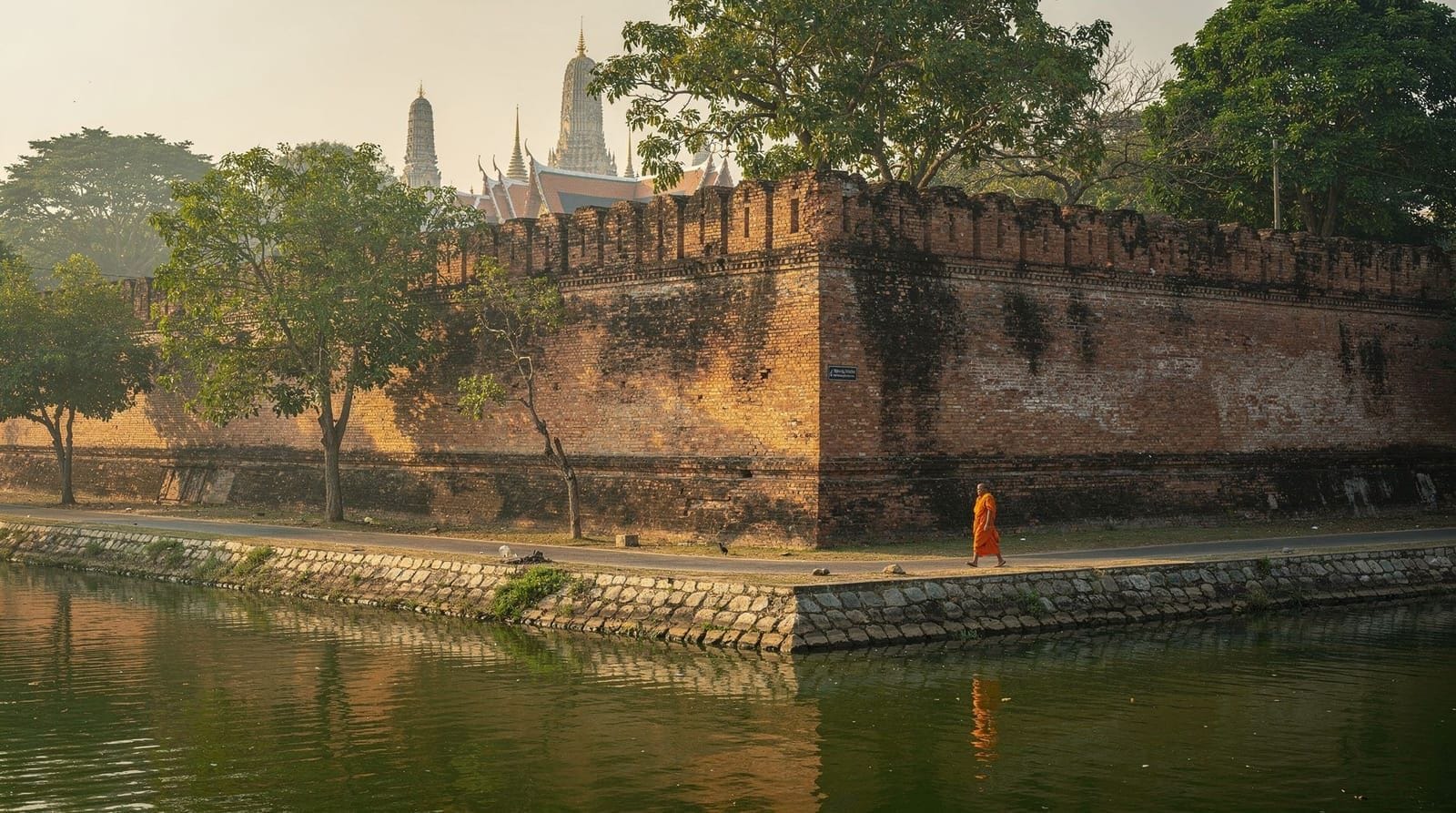
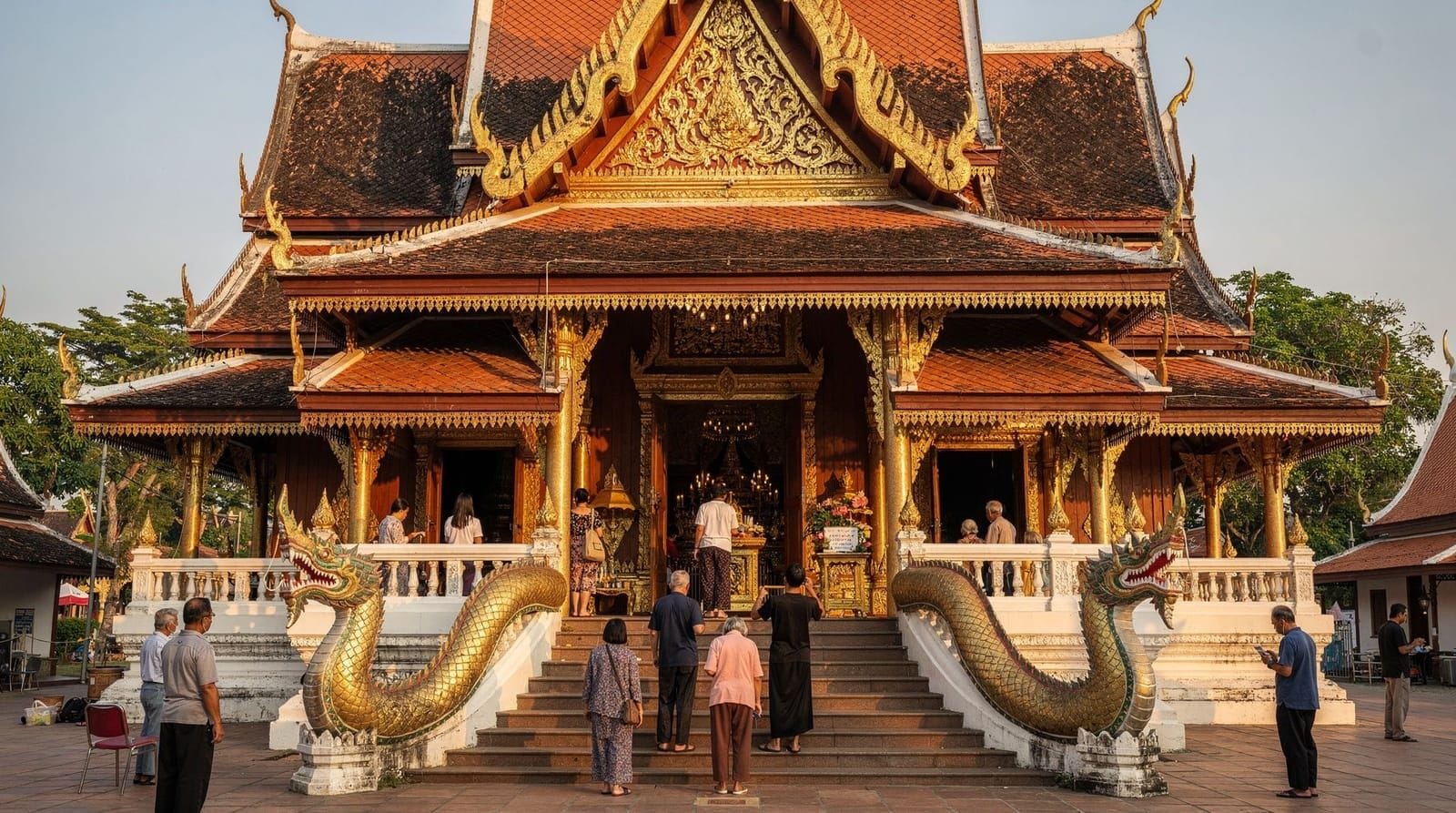
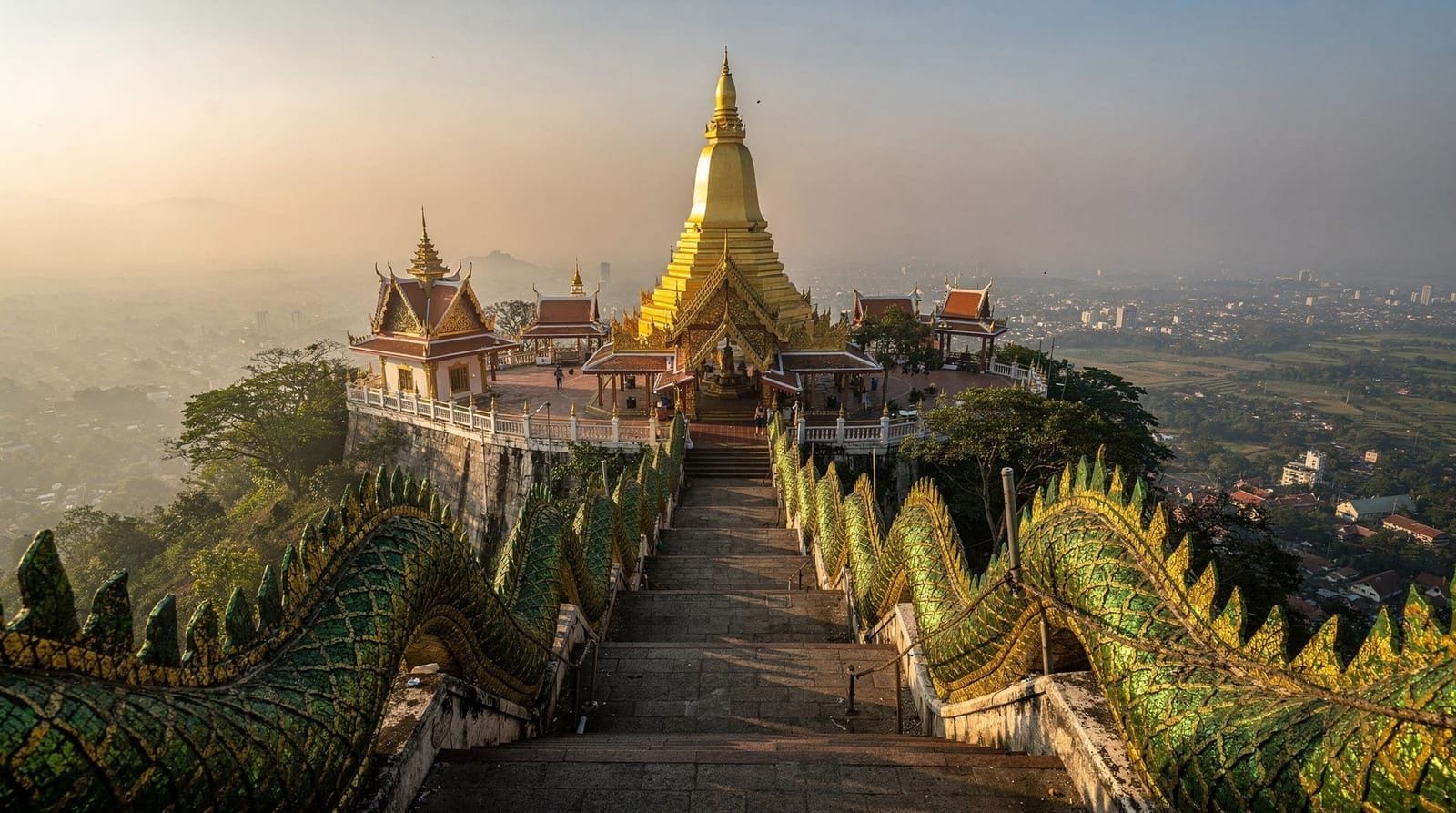
The complex sits inside an earthen moat and low outer wall, a defensive feature that hints at the site’s history as more than a religious building — it also served as a fortified stronghold at various points, most notably during conflicts with Burmese forces in the 18th century. A steep naga staircase leads up through the main gate to the temple platform itself, opening onto a wide courtyard dominated by the golden, bell-shaped chedi (Phra That) that gives the temple its name.
The main wihan, known as Wihan Luang, is the structure most visitors come specifically to see: a large, low, open-sided wooden hall with a heavily tiered roof and rows of thick teak columns supporting a surprisingly intricate wooden ceiling. Unlike the fully enclosed ubosot structures common elsewhere, Wihan Luang’s open sides let air and light move through the space in a way that feels closer to how these buildings were originally designed to function — as gathering halls, not sealed shrines.
The bullet holes and the Burmese siege
A section of wall inside the complex, near the smaller Wihan Phra Phutthabat, still shows what local guides identify as damage from muskets and cannon fire dating to fighting between Lanna and Burmese-aligned forces in the 1730s, tied to the legendary local hero Thao Fa Hao, who is said to have defended the temple against a Burmese governor’s forces from a hiding spot inside the compound. Whether every detail of the story is historically precise or has picked up embellishment over three centuries of retelling, the physical damage in the wall is real and visible, and it’s one of the details that makes a guided visit — rather than a silent self-guided walk — worth considering if this kind of history interests you.
The Ho Phra Phutthabat and its quiet optical trick
Tucked to one side of the main courtyard is a smaller building, the Ho Phra Phutthabat, that most first-time visitors walk straight past. Inside, a small aperture cut into a wooden window shutter allows a beam of light to project a faint, upside-down image of the golden chedi outside onto a white cloth or the interior wall — a natural pinhole-camera effect that has nothing to do with modern optics and everything to do with the same physics that made early photographic cameras work centuries later. It’s subtle, easy to miss if the light isn’t right or if nobody points it out, and genuinely one of the more interesting small details in any temple in the region. Ask the temple caretakers, who are usually happy to show visitors where and when to look.
A guided Lamphun and Lampang temples day trip from Chiang Mai typically builds in time at this hall specifically, with a guide who knows how to angle the shutter and time the light, which is the easiest way to actually see the effect rather than hunting for it alone.
The Emerald Buddha connection
Wat Phra That Lampang Luang holds a small reproduction of the Phra Kaew Don Tao, a jade Buddha image with a story connected — through local legend rather than settled historical record — to the more famous Emerald Buddha now enshrined in Bangkok. According to the temple’s own account, the image was carved from the same original jade boulder, and Lampang held custody of a related image for a period during the region’s complicated medieval history of shifting Lanna, Burmese, and Siamese control. The image is kept in a separate, smaller building within the complex and isn’t always on view to casual visitors, but the story is worth knowing before you arrive, since it explains why a temple in a comparatively minor northern town holds artefacts referenced in the same breath as the most sacred Buddha image in the country.
How it compares to Chiang Mai’s main temples
If you’ve already spent a day or two doing the old city temple circuit — Wat Phra Singh, Wat Chedi Luang, and the smaller wats around them — Lampang Luang offers something genuinely different rather than more of the same. Where the Chiang Mai temples are active urban sites woven into daily city life, with markets, coffee shops, and traffic pressing right up against their walls, Lampang Luang sits in comparative rural isolation, moated and quiet, closer in feel to what a 15th-century pilgrim would have experienced arriving at a walled religious compound outside a Lanna city.
It’s not, however, a replacement for a first-time visitor’s Chiang Mai temple circuit — if you have only a day or two in the region and haven’t yet seen Wat Phra Singh or spent time understanding basic Lanna temple etiquette, those should come first. Lampang Luang rewards travellers who already have a baseline for what a Thai temple typically looks like and are specifically curious about older, less-restored architecture.
Getting there from Chiang Mai
The drive covers roughly 100km and takes 1.5 to 2 hours depending on traffic through Lampang town itself, following Highway 11 south. Self-driving is straightforward on well-maintained roads, and a rental car or motorbike gives the most flexibility to also stop in Lampang town on the way. Public transport is possible but considerably slower: regular buses connect Chiang Mai and Lampang in around two hours, after which you’d still need a songthaew, taxi, or hired driver for the final 18km out to the temple in Ko Kha district, and again back into town afterward.
Most visitors without their own vehicle find it simpler to join a structured day trip. A Lampang province hidden temples tour typically covers Wat Phra That Lampang Luang alongside one or two lesser-known temples in the same district, with transport, a guide, and logistics handled end to end. For travellers who’d rather set their own pace and skip a shared group itinerary, a private, all-inclusive Lampang day tour covers the temple along with Lampang town’s other highlights on a schedule built around just your group.
Combining the temple with Lampang town
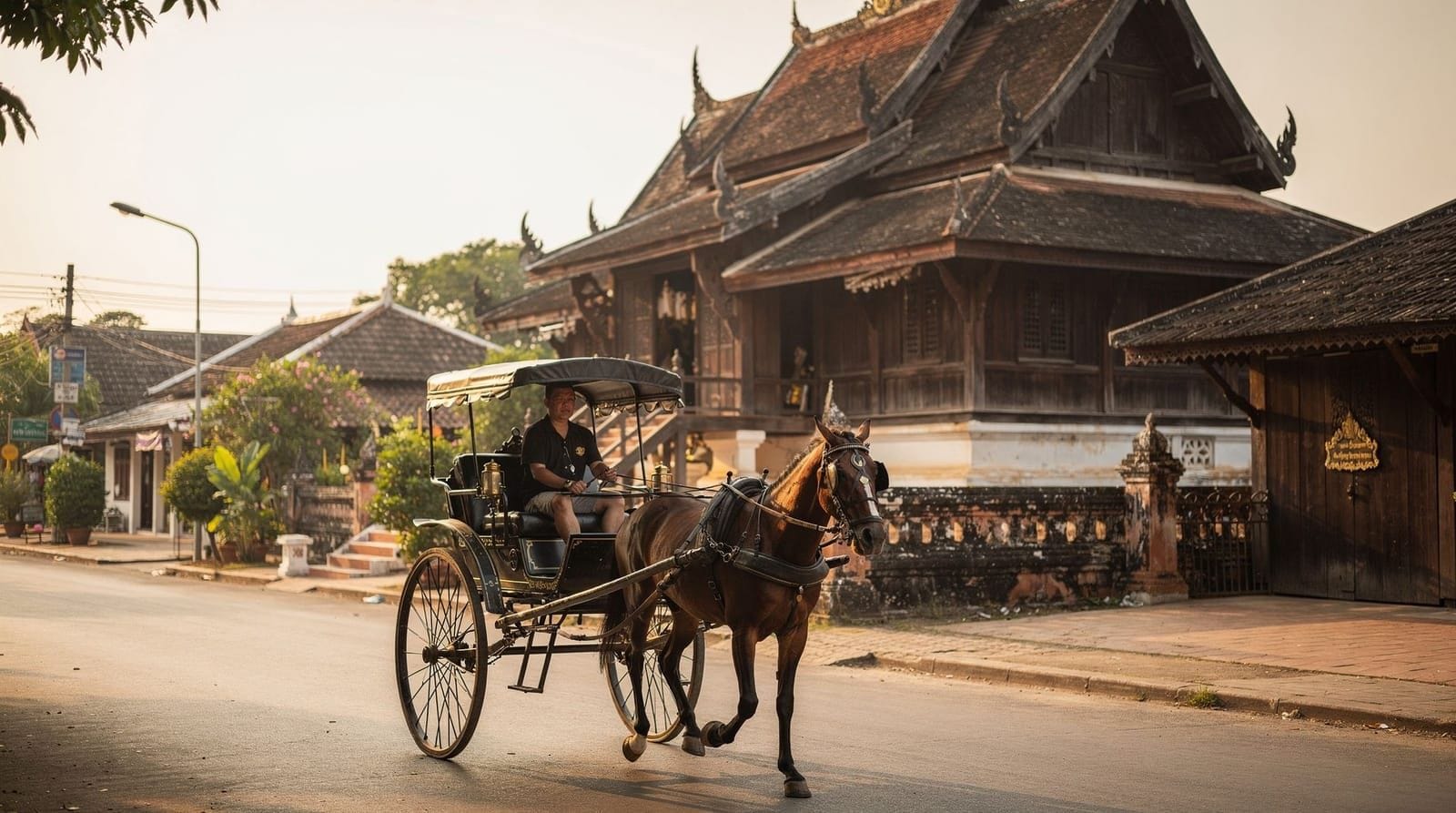
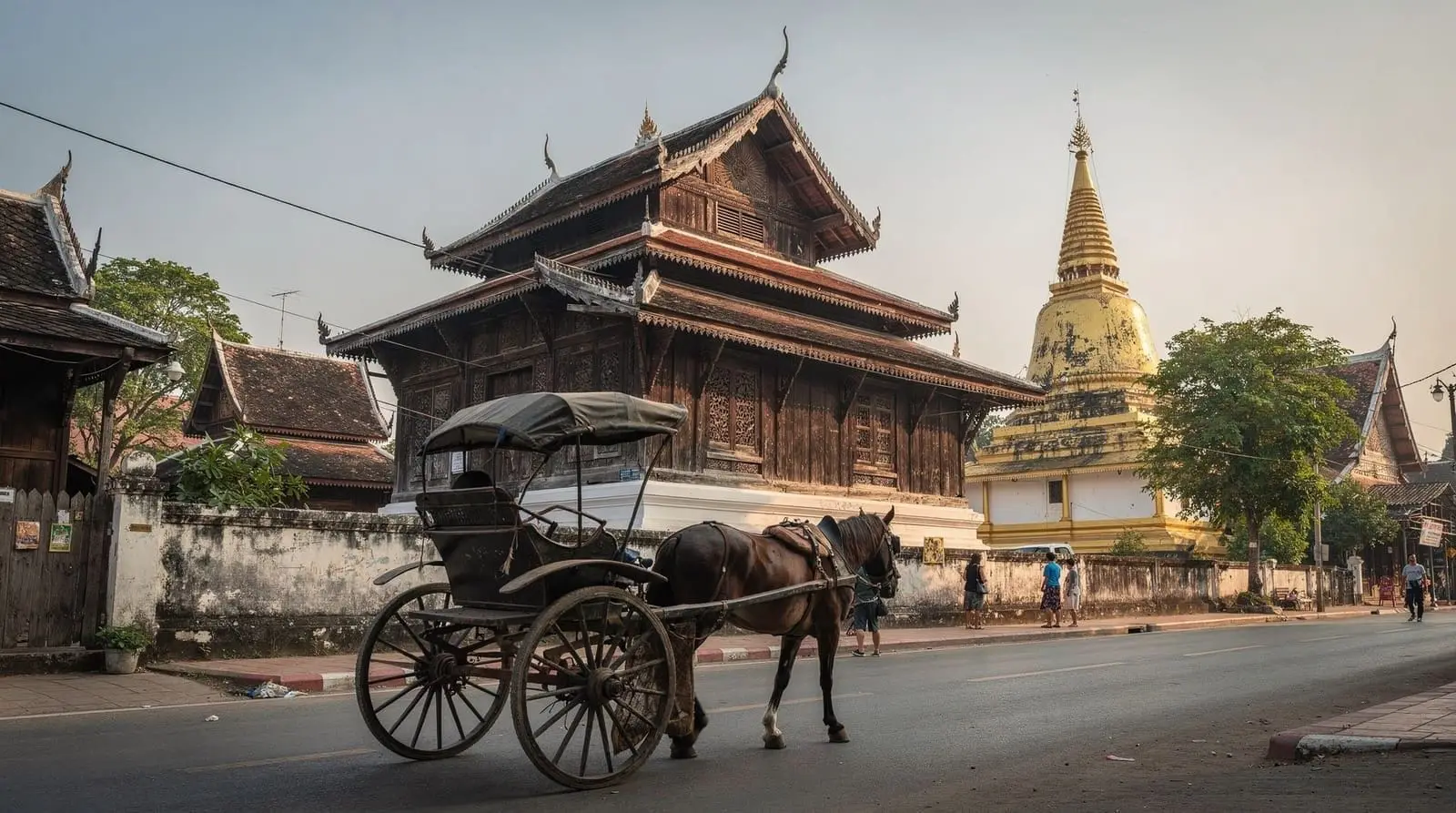
Lampang town itself, about 18km from the temple, has its own distinct identity worth an hour or two before or after your temple visit. It’s one of the last places in Thailand where horse-drawn carriages still operate as everyday transport rather than a tourist novelty alone, and a short carriage ride through the old quarter along the Wang River is a pleasant, low-effort way to see the town’s colonial-era shophouses and riverside temples. Wat Sri Chum, a Burmese-style temple built by teak merchants in the late 19th century, sits within the town itself and offers a useful architectural contrast to Lampang Luang’s older Lanna style — the two temples, seen on the same day, give a reasonably complete picture of how the region’s temple architecture shifted under different cultural influences over a few centuries.
Lampang is also known regionally for ceramics, particularly a style of chicken-motif pottery that developed in the area in the mid-20th century; several workshops on the edge of town welcome visitors to see pieces being made, and it’s a reasonable stop if you have an extra half-hour and want a genuine local souvenir rather than something mass-produced for the Chiang Mai night markets.
Practical tips for the visit
Wear or bring shoes that slip on and off easily, since you’ll be removing them repeatedly across several buildings within the same complex. Modest dress — shoulders and knees covered — applies throughout, and while sarongs are sometimes available at the entrance for underdressed visitors, it’s more reliable to simply dress appropriately before you arrive, particularly since this is a genuinely active place of worship with regular local visitors rather than a site geared primarily toward tourists.
Morning visits, ideally before 10am, avoid both the worst of the midday heat on the exposed courtyard and the busier tour-group windows in late morning. There’s limited shade across much of the open courtyard between buildings, so a hat and water are worth carrying even for a visit of under an hour. Photography is generally permitted throughout the grounds, though flash photography inside the darker wooden halls, particularly near any Buddha images, should be avoided as a matter of basic respect, and a few of the smaller interior rooms restrict photography entirely — signage, where present, should be followed.
Is the detour from Chiang Mai worth it?
For most first-time visitors to northern Thailand with only a handful of days available, Chiang Mai’s own temples and a single well-chosen day trip — Doi Suthep, or Chiang Rai’s temple cluster — will cover the core of what most people want from a temple-focused itinerary. Wat Phra That Lampang Luang is a stronger fit for travellers with a bit more time on their hands, a specific interest in traditional wooden architecture, or those who’ve found Chiang Mai’s central temples slightly too crowded or too polished and are looking for something quieter and more obviously old. It’s not a must-see in the way Wat Phra Singh or Doi Suthep are for a first visit, but for a second trip to the region, or for anyone building out a longer northern Thailand itinerary, it’s one of the better-value additions available within a single day’s round trip from Chiang Mai.
Best time of year to visit
Lampang’s climate follows the same broad seasonal pattern as Chiang Mai — a cooler, drier period from November through February that makes the exposed courtyard far more comfortable to walk around, a hot season from March through May where midday visits become genuinely uncomfortable without shade, and a wetter season from roughly June through October where rain showers are common but rarely all-day events. Because so much of the visit takes place outdoors moving between wooden halls, the cool season is the most pleasant window, though the temple itself is open and worth visiting year-round; the wooden structures themselves stay in reasonable condition regardless of season, being built to withstand the region’s weather over centuries rather than a handful of tourist seasons.
A quieter alternative for repeat visitors
If you’ve already done the standard Chiang Mai temple circuit on a previous trip and are looking for something with genuinely fewer visitors and a different historical texture, Wat Phra That Lampang Luang is one of the strongest options in the wider region — quieter than anything comparable within Chiang Mai city limits, and structurally distinct from both the old city’s brick-and-gold temples and the contemporary art-temple style found further north in Chiang Rai. It asks a bit more of travellers in terms of time and planning than a same-day city temple, but for anyone with a genuine interest in Lanna architecture rather than just a checklist of photogenic wats, it’s worth the half-day investment.
Who this temple suits, and who can skip it
Travellers who get the most out of Wat Phra That Lampang Luang tend to share a few traits: they’ve usually already seen at least one or two of Chiang Mai’s central temples and have a working sense of what a “typical” northern Thai wat looks like, which makes the differences here — the raw teak, the moat, the comparative quiet — register as meaningful rather than simply “another temple.” They’re often travellers with an interest in history or architecture specifically, rather than visitors mainly chasing photogenic backdrops for a short list of Instagram stops. And they usually have at least a half-day of unallocated time on their itinerary, since the round trip realistically consumes three to four hours once travel time on both ends is included.
Conversely, travellers on a tight one- or two-day Chiang Mai visit, or those whose main interest is simply “seeing a beautiful temple” rather than the deeper historical context, are usually better served spending that half-day at Doi Suthep or exploring the old city’s compact cluster of temples on foot, which deliver a comparable visual payoff without the two-hour drive each way. There’s no wrong choice here — it’s simply a question of how much of a limited trip you want to dedicate to one particular kind of temple experience.
The role of local guides on site
Unlike many of Chiang Mai’s central temples, where English-language information panels and a steady flow of other visitors make self-guided exploration reasonably comfortable, Wat Phra That Lampang Luang has comparatively sparse signage in English, and the details that make it interesting — the bullet-hole story, the pinhole optical trick inside the Ho Phra Phutthabat, the Emerald Buddha connection — aren’t always obvious from looking at the buildings alone. Some independent local guides operate around the temple entrance and can walk visitors through these stories for a modest negotiated fee, though availability isn’t guaranteed on any given day. Visitors who want to be certain of getting this context, rather than relying on chance, are generally better served booking a tour that already includes a guide familiar with the site, since it turns what could be a pleasant but somewhat opaque half-hour walk-through into a considerably richer visit.
What a typical half-day itinerary looks like
A reasonable structure for the round trip starts with an early departure from Chiang Mai, aiming to reach the temple by mid-morning before the heat of midday sets in across the open courtyard. Allow roughly an hour at Wat Phra That Lampang Luang itself, moving between the main Wihan Luang, the chedi courtyard, and the smaller Ho Phra Phutthabat hall with its optical curiosity. From there, a short drive back toward Lampang town allows time for a horse-carriage loop through the old quarter and a stop at Wat Sri Chum or one of the town’s ceramics workshops, before the return drive to Chiang Mai in the afternoon. Built this way, the whole excursion comfortably fits within a single day without feeling rushed, and it leaves the following morning free for a lighter activity back in the city, such as a slower walk through Nimmanhaemin or a return to the old city’s markets.
A note on nearby minor temples
Lampang province holds a scattering of smaller, lesser-known temples in the same general district as Wat Phra That Lampang Luang, several of which share elements of the same wooden Lanna architectural tradition on a smaller scale. Most visitors on a standard day trip won’t have time to add a second or third temple stop given the driving distances already involved, but travellers with a specific interest in the region’s temple architecture and more than a single day to dedicate to Lampang province may find it worthwhile to research one or two of these smaller sites in advance, since they receive markedly fewer visitors even than Lampang Luang itself and can offer a genuinely solitary experience of walking through centuries-old wooden halls with no one else around.
Frequently asked questions about Wat Phra That Lampang Luang: Lampang's revered wooden temple
How far is Wat Phra That Lampang Luang from Chiang Mai?
Can I visit by public transport, or do I need a car or tour?
Is there an entrance fee?
What is the famous 'upside-down image' inside the temple?
Is the dress code strict?
Can I combine this with other Lampang sights in one day trip?
How long should I plan to spend at the temple itself?
Top experiences
Bookable activities with verified prices and instant confirmation on GetYourGuide.