Doi Inthanon at sunrise: is the 3am wake-up actually worth it
The alarm went off at 2:40am and my first coherent thought was that this had been a mistake. My second thought, ninety minutes later, standing at 2,565 meters with my breath visible and my fingers gone numb inside gloves I’d packed almost as an afterthought, was considerably more complicated. So: is it worth it? Yes. But not for the reasons the photos suggest, and not without some real caveats that nobody mentioned before we booked the driver.
What actually happens before dawn
Doi Inthanon is Thailand’s highest point, and the drive up from Chiang Mai takes close to two hours even with no traffic, which at 3am is the only kind of traffic there is. The road climbs through switchbacks in complete darkness, past the entrance gate (still closed to general park hours, so pre-dawn access requires either a private arrangement or a tour that has cleared it in advance), and up toward the summit area where the temperature difference from the city is not subtle. Chiang Mai at that hour might be a mild 22°C. The summit was 8°C when we arrived, and locals who do this regularly told us it drops close to freezing in the coolest months.
Nobody warns you clearly enough about the cold. Our guide to visiting during cool season mentions it, but reading “bring a jacket” and standing at altitude in the dark with the wind picking up are two very different kinds of information. Bring more than you think: a proper layer, not a light cardigan, and something for your hands if you’re planning to hold a phone or camera for the twenty minutes before sunrise when your fingers stop cooperating.
The actual sunrise
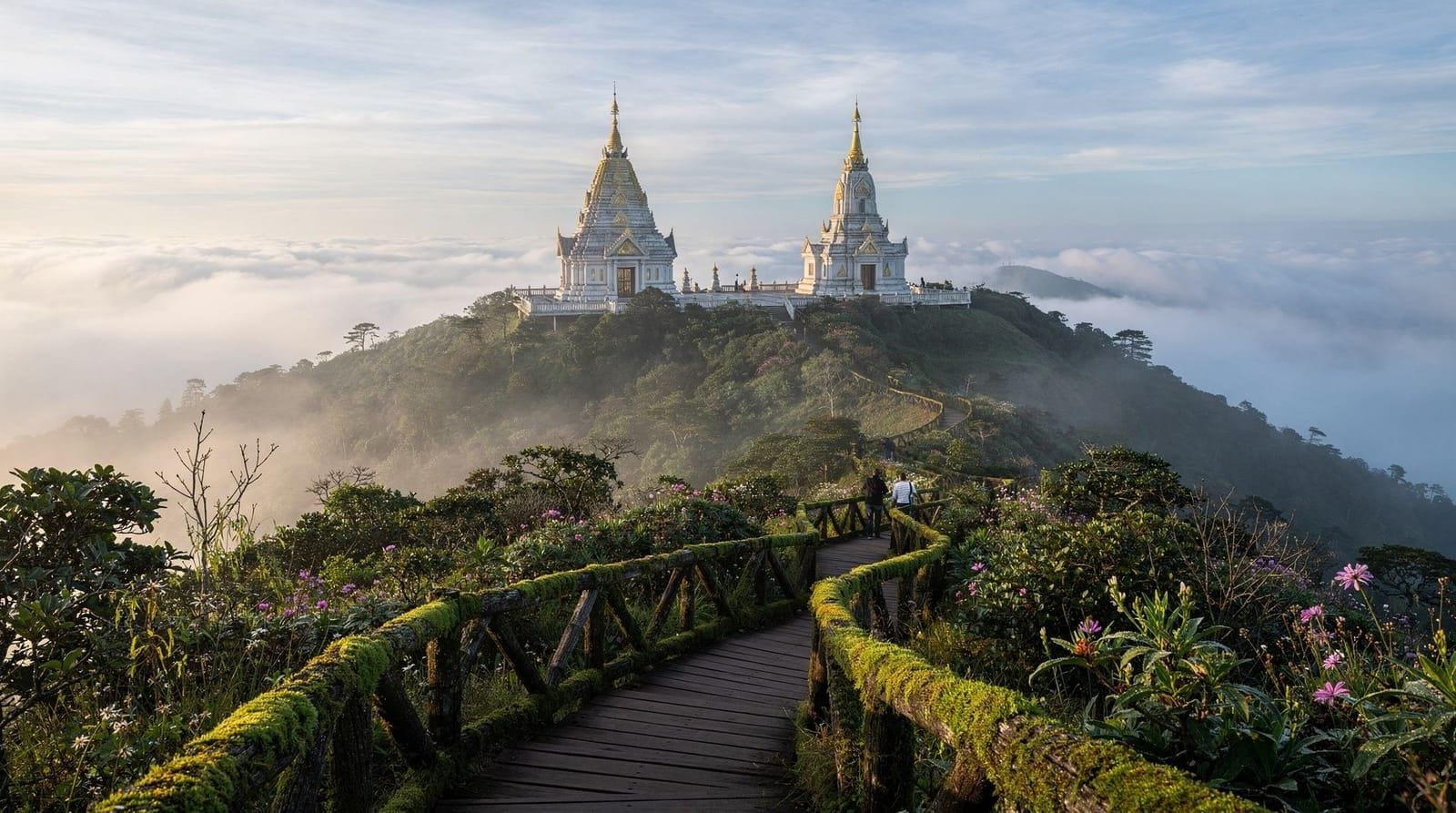
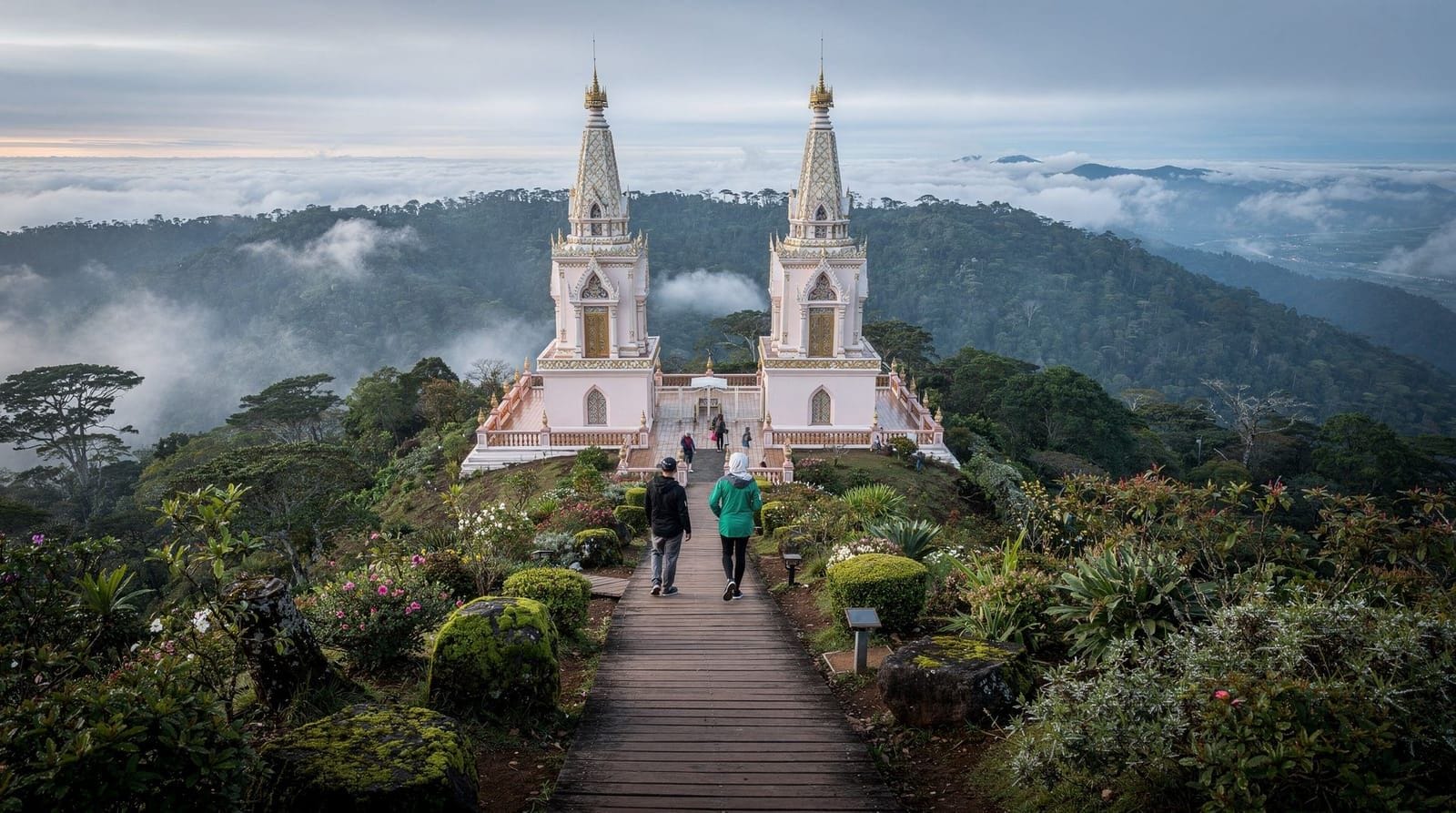
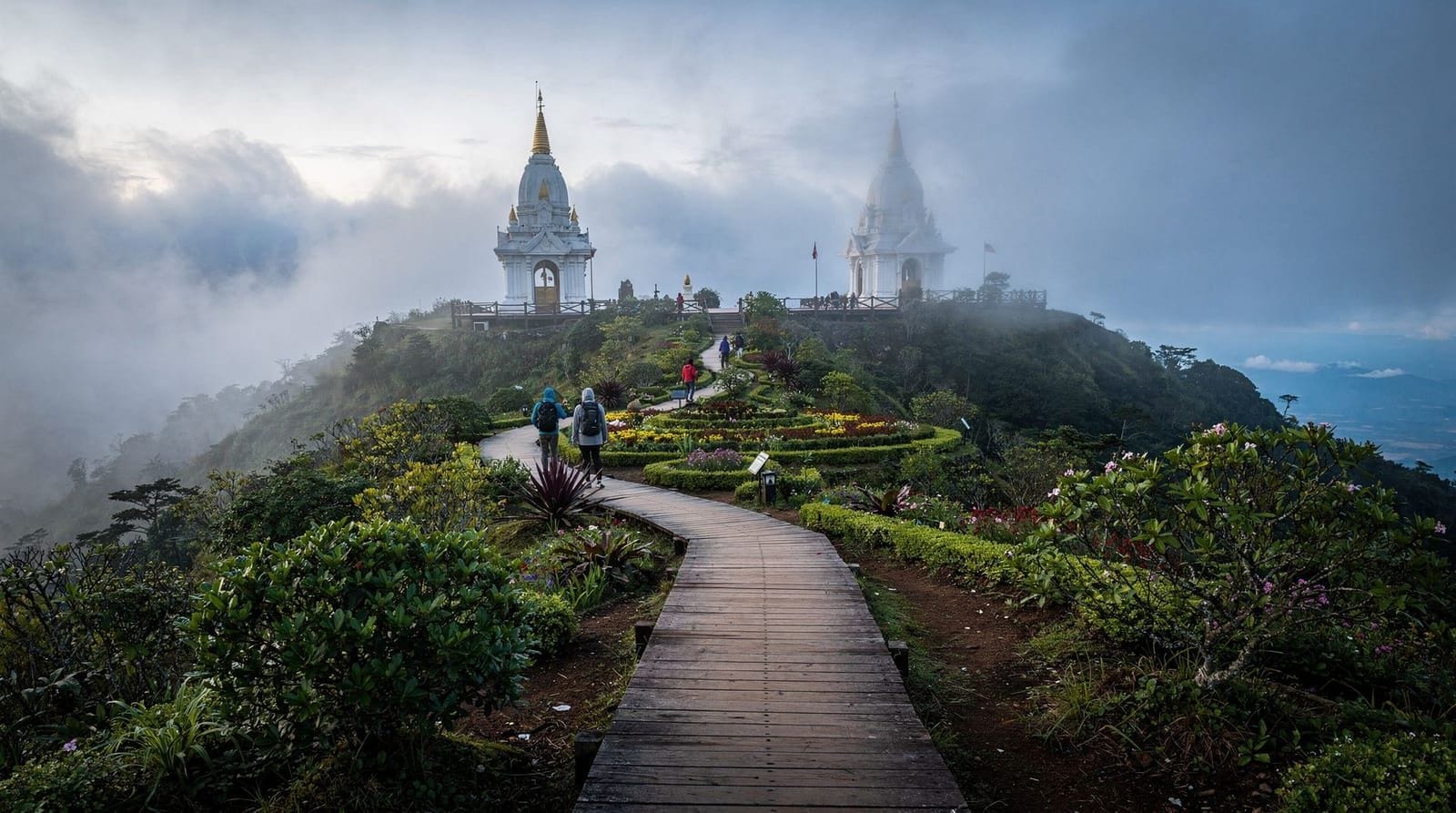
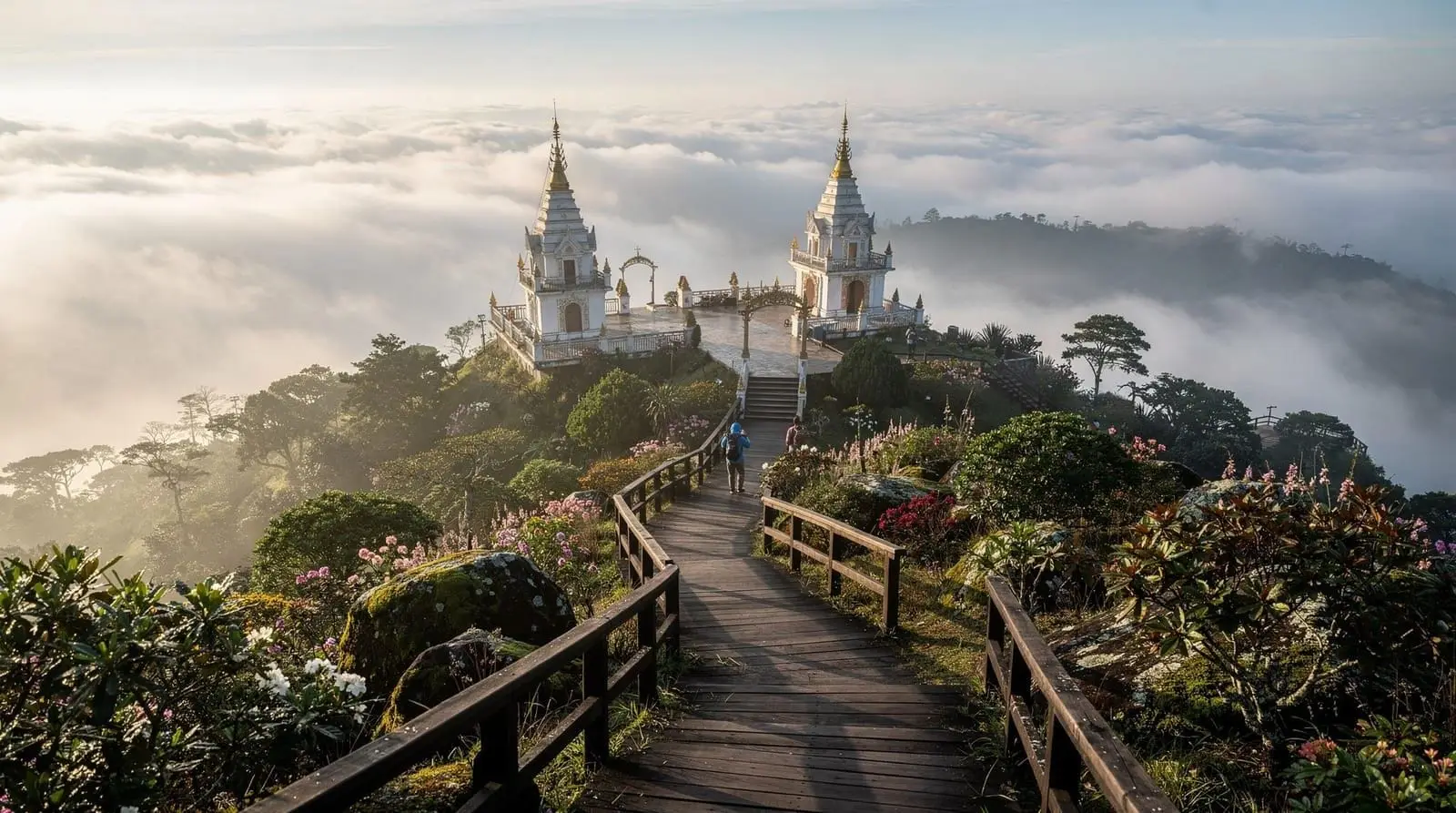
Here’s the part that surprised us: the summit itself, where the trig point and the short boardwalk sit, is not really the sunrise spot most people picture. The twin royal pagodas — Naphamethinidon and Naphaphonphumisiri — are lower down and have their own view, arguably better composed with the stupas in frame, but they don’t open until later in the morning, so the true pre-dawn crowd gathers either at the summit itself or along the Kew Mae Pan ridge trail, weather and permits permitting. We went for the summit, mostly because it required the least logistics coordination.
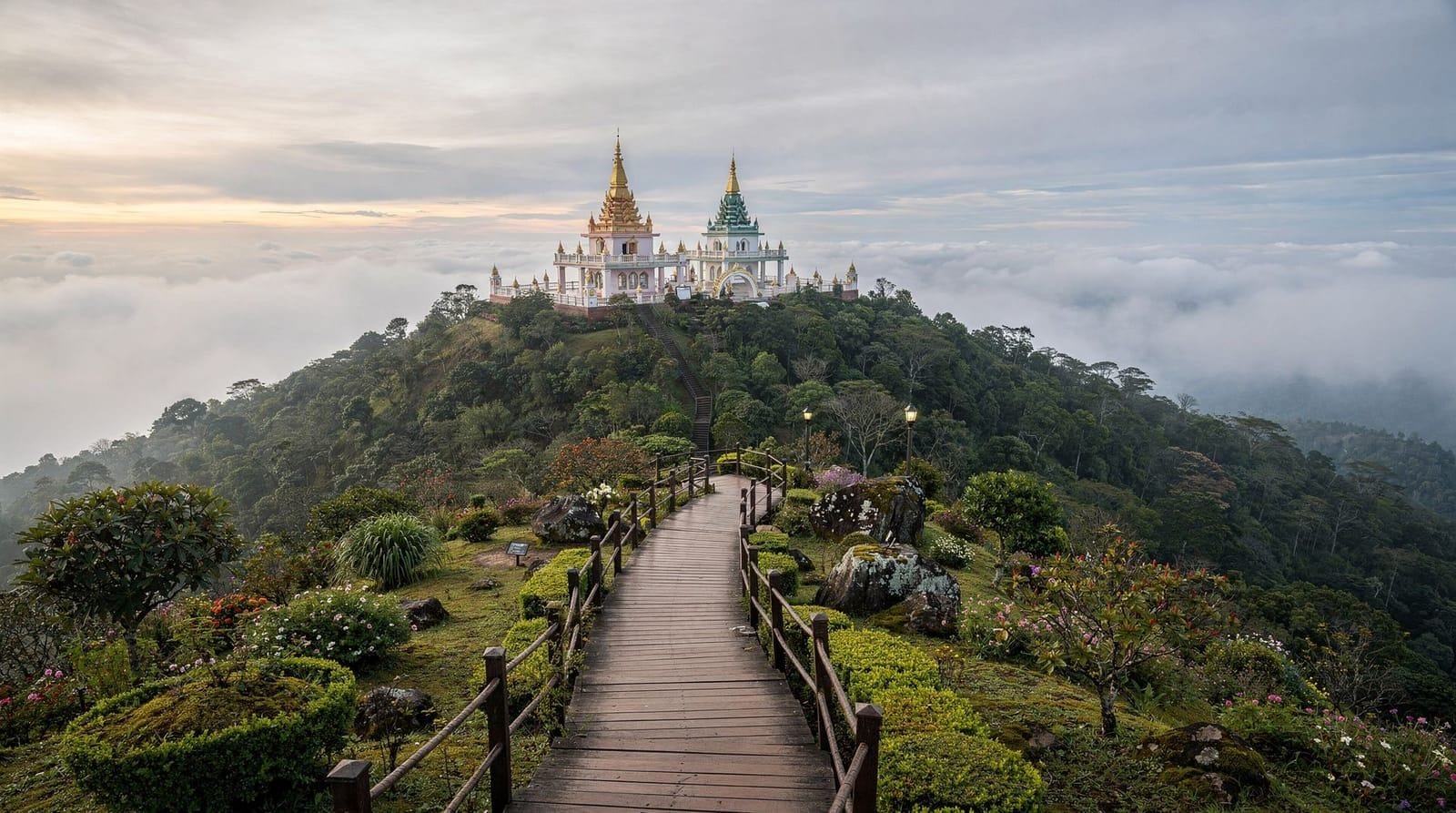
What you get, if the weather cooperates, is a sea of cloud filling the valleys below while the peak stands clear above it — genuinely one of the more striking sights we’ve had in northern Thailand, more evocative than dramatic in the way a proper mountain sunrise from a cloud forest can be. What you don’t get, most days between roughly June and October, is any of that. Doi Inthanon’s summit sits inside cloud forest and gets fogged in constantly, sunrise or not; our driver was blunt about it, telling us maybe six mornings in ten during rainy season produce nothing but grey. Our own Doi Inthanon guide covers the seasonal odds in more depth, but the short version: this trip is a much better bet from November through February, when skies are clearer and the “sea of cloud” phenomenon is actually visible from above rather than being the thing fogging out your view entirely.
The crowd question
We’d read that Doi Inthanon draws less of a scrum than Doi Suthep, and that held up — there is no comparison to the tour-bus density you’ll find at Doi Suthep on a normal afternoon. But “less crowded” at 3am still meant a scattering of maybe thirty to forty other people at the summit boardwalk by the time the light actually broke, most of them photographers with tripods claiming spots twenty minutes before anyone else arrived. If a completely solitary sunrise is the goal, this isn’t quite that. If the goal is avoiding daytime park traffic and midday coach groups, it delivers completely.
What happens after the sun actually comes up
The mistake we nearly made was treating the sunrise as the whole trip rather than the opening act. Once the light had properly broken and the initial rush of photographers began drifting back toward their vehicles, we stuck around for another ninety minutes rather than immediately heading back down, and it turned out to be the right call. The twin royal pagodas open a little later in the morning, once there’s enough light for the gardens surrounding them to be worth seeing, and arriving there just after opening meant we had the terraced flower beds and the two stupas — one built for the king, one for the queen, both offering their own valley views — almost entirely to ourselves, a full hour or two before the day-trip coach tours start arriving from the city.
If your legs and lungs are up for it, the Kew Mae Pan ridge trail is worth building into the same morning rather than treating the summit as the only stop. It requires a compulsory local guide, arranged at a checkpoint near the trailhead, and the roughly three-kilometer loop crosses genuinely striking high-altitude grassland and cloud-forest terrain that looks more like a temperate highland than anything most visitors associate with Thailand. We hadn’t planned enough time for it on our sunrise morning and had to return on a separate, regular-hours visit to do it properly — a scheduling mistake worth avoiding if you can help it, since combining the pre-dawn summit visit with the ridge trail in a single well-planned morning is entirely possible with the right timing.
The logistics nobody explains clearly
Getting up before official park hours isn’t as simple as just driving up and hoping for the best. Our driver, arranged through a small local operator rather than a large agency, had a pre-existing arrangement with the gate staff that let us through nearly an hour before the standard opening time — an arrangement we later learned isn’t universal and depends on which operator you book with. Anyone attempting this independently, without a private car and driver who has that relationship already established, risks arriving at a locked gate with no clear indication of when it will open. That uncertainty alone is probably the single strongest argument for booking a tour rather than attempting a self-driven sunrise visit, since the alternative is genuinely unpredictable rather than merely inconvenient.
Temperature planning matters more than most visitors expect too. Doi Inthanon holds the record for the coldest temperature ever recorded in Thailand, and while a summer sunrise won’t approach that extreme, the gap between valley-floor Chiang Mai and the summit is consistently large enough that dressing for the city rather than the mountain is a mistake we watched several other visitors make that same morning, arriving in shorts and t-shirts and visibly regretting it within minutes of stepping out of their vehicles.
Was it worth losing that much sleep
Yes, with conditions. It was worth it because the cloud sea, when it appears, is not a view you can replicate at a normal daytime visit to the same summit — by 9am the valley mist has usually burned off and the whole effect is gone, leaving just a nice mountain view rather than a genuinely uncommon one. It was worth it because the drive up in darkness, watching the temperature drop on the dashboard display degree by degree, has its own strange appeal that a midday visit can’t offer.
It was not worth it in the sense that we’d tell every visitor to do this. If you’re not a morning person, if two hours of sleep before a 2am alarm sounds like misery rather than adventure, or if you’re visiting outside the November–February window where fog odds are much higher, save the effort and do a standard day visit instead. Checking your travel dates against our best time to visit Chiang Mai overview and the more granular month-by-month weather breakdown beforehand would have saved some visitors we met that morning from a wasted wake-up call during a foggier stretch of the calendar than they’d realized. Our day trip guide to Doi Inthanon and the national park’s hiking trails overview both make the case for a well-planned regular-hours visit that still covers the twin pagodas, the Kew Mae Pan loop, and the summit boardwalk without the 3am wake-up call.
For those who do want to chase the sunrise specifically, arranging it independently means negotiating gate access before official opening hours, which isn’t guaranteed without a permit or a tour operator who has that sorted. A structured tour removes that uncertainty entirely:
Doi Inthanon National Park sightseeing tour from Chiang MaiWe came down from the summit around 7:30am, ears cold, stomachs empty, and stopped for khao soi at a roadside stall near the park gate that had clearly been serving this exact crowd of bleary sunrise-chasers for years. That bowl, more than the view itself, might be the thing I actually remember in five years. Which tells you something honest about how these trips actually work: the plan is the sunrise, but the memory ends up being everything around it.