Bhubing palace
The royal winter residence's rose and fern gardens sit a short drive past Doi Suthep — strict dress code, real crowds only on royal holidays.
Chiang Mai: Doi Suthep, Flower Gardens & Hmong Village
Quick facts
- Getting there
- ~4km past Doi Suthep on the same mountain road; songthaew, Grab, or combined tour
- Key sight
- Rose garden, fern garden, and palace grounds (residence buildings closed to the public)
- Time needed
- 1-1.5 hours
- Best time
- December-February when the rose garden is in fullest bloom
- Cost / entry
- ~50 THB entry; strict dress code enforced (no shorts, no leggings, no sleeveless tops)
Four kilometres past Wat Phra That Doi Suthep, the mountain road continues climbing to Bhubing Palace, the royal family’s winter residence — a formal garden estate that trades gold chedis for rose beds and clipped hedges, and trades temple crowds for a noticeably quieter, cooler stop.
Quick answer: Bhubing Palace is the Thai royal family’s winter residence on Doi Buak Ha, a peak near Doi Suthep, open to the public for its rose and fern gardens when the family isn’t in residence. Entry costs around 50 THB, the dress code is stricter than at most temples (no shorts, no leggings, no sleeveless tops for anyone, regardless of gender), and the gardens are at their best from December to February, when both the roses bloom fullest and the mountain air is at its coolest.
What it is, and what it isn’t
Most visitors reach Bhubing Palace as part of the same excursion that includes Doi Suthep, rather than as a first stop of the day, since the temple sits lower on the mountain road and is the more essential of the two sights.
Bhubing Palace is a working royal residence, not a museum or a historic ruin — the buildings themselves are closed to the public, and what you’re visiting is the surrounding garden grounds rather than palace interiors. That distinction matters for expectations: this isn’t a Versailles-style palace tour with room-by-room access, but a walk through manicured gardens with the residence buildings visible but off-limits.
Because it remains an active royal property, the palace occasionally closes to the public entirely when the royal family is in residence, typically over the winter months when Chiang Mai’s cooler climate is most appealing. Checking current opening status before making the drive is worth the extra step, particularly if this is the sole reason for your trip up the mountain that day.
The gardens
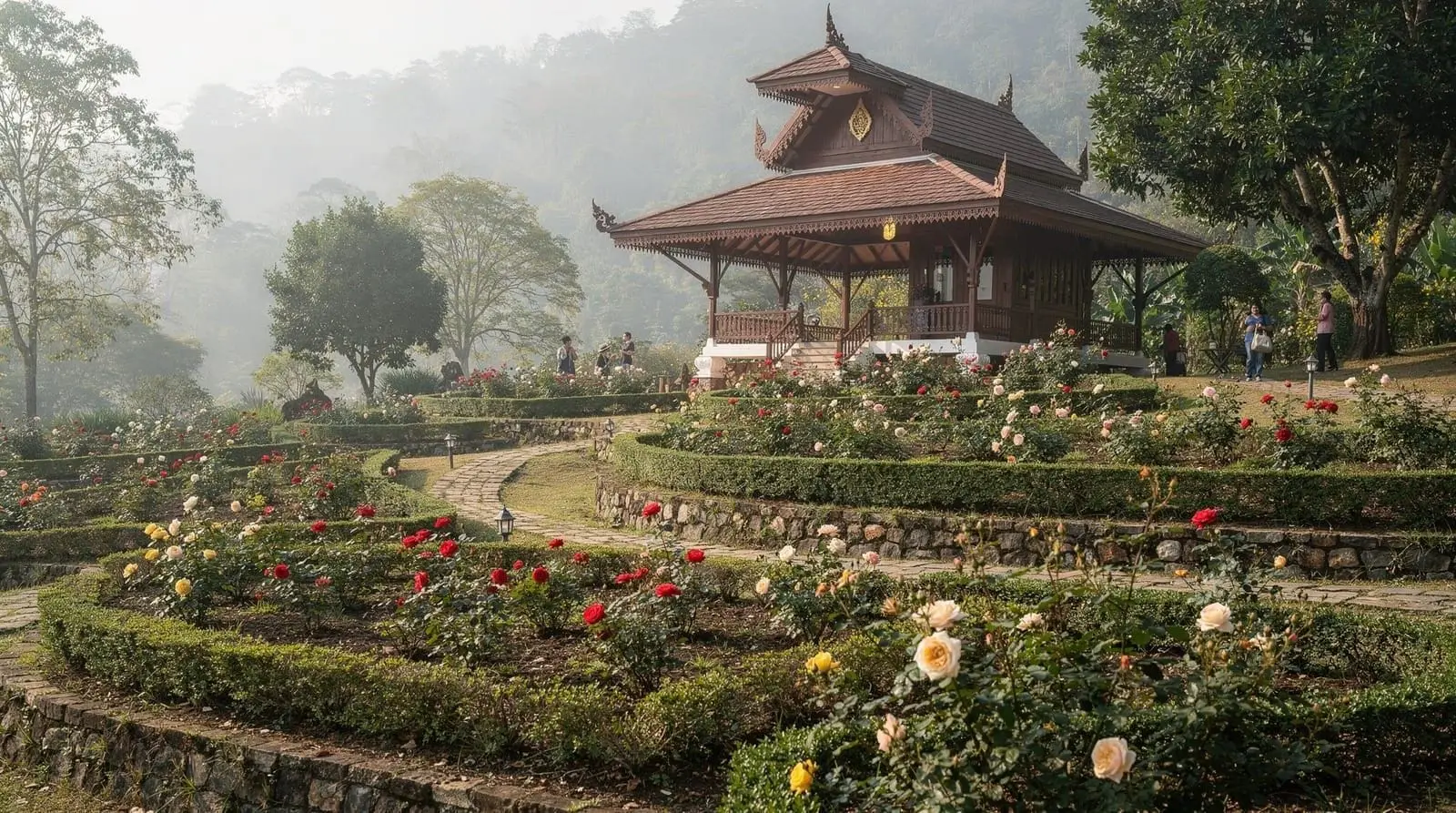
The rose garden is the palace’s signature feature — terraced beds of roses in a wide range of varieties, planted specifically because Doi Buak Ha’s elevation (around 1,300m) and cooler temperatures suit roses better than the tropical lowland climate of the city below. December through February is peak bloom, coinciding conveniently with the coolest and most comfortable time to visit generally. Outside this window the garden is still maintained and pleasant, if less dramatically in flower.
Beyond the roses, a separate fern garden showcases a shaded collection of native and ornamental ferns, a cooler, greener contrast to the open rose beds, and a good spot to linger if the day is warm. Paved paths wind through both gardens and the wider grounds, well maintained and easy walking for most visitors, including those with limited mobility, though there are some gentle slopes given the mountainside setting.
The dress code — stricter than you’d expect
This is the detail most visitors underestimate. As a royal property, Bhubing Palace enforces a formal dress code more strictly than most Chiang Mai temples: no shorts, no short skirts, no sleeveless tops, and no leggings or tight-fitting trousers, for visitors of any gender. Temple-style sarongs, which typically satisfy Doi Suthep’s dress requirements, may not be sufficient here — full-length, looser trousers or a long skirt are the safer choice. Some visitors have been turned away at the entrance for clothing that would have passed at Doi Suthep an hour earlier, so it’s worth dressing for the stricter of the two stops if you’re combining them in one morning.
Getting there
Bhubing Palace sits about 4km further up the same mountain road that leads to Doi Suthep, meaning the two are naturally combined rather than visited as separate trips. Songthaews continuing past Doi Suthep to the palace are less frequent than the main Doi Suthep run, so a private car, Grab, or a combined tour is generally the more reliable option for reaching the palace specifically, rather than relying on shared transport to be waiting at the right time.
The Doi Suthep to Bhubing Palace combination
Nearly every visitor who reaches Bhubing Palace does so as an extension of a Doi Suthep visit, given the shared access road. A combined Doi Suthep, Bhubing Palace and Hmong village tour covers all three stops — temple, gardens, and hill-tribe village — in a single half-day itinerary, which is the most efficient way to see the mountain without arranging transport twice. A slightly shorter Doi Suthep and Hmong village half-day tour is a reasonable alternative if the garden stop matters less to you than the temple and village.
Continuing on to Doi Pui village
Past Bhubing Palace, the road continues to Doi Pui Hmong Village, a hill-tribe settlement higher up the mountain with its own small museum and market stalls. Combining all three — temple, palace gardens, and village — makes for a full, satisfying half-day out of the city, and most tour operators price the three-stop itinerary only modestly above the Doi Suthep-only option, since the additional driving distance is relatively short. A morning Doi Suthep and Doi Pui village tour or the more focused Doi Suthep temple and Hmong hill tribe culture tour both build in a village stop alongside the palace and temple.
Practical tips
Bring a light layer — the elevation here is higher than Doi Suthep itself, and mornings especially can be genuinely cool by Chiang Mai standards, a welcome change if you’ve spent days in the lowland heat. Entry is a straightforward fixed fee (around 50 THB) rather than a negotiated price. Photography is generally permitted throughout the public garden areas, though signage near any residential buildings should be respected.
Nearby alternatives if the gardens aren’t your priority
If formal gardens aren’t a strong draw but you’re already on the mountain, Doi Pui Hmong Village a short distance further up offers a different kind of stop — a hill-tribe settlement with its own market and small museum — and Huay Kaew Waterfall lower down the mountain, near the Chiang Mai University and Huay Kaew Road area, gives a nature-focused alternative that doesn’t require the same dress code considerations as the palace. Between the three, most visitors find at least one option that matches their interests without needing to visit all of them in a single day.
A short history of the palace
Bhubing Palace was constructed in the 1960s as a winter residence for the Thai royal family, chosen for its location on Doi Buak Ha specifically for the cool climate the elevation provides relative to the lowland heat of the city and Bangkok. It remains an active royal property rather than a preserved historic site, which is the key distinction from most of the temples and attractions elsewhere on this list — its opening to the public is a courtesy extended when the family isn’t in residence, rather than a permanent arrangement, and the rose gardens were developed specifically to take advantage of the cooler mountain climate that ordinary lowland Chiang Mai can’t support for that kind of planting. This working, functional identity — a genuine residence rather than a museum piece — is worth keeping in mind when setting expectations for the visit.
Weather at altitude
At roughly 1,300m elevation, Bhubing Palace sits noticeably higher and cooler than both central Chiang Mai and Doi Suthep itself, which sits lower on the same mountain. Morning temperatures here during the cool season (November-February) can dip into a range that feels genuinely chilly by Thai standards, particularly if there’s any wind — a light jacket or long-sleeved layer is a reasonable addition even if you haven’t needed one anywhere else in the city. During the hot season (March-May), this elevation advantage makes Bhubing Palace one of the more comfortable outdoor stops in the region, a useful fact if you’re trying to plan an itinerary that avoids the worst of the lowland heat during midday hours.
Ending the day back in the city
Most visitors descend from Bhubing Palace and Doi Suthep by early-to-mid afternoon, which lines up well with either an afternoon in Nimmanhaemin for cafés and shopping, or a return to the Old City for its temples if you haven’t covered them yet. Since the mountain excursion is inherently a half-day commitment once transport time is included, planning a lighter, more relaxed second half of the day — rather than stacking another major sight immediately afterward — tends to make for a better-paced overall itinerary.
A realistic itinerary combining all three mountain stops
For visitors with a full morning or half-day to spend on the mountain, a workable sequence is: Doi Suthep first, arriving at opening to beat the crowds and get the clearest possible view before any midday haze builds, roughly 1-1.5 hours there; a short drive to Bhubing Palace next, allowing another hour for the gardens; and finally continuing to Doi Pui village for a final 45 minutes to an hour before heading back down. This ordering works better than the reverse, since Doi Suthep’s crowd levels change most dramatically through the morning, while the palace gardens and Doi Pui village are comparatively steady in visitor numbers throughout the day. Private transport or a combined guided tour makes this sequencing far easier than trying to coordinate shared songthaews between three separate stops.
Bringing children
Compared to a full morning at Doi Suthep or a longer village stop at Doi Pui Hmong Village, the palace gardens ask the least of younger children physically, making it a reasonable place to let them run off energy on open lawn areas while adults enjoy the rose beds at a slower pace.
The gardens are a genuinely pleasant, low-effort stop for families, with level paved paths, open lawn areas, and enough visual interest in the rose beds to hold younger children’s attention without requiring the sustained walking that a temple or hiking-focused stop demands. The main consideration for families is the dress code, which applies to children as well as adults — shorts on younger children are generally tolerated with more leeway than on adults, but it’s safer to dress the whole family in longer clothing to avoid any confusion at the entrance gate.
Etiquette beyond the dress code
Beyond what to wear, a few additional courtesies matter at Bhubing Palace given its status as an active royal residence rather than a general tourist site. Loud conversation, running, or boisterous behaviour on the grounds is noticeably more out of place here than at most attractions in this guide, and staff may politely intervene if visitors are behaving inappropriately for a royal property. Photography of the gardens is welcome, but pointing cameras directly at any residence buildings or staff, rather than the public garden areas, should be avoided out of the same respect extended to the site’s residential function. None of this makes for an unpleasant visit — most visitors naturally adjust their behaviour once they understand the context — but it’s worth knowing in advance rather than discovering it from a staff member’s correction.
A note on the wider Doi Suthep-Pui National Park
Bhubing Palace sits within Doi Suthep-Pui National Park, the protected area that also encompasses the temple, the Monk’s Trail, and Doi Pui village further up the mountain. The park designation means the surrounding forest is managed conservation land rather than open to development, which is part of why the drive up feels progressively more forested and less built-up the higher you climb — a contrast worth noticing against the rapid development visible in parts of the city below. Trail access within the park beyond the palace grounds themselves is limited without a guide or clear signage, so the palace’s own gardens remain the main self-guided activity at this stop, with any deeper forest exploration better handled through a guided hike option elsewhere on the mountain.
Is Bhubing Palace worth it compared to other Chiang Mai gardens?
Chiang Mai has several notable gardens, most prominently the much larger Queen Sirikit Botanic Garden in Mae Rim, which offers a canopy walk and glasshouses across a considerably bigger site. Bhubing Palace is smaller and more formal in style — closer to a palatial rose garden than a botanic research collection — and its main advantage is proximity to Doi Suthep rather than scale or botanical variety. If you’re specifically interested in gardens as a primary activity, Queen Sirikit’s larger grounds may reward a dedicated half-day trip better than Bhubing Palace’s more modest offering. If gardens are a secondary interest and you’re already headed up the Doi Suthep road, Bhubing Palace’s convenience makes it the easier addition.
What to bring
Beyond appropriate full-length clothing for the dress code, a light jacket or long-sleeved layer is worth packing given the cooler temperatures at this elevation, particularly for an early-morning visit combined with Doi Suthep. Comfortable walking shoes suit the garden paths well, since the terraced layout involves a reasonable amount of walking across a mildly sloped site. A small amount of cash covers the entry fee, since card payment isn’t reliably available at the gate.
Accessibility notes
The palace’s public garden paths are paved and generally well maintained, making them manageable for most mobility levels, though the mountainside setting means some gentle grades between garden terraces rather than a fully flat layout. There are no stairs comparable to Doi Suthep’s Naga staircase involved in visiting the gardens themselves, which makes Bhubing Palace a genuinely easier stop for visitors who found the temple’s climb challenging, provided transport up the mountain is arranged separately since public songthaew service to the palace specifically is limited.
Frequently asked questions about Bhubing Palace
Can I go inside the palace buildings?
No, the residence buildings are closed to the public. Visits are limited to the surrounding rose and fern gardens and the general grounds.
What is the dress code at Bhubing Palace?
Stricter than most Chiang Mai temples: no shorts, no leggings or tight trousers, and no sleeveless tops, for any visitor regardless of gender. Full-length, looser clothing is the safest choice.
Is Bhubing Palace always open to visitors?
No — as an active royal residence, it closes to the public when the royal family is in residence, typically during parts of the cooler season. Check current status before making the trip if this is your primary destination that day.
When is the best time to see the rose garden in bloom?
December through February, which also coincides with Chiang Mai’s coolest, most comfortable weather at this elevation.
How far is Bhubing Palace from Doi Suthep?
About 4km further up the same mountain road, making the two a natural combination rather than separate trips.
How much time should I set aside for Bhubing Palace?
Around 1 to 1.5 hours is enough for the gardens and grounds, on top of whatever time you allocate for Doi Suthep itself.
Is it worth visiting Bhubing Palace on its own, without Doi Suthep?
Not really recommended — since transport up the mountain naturally passes Doi Suthep first, most visitors combine the two, and Doi Suthep is the more essential stop if you had to choose only one.
Top experiences
Bookable activities with verified prices and instant confirmation on GetYourGuide.