Khao soi recipe: where to learn it in Chiang Mai
Chiang Mai: Local Northern Thai Cooking Class at Grandma's
Which cooking classes in Chiang Mai teach khao soi?
Most full-lineup half-day and full-day cooking schools in Chiang Mai include khao soi or a closely related northern curry as a paste-pounding lesson, though it's sometimes offered as one option among several rather than guaranteed on every date. Northern-focused schools built around Lanna home cooking are the most reliable bet; always confirm the specific dish list before booking rather than assuming.
Ask ten visitors what they most want to eat in Chiang Mai and at least seven will say khao soi before you finish the question. It’s the dish that gets photographed, posted, and argued about (whose version is best is a genuine local sport), and it’s also the single dish most people specifically want to learn to cook rather than just eat. That makes it worth being precise about which cooking classes actually teach it, what’s involved in the paste that gives it its flavor, and what you’re realistically signing up for if khao soi is the reason you’re booking a class at all.
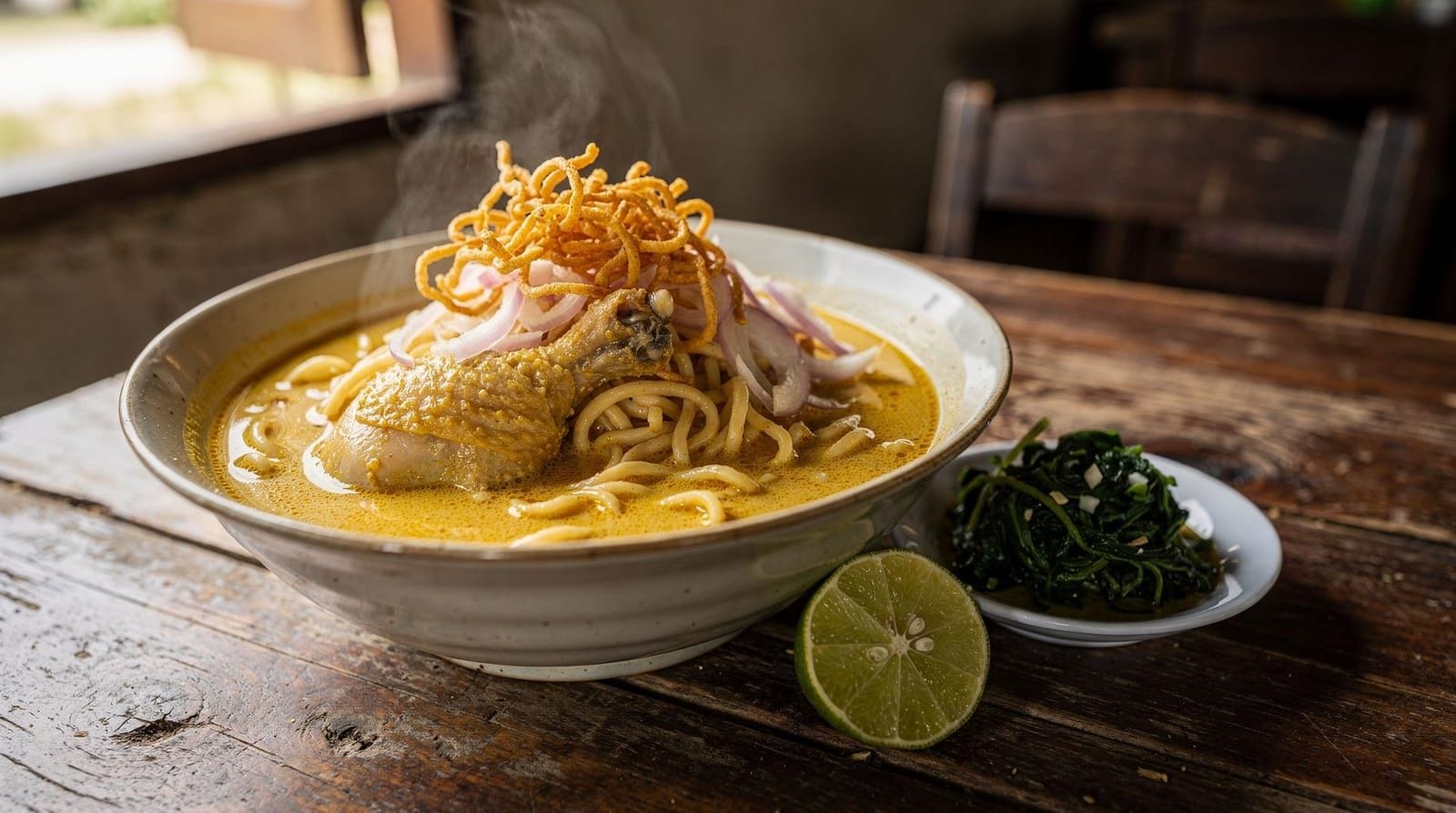
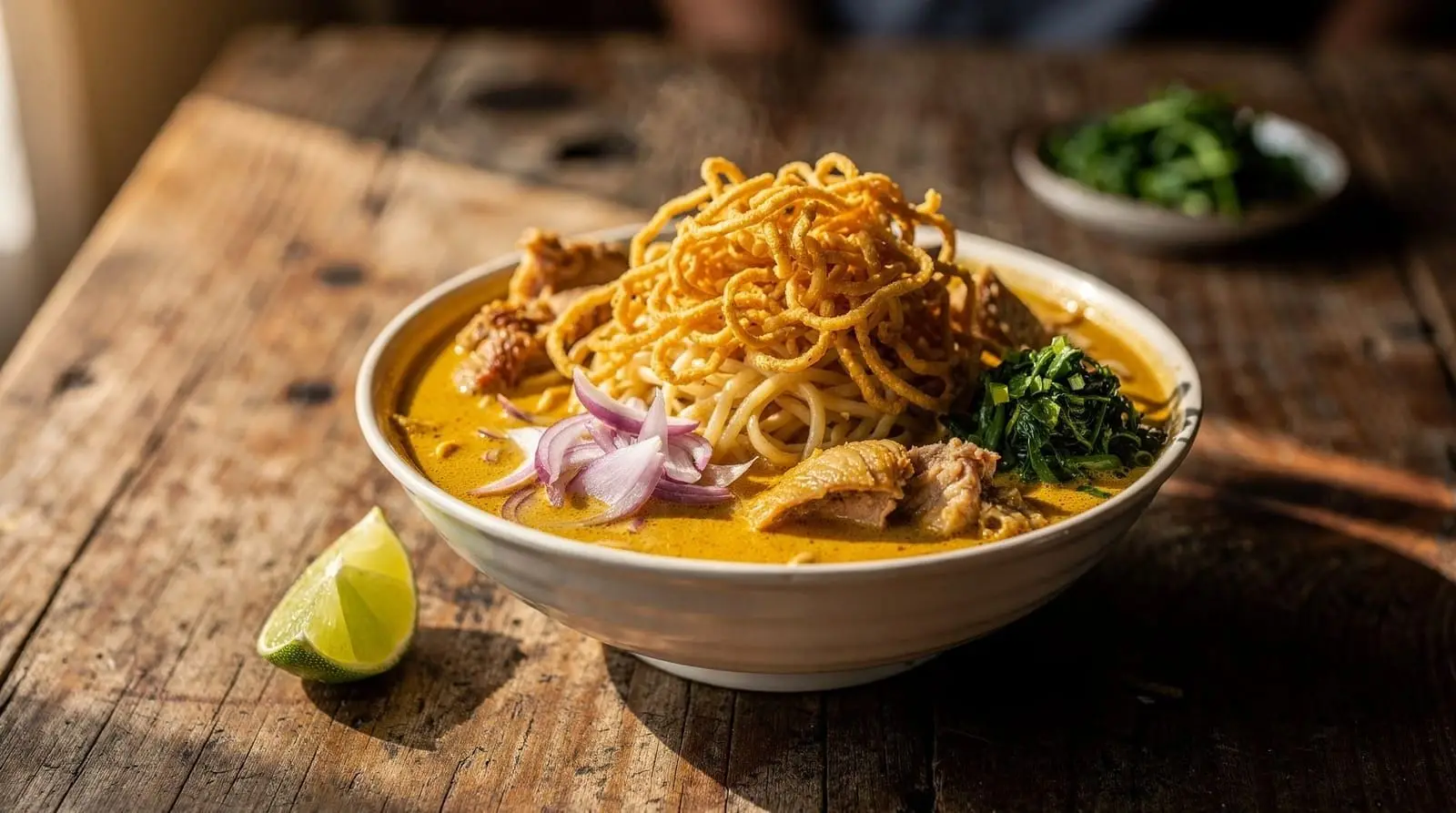
Khao soi is a northern Thai curry noodle soup built around three layers that have to work together: a coconut curry broth carrying real depth from a northern spice paste, boiled egg noodles sitting in that broth, and a tangle of deep-fried crispy egg noodles piled on top for crunch and visual contrast. It’s usually made with chicken (often a leg or thigh piece simmered directly in the broth) or beef, occasionally pork, and it comes to the table with a small plate of add-ins on the side: pickled mustard greens (dong), sliced shallots, wedges of lime, and a spoonful of chili paste fried in oil (nam phrik phao) for those who want more heat. Getting all of that right — broth that’s rich without being greasy, noodles that hold their bite, a crispy topping that doesn’t turn soggy in the first two minutes — is exactly the kind of thing a hands-on class can teach you far better than a recipe card ever could.
Why khao soi is harder to teach than a stir-fry
Most dishes on a Chiang Mai cooking class menu — pad thai, a cashew chicken stir-fry, tom yum soup — come together in ten or fifteen minutes once your ingredients are prepped. Khao soi doesn’t work that way. The curry paste needs to be built from scratch (dried chilies rehydrated and pounded, spices toasted and ground), the broth needs real simmering time to let the coconut milk and paste marry properly, and the crispy noodle topping needs a separate frying step that most home cooks have never attempted. That’s roughly forty-five minutes to an hour of active cooking time for one dish, compared to ten minutes for a stir-fry, which is exactly why some schools treat khao soi as an optional or rotating menu item rather than a guaranteed inclusion on every single booking. If khao soi is your main reason for taking a class, don’t assume it’s on the day’s menu — check, or book a school that names it explicitly.
Which classes specifically teach khao soi
The most dependable option is a class built around northern Lanna home cooking rather than a generic pan-Thai menu, since these schools tend to treat khao soi as a signature lesson rather than an afterthought.
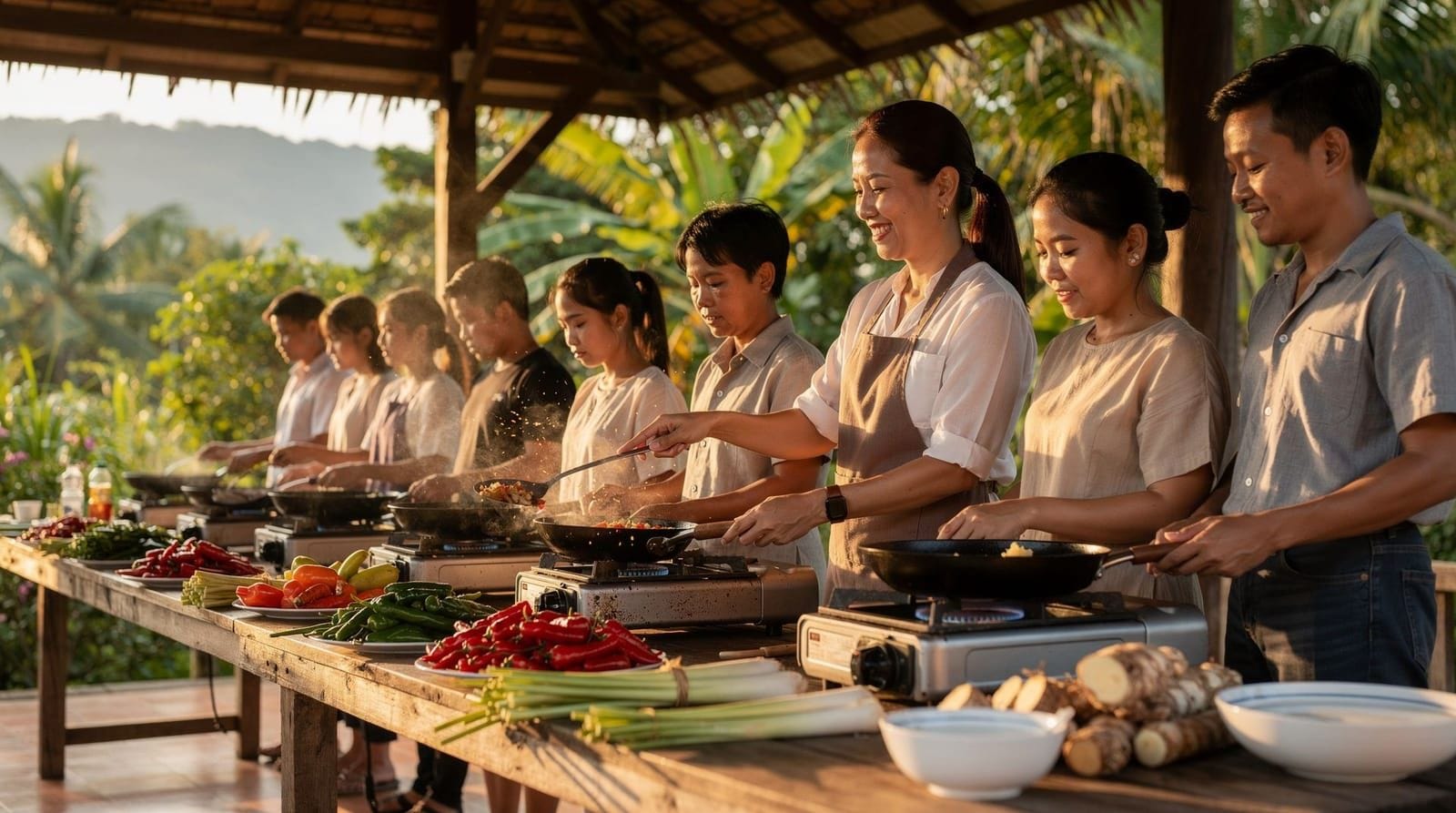
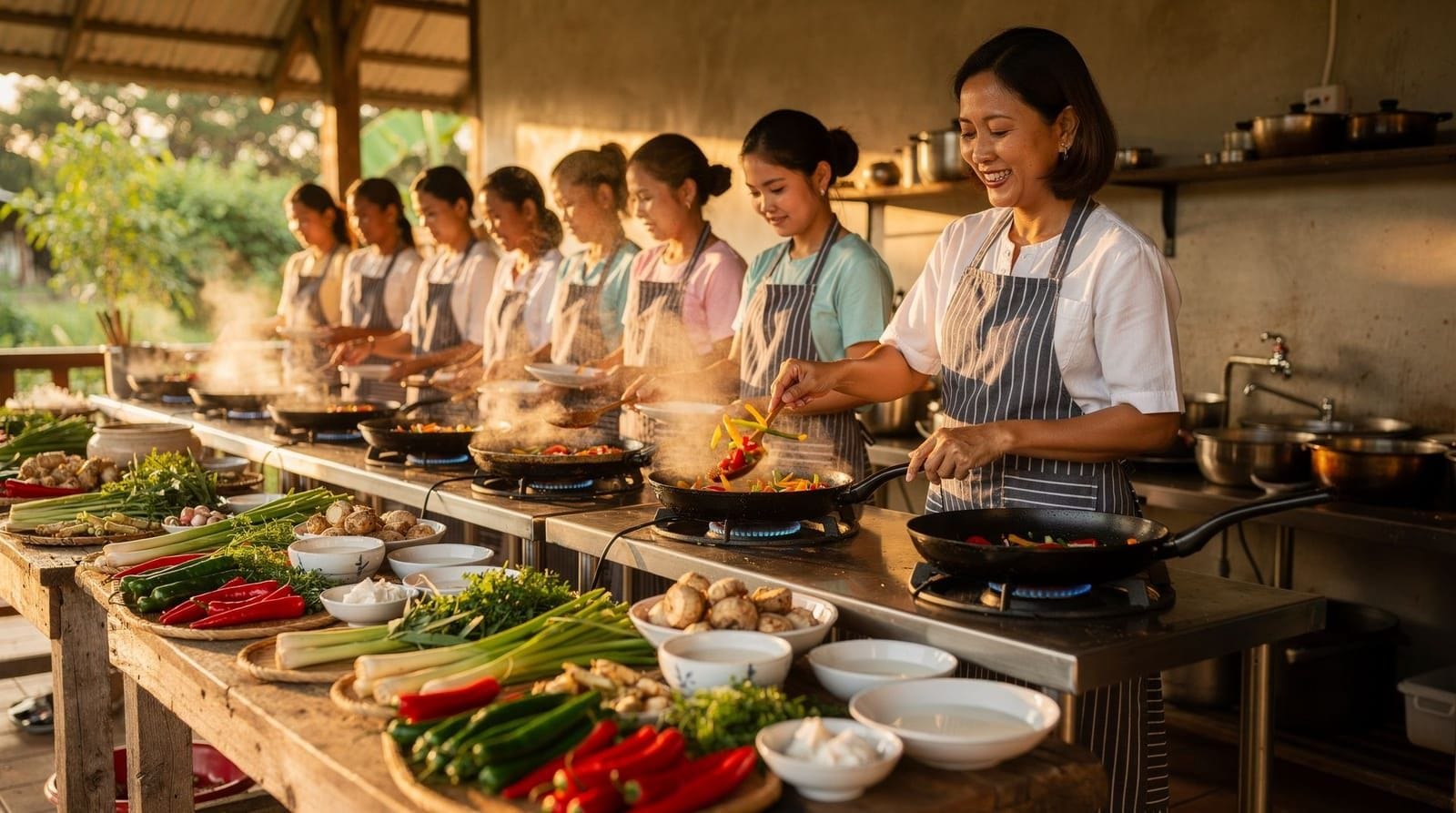
Book the Lanna cooking class at Grandma’s home for the class most consistently structured around northern dishes, khao soi included among the paste-based lessons taught in a home-kitchen setting rather than a commercial demonstration kitchen — a format that tends to slow the pace down in a good way, since you’re working alongside a home cook rather than watching a chef perform.
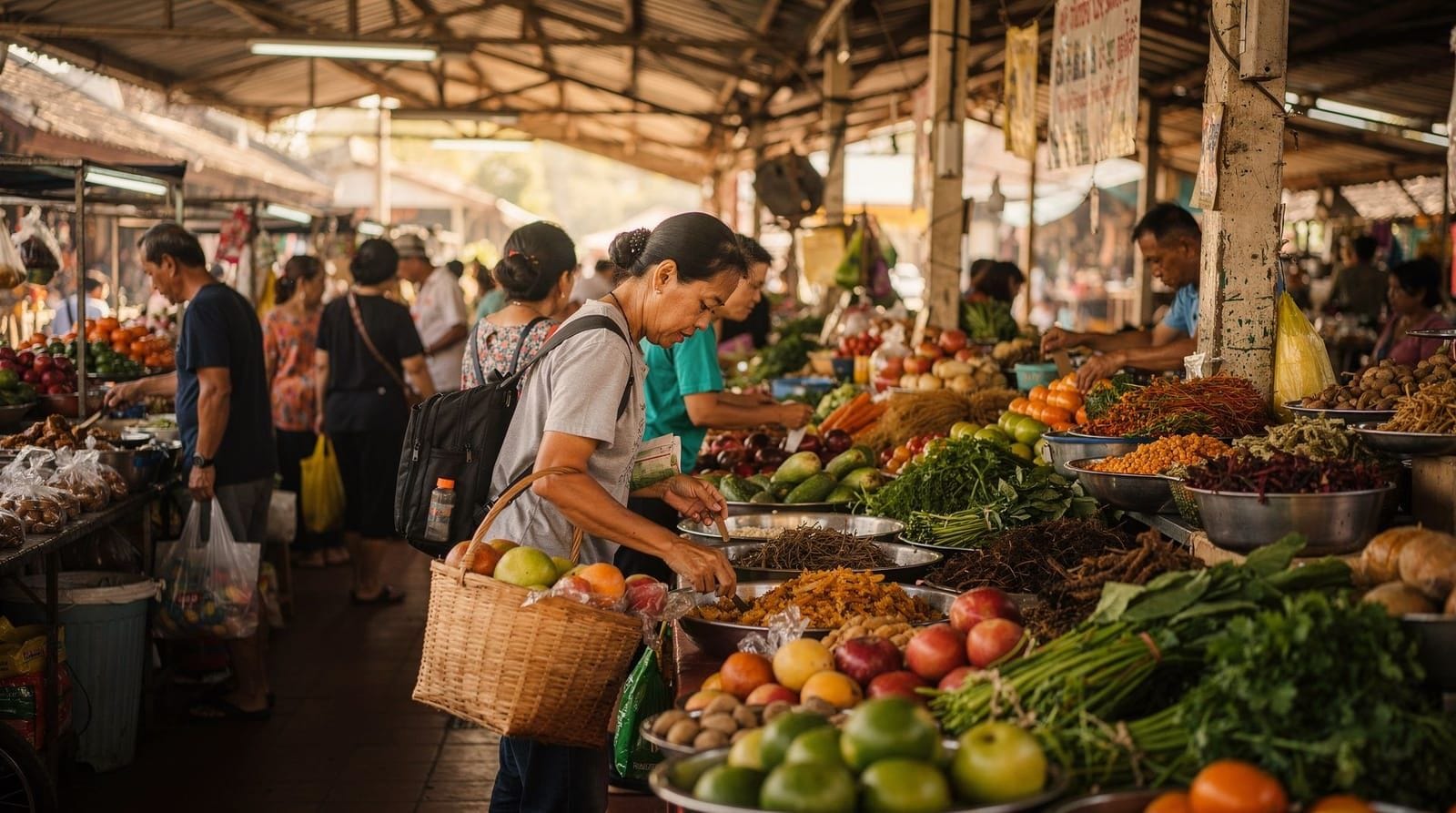
Several of the broader, market-tour-style classes also rotate khao soi into their standard lineup, usually letting you pick from a short list of curries and stir-fries during the market stop.
Check the traditional Thai cooking class with market tour for a well-reviewed, market-first format where khao soi is commonly one of the curry options on the day’s dish list — confirm at booking or during the market briefing, since exact rotations shift with what’s fresh and what the group votes for.
Look at We Cook Thai Home Garden Cooking School for a garden-and-market format that also regularly includes a northern curry option; the home-garden setting means smaller batches and more one-on-one guidance during the paste-pounding stage, which is the part of khao soi most people actually want help with.
See the cooking class with market and Thai herbs garden tour for another market-based option where northern curry pastes, including khao soi’s, are taught alongside the herb-identification portion of the day — useful if you want to actually see and smell the difference between northern and central Thai aromatics before you start pounding.
Whichever class you book, the honest approach is to email or message the operator ahead of time and ask directly: “Is khao soi on the menu for my date?” Reputable schools answer this without hesitation, and it saves you from discovering on the day that you’ve been assigned a green curry lesson instead.
What makes the khao soi curry paste distinct
This is the part that actually separates a decent khao soi from a forgettable one, and it’s also the part a class teaches better than any recipe. Northern Thai curry pastes, khao soi’s included, differ from the central Thai pastes most international visitors already know (green curry, red curry, massaman) in a few specific ways.
Dried chilies over fresh. Where a central Thai green curry paste leans on fresh green chilies pounded straight into the mortar, northern pastes typically start with dried red chilies, soaked in warm water until soft before pounding. This changes the color (a deeper brick-red rather than bright green or red) and the flavor profile — drier, more concentrated, less of the grassy sharpness fresh chilies bring.
Curry powder in the mix. This is the single biggest giveaway that you’re making a northern paste rather than a central one. Khao soi’s paste typically incorporates a small amount of dry curry powder — a legacy of trade and cultural exchange with Yunnanese Chinese Muslim traders and Burmese cooking traditions that shaped Lanna cuisine over centuries. Central Thai curry pastes almost never include curry powder; its presence here is what gives khao soi its slightly earthier, warmer spice note compared to the brighter, more citrus-forward pastes used in the south and center of the country.
A different aromatic balance. Lemongrass, galangal, and shallots still appear, but in different proportions than you’d find in a tom yum or green curry paste, and turmeric plays a bigger role here (often fresh turmeric root pounded directly in, giving the paste and the finished broth its yellow-orange tint).
Coconut milk added in two stages. Most classes teach adding thick coconut cream first to fry the paste until it splits and releases oil (a technique called “breaking” the curry, which develops real depth of flavor), then thinning with coconut milk to reach the final soupy consistency. Skipping the frying stage and just dumping everything into a pot together is the single most common shortcut that produces a flat, under-developed broth — and it’s exactly the technique a hands-on class corrects that a recipe blog rarely explains well.
A typical khao soi lesson, step by step
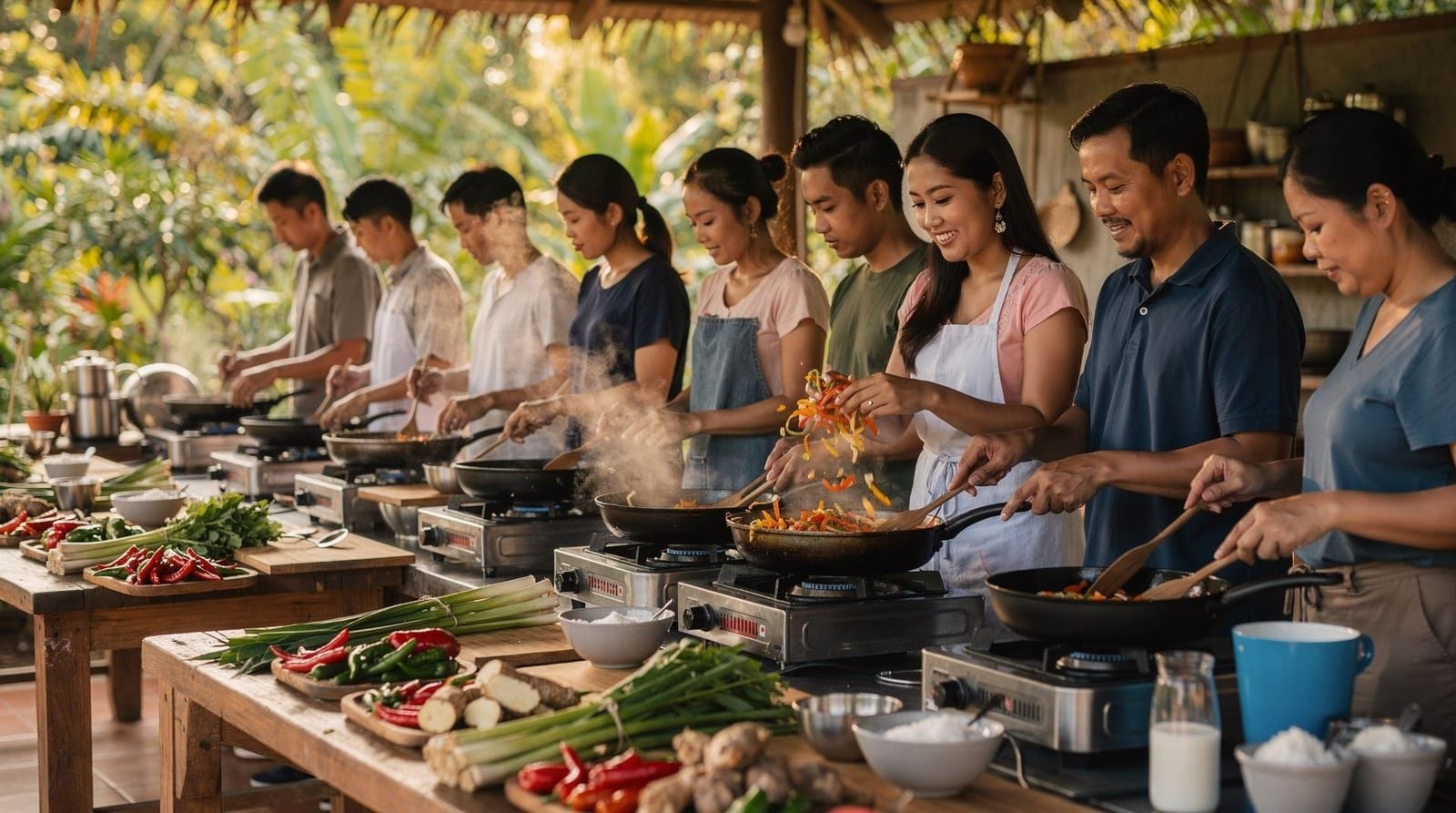
Most classes that include khao soi structure the lesson in roughly this order: dried chilies get soaked while the instructor talks through the northern paste ingredients (a good moment to ask questions about ingredient substitutions if you’re planning to cook this at home afterward); everyone pounds their own paste in an individual granite mortar, usually the most physically demanding part of the day and also the part people remember best; the paste gets fried in coconut cream until it splits, then loosened with more coconut milk and stock; chicken or beef goes into the broth to simmer while a separate batch of noodles gets boiled for the base layer and a second batch gets deep-fried for the crispy topping; and everyone assembles their own bowl at the end, garnished from a shared plate of pickled mustard greens, shallots, lime, and chili oil. That last step — building your own bowl exactly the way you like it — is also where you’ll notice how much the balance of lime, pickle, and chili changes the dish, which is a genuinely useful thing to feel out with your own hands rather than read about.
Where to also just eat khao soi well
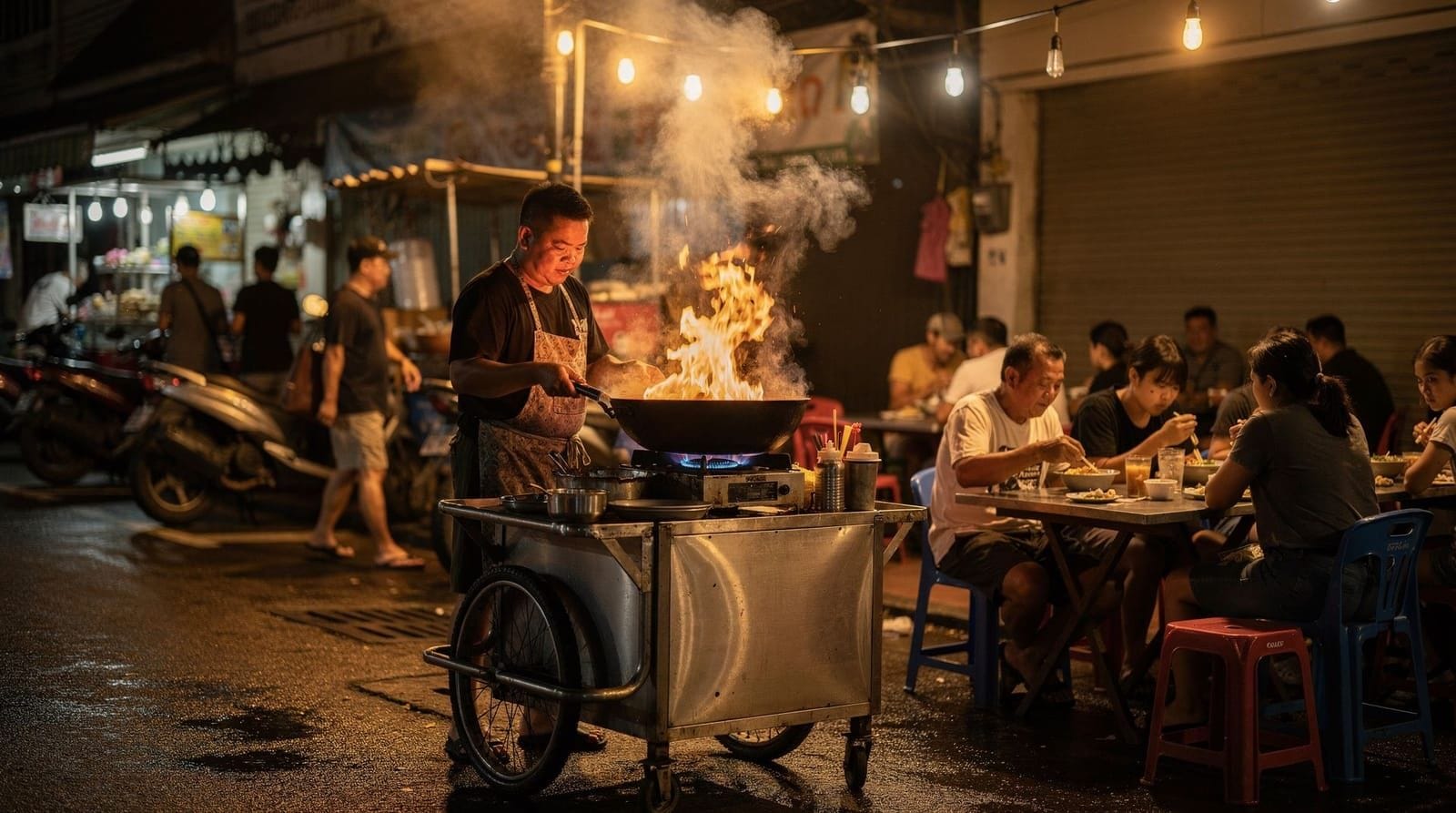
Not everyone wants to spend three or four hours cooking one dish, and that’s a completely reasonable position — khao soi is available all over Chiang Mai at a much lower cost and time commitment than a class. Warorot Market has several long-running khao soi stalls that locals actually eat at, generally a better bet than the tourist-facing restaurants clustered near the old city moat. Expect to pay roughly 40-60 THB (around $1-2) for a bowl at a market stall or simple noodle shop, versus 80-150 THB (about $2-4) at a sit-down restaurant aimed at visitors — the price gap rarely reflects a proportional quality gap. For a fuller rundown of specific stalls and restaurants worth seeking out, see the dedicated guide on where to eat khao soi in Chiang Mai, and for the wider northern Thai menu beyond this one dish, the guide to northern Thai dishes to try covers what else belongs on your list. Warorot Market itself gets a full food-focused rundown in the Warorot Market food guide, useful for planning a self-guided eating crawl around the same stalls a market-tour cooking class would visit anyway.
A short history of how khao soi arrived in Chiang Mai
Khao soi’s roots trace back to trade routes connecting northern Thailand with Yunnan in southern China and with Burma (Myanmar), carried in large part by Chinese Muslim traders known locally as Chin Haw who moved goods, and food traditions along with them, through the highlands over the nineteenth and early twentieth centuries. The curry-powder note in the paste and the general silhouette of the dish — noodles in a rich, spiced broth — echo those overland connections rather than the coastal, maritime trade routes that shaped much of central and southern Thai cuisine. Some food historians also point to a version of the dish documented among Muslim communities in Chiang Mai and Mae Hong Son by the early twentieth century, gradually adopted and adapted by the wider northern Thai population from there. None of that history is required knowledge to enjoy a bowl, but it does explain why khao soi tastes distinctly different from anything you’d find in Bangkok, Phuket, or the Isaan region — it genuinely comes from a different culinary lineage within the same country, shaped by a different set of neighbors and trade partners than the rest of Thailand.
Regional variations worth knowing about
Not every khao soi is identical even within Chiang Mai, and a class will usually teach you one specific version rather than a definitive, universal recipe — there isn’t really such a thing. Some cooks add a touch of soybean paste (tao jiao) for extra depth; others adjust the ratio of coconut cream to coconut milk to make the broth thicker or thinner; and the exact chili count in the paste varies significantly by household and stall, which is part of why the same dish can taste noticeably different from one place to the next even a few streets apart. If you take a class and later try khao soi at a market stall or restaurant and notice a different flavor balance, that’s normal variation rather than either version being “wrong.” It’s also a good reason to try more than one bowl during your stay — the northern Thai dishes to try guide covers other regional specialties worth comparing khao soi against, including dishes that share some of the same paste ingredients but land in a very different final dish.
Recreating it at home after your class
The recipe booklet most schools hand out at the end covers quantities and steps, but a few practical notes make the difference between a decent attempt at home and a disappointing one. Dried chilies specific to northern Thai cooking (and curry powder blended for this style rather than a generic garam masala or Madras blend) can be hard to source outside Thailand, so it’s worth buying a small stock of dried chilies and northern curry powder at Warorot Market before you fly home if you’re serious about cooking khao soi again — most stalls sell vacuum-sealed spice packs specifically aimed at travelers taking food home. Fresh kaffir lime leaves and Thai basil are the hardest components to replace convincingly; frozen versions (increasingly available at Asian grocery stores abroad) hold their aroma far better than dried substitutes. And don’t skip the step of frying the paste in coconut cream until it visibly splits before adding the thinner coconut milk — it’s the step most home cooks are tempted to rush, and it’s the one that separates a genuinely rich broth from a flat one.
Booking logistics and prices
Classes that include a khao soi lesson generally sit in the same price range as any other half-day Chiang Mai cooking class: roughly 900-1,400 THB per person (about $25-39) for a half-day format with market visit, transport, ingredients, and the recipe booklet included. Full-day formats that add a farm visit or a longer dish list typically run 1,300-1,800 THB (about $36-50). None of these prices are unusual for the category — khao soi isn’t priced as a premium add-on, it’s simply one of the dishes on an already-standard menu. Group sizes for the classes above typically run 6-12 participants, though this varies by date; if a small, unhurried pace matters more to you than guaranteed khao soi, it’s worth reading the companion guide on what to expect from a Thai cooking class before you book, since pacing and group size affect how much individual attention you get during the paste-pounding stage specifically.
If you’d rather harvest your own herbs before cooking them, several organic-farm classes also teach northern curries including khao soi as part of a broader farm-to-table format — see the farm-to-table cooking class guide for how that differs from the market-based classes described above. For a wider view of the full Chiang Mai cooking school landscape beyond this one dish, the best cooking schools in Chiang Mai guide and the general Chiang Mai cooking class overview both cover the category from a broader angle, and the cooking classes hub rounds up every format side by side.
Frequently asked questions about learning khao soi in Chiang Mai
Is khao soi guaranteed on every cooking class menu?
No. Many classes rotate a short list of curry and stir-fry options, and khao soi’s longer prep time (paste-pounding, double-cooked noodles) means some schools treat it as one choice among several rather than a fixed inclusion. Confirm with the operator before booking if khao soi is your main goal.
What’s the difference between khao soi paste and green curry paste?
Khao soi’s northern paste is built from dried rather than fresh chilies, includes a portion of dry curry powder (a Yunnanese and Burmese-influenced touch absent from central Thai pastes), and leans more heavily on fresh turmeric. Green curry paste uses fresh green chilies, no curry powder, and a brighter, more citrus-forward balance of lemongrass and galangal.
Is khao soi difficult for a beginner cook to make?
The individual steps (pounding paste, simmering broth, boiling noodles, frying a topping) are all beginner-manageable with guidance, but there are more steps than a simple stir-fry, so expect the lesson to take closer to an hour of hands-on time rather than fifteen minutes.
Is khao soi always made with chicken?
No — chicken (often a bone-in leg or thigh piece) is most common in restaurants and classes, but beef and occasionally pork versions are traditional and appear on some menus. Ask which protein a specific class uses if you have a preference.
Can vegetarians learn a khao soi recipe in a Chiang Mai cooking class?
Most schools can substitute tofu or extra vegetables for the meat and adjust the broth base, though the curry paste and coconut broth technique stays the same either way. Confirm dietary needs when booking rather than assuming on arrival.
How much does a khao soi cooking lesson typically cost?
Classes that include khao soi are priced the same as standard half-day or full-day cooking classes: roughly 900-1,400 THB (about $25-39) for a half day, or 1,300-1,800 THB (about $36-50) for a full day including a farm or additional market stop.
Where can I eat khao soi if I don’t want to take a class?
Warorot Market has several long-running stalls locals frequent, generally cheaper and just as good as tourist-oriented restaurants near the old city. See the dedicated where to eat khao soi guide for specific recommendations.
Do all khao soi classes teach you to make the crispy noodle topping from scratch?
Most do, since it’s a defining part of the dish, but a few shorter or budget classes skip the frying step and provide pre-fried noodles to save time. If making every component yourself matters to you, ask specifically whether the crispy topping is part of the hands-on portion.
Top experiences
Bookable activities with verified prices and instant confirmation on GetYourGuide.