Three Kings Monument
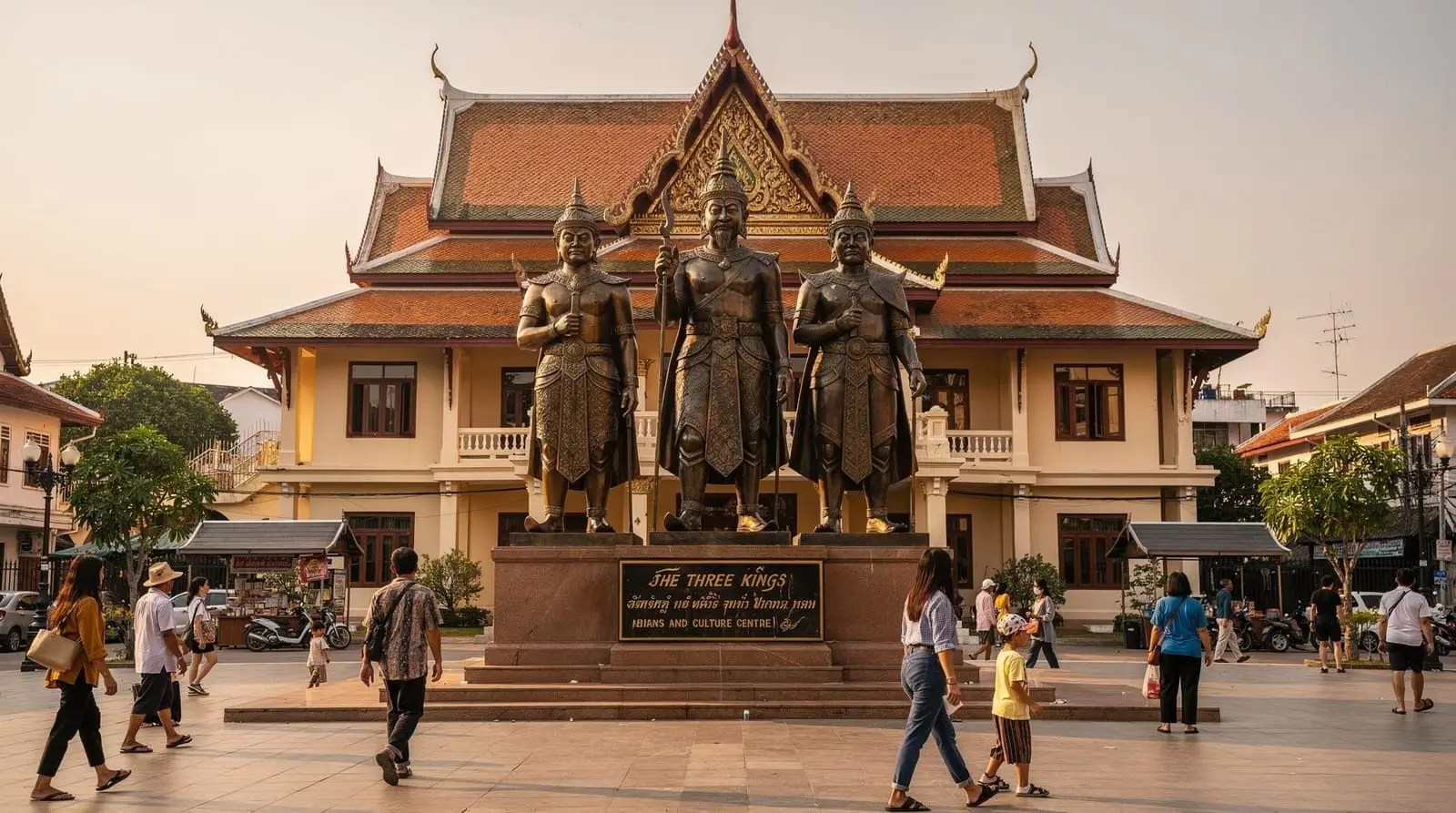
Three Kings Monument is Chiang Mai's civic square in the Old City, framed by the Lanna Folklife Museum and City Arts and Cultural Centre.
Chiang Mai: 3 Hour Old City and Temples Guided Walking Tour
Duration: 3 hours
Quick facts
- Getting there
- Central Old City, walkable from any moat-side hotel; songthaew ~30 THB, Grab ~50-70 THB
- Key sight
- The bronze statue group of Kings Mangrai, Ngam Muang and Ram Khamhaeng
- Time needed
- 20-30 minutes for the square, 2-3 hours if visiting both surrounding museums
- Best time
- Weekday mornings for the museums (quieter, cooler); evenings for the square itself
- Cost
- Free to view the monument; museum entry roughly 90 THB per adult, per museum
Three Kings Monument sits at the historical and, arguably, civic centre of the Old City: a bronze statue group depicting the three kings credited with founding Chiang Mai, standing on an open square framed by two of the city’s more substantial history museums. It is a quieter, less temple-dense stop than most of what surrounds it, and functions as much as a history lesson as a photo stop.
Quick answer: Three Kings Monument is a civic square in the middle of the Old City, walkable from almost any moat-side accommodation, featuring bronze statues of Kings Mangrai, Ngam Muang and Ram Khamhaeng alongside the Lanna Folklife Museum and Chiang Mai City Arts and Cultural Centre. The square itself takes 20-30 minutes; add 2-3 hours if you visit both museums properly. Entry to the square is free, with roughly 90 THB museum admission each.
The statue and the founding story
The three bronze figures at the monument’s centre represent King Mangrai of Lanna, King Ngam Muang of Phayao and King Ram Khamhaeng of Sukhothai, depicted in conference — a scene referencing the historical alliance between the three kings that led to Chiang Mai’s founding in 1296 as the capital of the Lanna kingdom. The statue group sits on a raised plinth in the open square, with space around it that locals use for everything from casual sitting to occasional civic gatherings and ceremonies, giving the monument a genuinely functional role in city life rather than existing purely as a tourist photo point.
Understanding this founding story adds useful context to a wider Old City visit: the moat, the grid street layout and several of the oldest temples nearby, including Wat Chiang Man (built the same year as the city’s founding), all trace back to the same historical moment the monument commemorates.
Lanna Folklife Museum
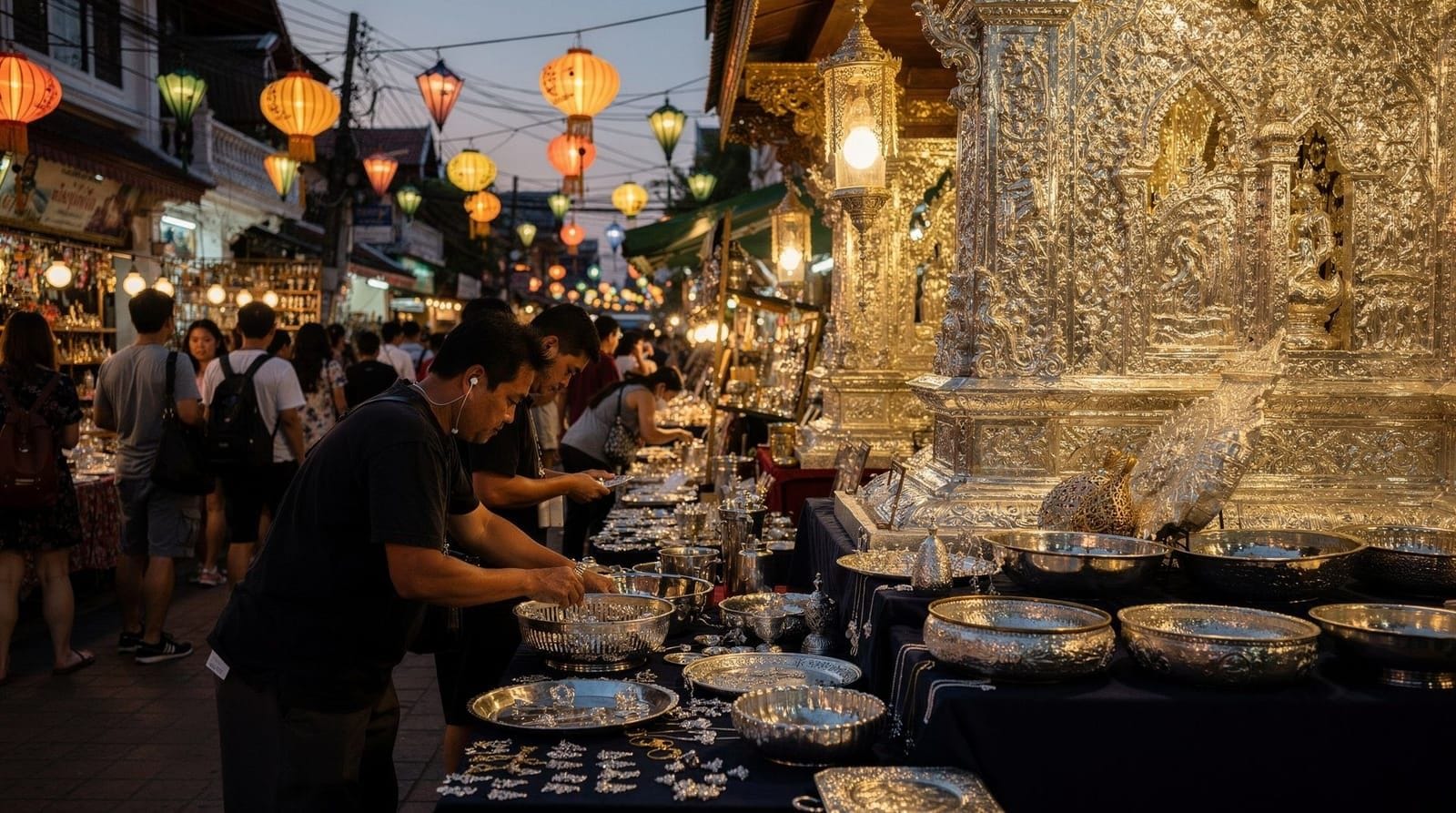
On one side of the square, the Lanna Folklife Museum occupies a former provincial court building and covers everyday northern Thai life rather than royal or religious history specifically — traditional costume, tools, crafts, festival customs and domestic life across different eras of Lanna culture. It is a smaller, more manageable museum than it might sound, comfortably covered in an hour, and gives useful grounding for anything encountered elsewhere in the city, from the silverwork seen at Wualai’s Saturday Walking Street to festival traditions referenced at temples across the Old City.
Chiang Mai City Arts and Cultural Centre
Across the square, the City Arts and Cultural Centre occupies the former provincial hall, a well-preserved colonial-era building in its own right, and covers Chiang Mai’s history in more chronological depth — from the Lanna kingdom’s founding through Burmese rule, absorption into Siam, and into the modern era. The exhibits lean toward reading and viewing rather than interactive displays, which makes it a better fit for visitors genuinely interested in the history than for young children looking for something to touch or do.
Together, the two museums form a reasonably complete crash course in how Chiang Mai got to be the city visitors see today, and are best visited as a pair on the same visit given their shared square-side location.
The founding alliance in more depth
The scene depicted by the statues — three kings apparently in conversation — represents a specific historical moment worth understanding a little more fully, since it explains a surprising amount of what still shapes the wider region today. King Mangrai of Lanna, King Ngam Muang of Phayao and King Ram Khamhaeng of Sukhothai are traditionally described as having formed a mutual alliance in the years before Chiang Mai’s founding, with Ram Khamhaeng and Ngam Muang reportedly advising Mangrai on the site and layout of his planned new capital. The result, founded in 1296, was a city built with its own distinct Lanna identity, moated and walled in a way still traceable in today’s Old City street grid, rather than a simple extension of either of the other two kingdoms.
That distinct Lanna identity — its own script, its own architectural style, its own Buddhist artistic tradition — is what still differentiates Chiang Mai’s temples and culture from those of Bangkok and the central Thai plains today, even though all now sit within modern Thailand. Visitors who see the statues and then walk into Wat Chiang Man or Wat Phra Singh immediately afterward are, in effect, walking directly from a monument commemorating this founding alliance into the physical Lanna culture it produced.
Practical tips for visiting
Photography of the statue group is unrestricted and it is a popular spot for it, particularly in early morning or evening light when the square is quieter and the bronze catches warmer tones. Both surrounding museums charge separate entry, generally in the range of 90 THB per adult per museum, with reduced rates commonly available for students and, at some periods, for children — worth checking current signage or asking at the ticket counter rather than assuming a fixed rate, since museum pricing in Thailand shifts periodically.
Neither museum is especially large, and both are air-conditioned, making the pair a genuinely comfortable midday option when the outdoor heat elsewhere in Old City is at its most punishing — a practical, non-obvious reason to schedule this stop for the hottest part of the day rather than treating it purely as a morning or evening visit. Toilets are available inside both museum buildings; the open square itself has no dedicated public facilities. Cash is useful for ticket purchase, though card payment is increasingly accepted at both museums’ ticket counters, unlike most of Chiang Mai’s outdoor markets.
A quiet contrast to the temple circuit
Part of what makes Three Kings Monument worth deliberately building into an itinerary, rather than stumbling onto by accident, is the contrast it offers with the rest of the Old City temple circuit. Temples ask for a specific kind of engagement — modest dress, quiet reverence, an awareness of active religious practice happening around you. The square and its museums ask for something closer to ordinary museum-going: reading plaques, looking at objects behind glass, absorbing history at your own pace without any religious etiquette to navigate.
For travellers who find a full day of consecutive temple visits starts to blur together by the third or fourth stop — a genuinely common experience for first-time visitors moving quickly between Wat Phra Singh, Wat Chedi Luang and Wat Chiang Man — inserting this stop partway through the day offers a genuine change of pace and register, not just a different building to look at.
Getting there and getting around
Three Kings Monument sits well within the Old City moat, close enough to most central accommodation to reach on foot within 10-15 minutes. From further out, a songthaew costs roughly 30 THB and a Grab runs 50-70 THB. Given its central location, most visitors simply fold it into a walking route between other Old City temples rather than treating it as a separate trip.
The square itself is flat, open and shaded in patches by surrounding trees, comfortable to visit at most times of day, though the two museums are air-conditioned and offer a genuine break from the heat if visited around midday — a useful piece of route planning if you are otherwise walking temple to temple in direct sun.
Nearby and easy to combine
The monument’s central Old City location means it combines naturally with almost any temple-focused route through the area — Wat Phra Singh, Wat Chedi Luang and Wat Chiang Man are all a short walk away, and a loop taking in the square alongside two or three of these temples makes a complete half-day. Tha Phae Gate and the Sunday Walking Street route are also close by for an evening extension of the same day, and Saturday Walking Street at Wualai is a short ride south if your visit falls on a Saturday.
Visitors staying multiple nights in the Old City often find it useful to split temple visits and this kind of history-museum stop across separate days rather than cramming everything into one, since the pacing and etiquette required at each is different enough to benefit from a mental reset between them. A first day focused purely on temples, followed by a second, lighter day mixing Three Kings Monument, its museums and a market evening, tends to leave a more balanced impression of the city than one exhausting marathon day trying to cover everything at once, and it leaves room to slow down rather than rushing between sights purely to check them off a list.
For visitors who prefer a guided route rather than self-directed walking, a three-hour Old City and temples guided walking tour typically passes through the central Old City area including this square, pairing the monument’s history with a broader temple circuit and a guide who can add context the plaques alone do not cover. A historic temples and city guided walking tour offers a similar format for visitors who would rather book a slightly different departure time or itinerary emphasis.
For a private alternative that moves at your own pace rather than a fixed group schedule, a private tuk-tuk exploration of Old City can be routed to include Three Kings Monument alongside whichever temples matter most to you, useful for travellers short on time who want to prioritise specific stops rather than following a set walking-tour route.
A short self-guided route through the area
For travellers who prefer to walk this part of Old City independently rather than book a guided tour, a workable half-day route starts at Tha Phae Gate on the eastern moat, heads west along the main road toward Wat Chedi Luang and its towering ruined chedi, continues a short distance to Wat Phra Singh for the Lai Kham chapel and its revered Buddha image, then loops back toward Three Kings Monument and its two museums for a cooler, seated break before finishing at Wat Chiang Man, the city’s oldest temple, a short walk further north.
This route covers roughly two kilometres of walking at a relaxed pace, comfortably manageable in a morning with time for the museums in the middle as an air-conditioned pause, and it hits four of the most historically significant stops inside the moat without needing transport between any of them — the entire route stays within easy walking distance given how compact the Old City core actually is. Starting early, before 9am, avoids both the day’s peak heat and the larger tour groups that tend to arrive at the more famous temples slightly later in the morning.
Frequently asked questions about Three Kings Monument
What is Three Kings Monument in Chiang Mai?
It is a bronze statue group in the centre of the Old City depicting Kings Mangrai, Ngam Muang and Ram Khamhaeng, commemorating the historical alliance credited with founding Chiang Mai in 1296.
Is Three Kings Monument worth visiting?
Yes, particularly alongside the two surrounding museums (Lanna Folklife Museum and the City Arts and Cultural Centre), which add real historical context to a wider Old City temple visit. On its own, the statue itself is a brief 20-30 minute stop.
What is the Lanna Folklife Museum?
It is a museum on the Three Kings Monument square covering everyday northern Thai life — traditional costume, tools, crafts and festival customs — housed in a former provincial court building, comfortably visited in about an hour.
What is the Chiang Mai City Arts and Cultural Centre?
It is a history museum on the same square, covering Chiang Mai’s history from the Lanna kingdom’s founding through Burmese rule and into the modern era, housed in a former provincial hall building.
How do I get to Three Kings Monument?
It sits within the Old City moat, walkable from most central accommodation in 10-15 minutes. A songthaew costs roughly 30 THB and a Grab runs 50-70 THB from further out.
How much time should I spend at Three Kings Monument?
20-30 minutes covers the square and statues; budget 2-3 hours total if visiting both surrounding museums properly.
Is Three Kings Monument suitable for children?
The square itself is fine for any age, but the two museums lean toward text and object-based exhibits rather than interactive displays, which suit history-minded adults better than young children.
Can I combine Three Kings Monument with other Old City temples?
Yes, easily — Wat Phra Singh, Wat Chedi Luang and Wat Chiang Man are all a short walk away, and the monument fits naturally into a broader Old City walking route.
What are the museum opening hours at Three Kings Monument?
Both the Lanna Folklife Museum and the City Arts and Cultural Centre generally close one day a week, commonly a Monday, in addition to standard daily hours — confirm current hours locally or with your accommodation before a dedicated visit, since these can shift.
Who are the three kings depicted in the monument?
King Mangrai of Lanna (Chiang Mai’s founder), King Ngam Muang of Phayao and King Ram Khamhaeng of Sukhothai, shown together to commemorate the alliance traditionally credited with advising Mangrai on founding Chiang Mai in 1296.
Top experiences
Bookable activities with verified prices and instant confirmation on GetYourGuide.